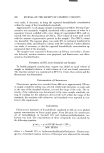
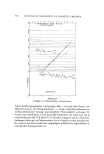
FLUOROMETRIC DETERMINATION OF PRESERVATIVES 661 Table III Fluoroinetric Determination of 3 Methylol-containing Compounds in Shampoo Utilizing the Hantzsch Reaction at 60 ø C, pH 6, for 1 Hour Preservative Known Concentration % Found • % of Theoretical Concentration Determined (mg/ml) (Average) b (mg/ml) Germall 115 1.0 1.0 100 Germall 115 0.50 0.52 104 Germall 115 0.10 0.10 100' 51 Hydroxymethyl- dimethylhydantoin 0.15 0.14 93 Hydroxymethyl- dimethylhydantoin 0.020 0.020 100 a 96.5 Bronopol 0.15 0.12, 0.17 97 • Bronopol 0.080 0.070 99 Bronopol 0.020 0.020 100 28 Calculations based on 1:1 molar stoichiometry (1 mole methylol-containing compound yields 1 mole formaldehyde). Values are averages of those given in the previous column adiusted for the stoichiometry observed. Interference extracted. Interference diluted. Average of two determinations. During the course of the study, reported in Table III, a number of observa- tions were made which are pertinent to the fluorometric determination of these preservatives in cosmetics. The unknowns were prepared for assay by adding three 1-ml portions of the solution of the unknown to 100 mg of a shampoo base and diluting to 5, 10, .or 100 ml with 10% methanol. The reac- tion mixtures were made from these dilutions. It was found that Raman scat- tering interfered with the emission intensity of the most concentrated solution by shifting its baseline. The other dilutions gave acceptable baselines which were corrected for relatively minor shifts before determination of peak heights. This initial step gave a rough estimate of the amount of preservative in the unknowns so that it was possible to prepare a solution giving a fluores- cence intensity which fell well within the limits of the formaldehyde calibra- tion curve. This was necessary because if the peak happened to occur near the origin of the calibration curve, imprecise results were obtained. Similarly, on occasion, the determination was inadequate if the intensity maximum ap- peared on the upper portion of the standard curve. These discrepancies can be understood by examining Fig. 3, which shows the daily variation of the fluorescence intensity of DDL as a function of the concentration of formalde- hyde in the reaction mixture. The data presented in this figure are typical of many such standard curves and were obtained using an acetylacetone-ammo- nium acetate reagent ranging in age from 0 to 7 days. They do not differ es-

662 JOURNAL OF THE SOCIETY OF COSMETIC CHEMISTS Table IV Fluorometric Determination of 3 Methyl,ol-containing Compounds in Shampoo and Skin Cream Utilizing the Hantzsch Reaction at 60øC, pH 6, for 1 Hour Preservative Cosmetic Known Concentration Per Cent Concentration Determined Determined (mg/ml) (mg/ml) Germall 115 Shampoo 1.0 1.1 110 Germall 115 Shampoo 0.10 0.11 110 Germall 115 Shampoo 0.050 0.052 104 Germall 115 Skin cream 1.0 1.1 110 Germall 115 Skin cream 0.10 0.11 110 Germall 115 Skin cream 0.050 0.052 104 Hydroxymethyl- dimethylhydantoin Shampoo 1.0 1.0 100 Hydroxymethyl- dimethylhydantoin Shampoo 0.10 0.090 90 Hydroxymethyl- dimethylhydantoin Shampoo 0.052 0.050 96 Hydroxymethyl- dfinethylhydantoin Skin cream 1.0 0.93 93 Hydroxymethyl- dfinethylhydantoin Skin cream 0.10 0.094 92 Hydroxymethy]- dimethylhydantoin Skin cream 0.052 0.050 96 Bronopol Shampoo 1.1 1.2, 0.92 100 Bronopol Shampoo 0.11 0.11, 0.11 100 Bronopol Shampoo 0.053 0.063, 0.051 102 0.044 Bronopol Skin cream 1.1 0.90 82 Bronopol Skin cream 0.11 0.091 83 Bronopol Skin cream 0.053 0.055 104 sentially from those reported by Belman (2). It is to be noted, however, that a variable background fluorescence is contributed from the reagent itself, and occasionally a downward deviation from linearity is observed at 0.4 mg/ml formaldehyde. Thus, dilutions of the sample were made which gave an inten- sity reading on the linear portion of the standard curve if the initial concen- tration of the unknown permitted such a manipulation. If the initial concen- tration was sufficiently low so that it was necessary to determine its fluores- cence intensity near the origin, the problem could be solved by extraction from the shampoo of the ingredients causing the Raman scattering and by use of freshly prepared reagent, which gave a consistent and lower background fluorescence (Fig. 4). In this study, the per cent of the true value determined ranged from 93 to 104 for the three compounds (Colunto 4, Table III). In the last column of Table III, the average per cent of the theoretical yield of for- maldehyde derived from these compounds is given. One of the two hydroxy-
Purchased for the exclusive use of nofirst nolast (unknown)
From: SCC Media Library & Resource Center (library.scconline.org)