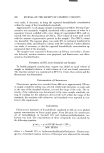
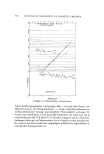
HAIRLESS MOUSE FOR EVALUATING SUNSCREENS 641 The following preparations were tested*: A: Contains 5.4% p-aminobenzoic acid. B: Contains 7.7% homomenthyl salicylate. C.' Contains 2.7% alkyl p-dimethylaminobenzoate (declared as isoamyl- p-N,N-dimethylaminobenzoate) analysis of standards showed a mixture of amyl and isoamyl isomers. D: Contains 11.2% 2-hydroxy-4-methoxybenzophenone?. E: Contains 4.4% homomenthyl salicylate. F: Label declaration 8% 2,2-dihydroxy-4,4-dimethoxybenzophenone plus 6% sodium 3,4-dimethoxyphenylglyoxylate (not analyzed). G: Contains 4% menthyl anthranilate plus 5% 2-ethoxyethyl p-methoxycinnamate. H: Contains 1.6% alkyl p-dimethylaminobenzoate (declared as amyl p-dimethylaminobenzoate) analysis of standards showed a mixture of amyl and isoamyl isomers. RESULTS AND DISCUSSION The minimal erythema dose (1 MED) in unprotected animals, a 2-min exposure, produced erythema in about 3 hr. In addition, the following grades of skin damage were seen. ß +----mild reaction (1-1.5 MED) moderate edema followed by desquama- tion at 8 days. ++ =moderate reaction (2.5 MED) edema followed by superficial ero- sion in the center of the exposed area. Changes disappeared within 10 days, leaving small scars. +++ = strong reaction (5-7.5 MED) sharply limited pale edema at 24 hr an inflammatory halo around the swollen area at 72 hr with puncrate hemorrhages and erosion in the center followed by extensive necrosis with desquamation beginning at the periphery. The process of cicatrization was completed after 12-13 days. ++++=very strong reaction (7.5-10 MED) sharply limited pale edema of the exposed area at 24 hr inflammatory halo around swollen area and puncrate hemorrhages and erosion in the center at 48 hr prominent inflammatory halo with greater confluent erosion in center at 72 hr extensive necrosis in the area of exposure with desquamation at periphery cicatrization complete on 11-16th day (Fig. 1, 10 MED, 3 days after 20-min exposure). In the present studies, preparations A and C protected hairless mouse skin against up to 10 MED compared to 7.5 MED for preparations D and F, *One container of each lot of all samples except preparation F was chemically analyzed to identify the amount and type of UV absorber by chemists of Cosmetic Technology Divi- sion, Food and Drug Administration, under the direction of Henry Davis. ]'A similar product by the same manufacturer contains the 5-sulfonic acid.

642 jOURNAL OF THE SOCIETY OF COSMETIC CHEMISTS Figure 1. Response of unprotected hairless mouse (q-q-q-q- reactions) three days after 20- rain exposure to 10 MED ultraviolet irradiation 5 MED for preparation G, and 2.5 MED for preparation B. Preparations E and H were ineffective in protecting mouse skin under all test conditions (Table I). Thus 5.4% p-aminobenzoic acid (A) and 2.7% alkyl p-dimethyl- aminobenzoate (C) in commercial sunscreen preparations appeared to be superior under these test conditions to 6 preparations containing other active ingredients or concentrations. Preparations D containing 11.2% 2-hydroxy-4- methoxybenzophenone, and F, containing a combination of a benzophenone and a phenyl glyoxylate, though effective, were not as efficient as A and C. Preparation B, containing 7.7% homomenthyl salicylate, showed some advan- tage over preparation E, which contained only 4.4% of this active ingredient. Preparation H, containing 1.6% alkyl p-dimethylaminobenzoate, was ineffec- tive. Yet preparation C, containing 2.7% of the same ingredient, was highly effective, suggesting the importance of concentration as a factor in effective- ness. The results obtained on hairless mice are consistent with certain results reported in the literature involving human subjects. For example, Pathak et al. (5) found 5% PABA and 2.5% isoamyl p-N,N-dimethylaminobenzoate most protective when compared with 24 other preparations under practical field conditions involving human subjects. They pointed out the importance of skin substantivity as a factor in a sunscreen's effectiveness under use conditions as contrasted with in vitro effectiveness. As in the present study on mice, Langner and Kligman (6) found PABA effective and menthyl anthranilate
Purchased for the exclusive use of nofirst nolast (unknown)
From: SCC Media Library & Resource Center (library.scconline.org)