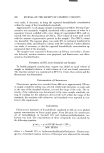
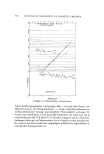
FLUOROMETRIC DETERMINATION OF PRESERVATIVES 665 80 • 70 • •0 • 50 • 4,0 • 30 _o= lO I I I I I I I 2 3 4 5 6 Bronopol (pg/ml) Figure 5. Daily variation of fluorescence intensity of DDL produced from Bronopol In the final blind study, reported in Table IV, a protocol similar to that giv- en above was followed. In this experiment, however, the unknowns were mixed with a skin cream base in addition to a shampoo base. The cream, with added preservative, was extracted with CHCla from an acid aqueous disper- sion to remove ingredients that would otherwise have led to turbidity in the reaction mixtures. The results were essentially the same as those found previ- ously at a reaction temperature of 60øC. With regard to the data for Brono-

666 JOURNAL OF THE SOCIETY OF COSMETIC CHEMISTS Table V Statistical Analysis of Data Obtained from the Fluorometric Determination of Bronopol, Germall 115, and Hydroxymethy]dimethylhydantoin in Cosmetics Compound Mean Per Cent Average Relative Mean ñ Determined Error Standard Deviation a (mg/ml) Bronopol 96.2 • -53.9 • 1.10 _ 0.18 Bronopol 0.11 4- 0.011 Bronopol 0,052 4- 0.0095 Germall 115 106.0 • --6.4' 1.0 ___ 0.044 Germall 115 0.10 ___, 0.0044 Germall 115 0.161 ___ 0.0160 Germall 115 0.050 ___ 0.0024 Hydroxymethyl- dimethylhydantoin 96.5 • -•4.0 a 1.0 ñ 0.048 Hydroxymethyl- dimethylhydantoin 0.15 4- 0.0092 Hydroxymethyl- dimethylhydantoin 0.10 4- 0.005 _ Standard deviations of the means were calculated from 3 replicate determinations. • Average of 14 determinations ranging in concentration from 1.10 to 0.0200 mg/ml. • Average of 12 determinations ranging in concentration from 1.00 to 0.0500 mg/ml. a Average of 14 determinations ranging in concentration from 1.00 to 0.0200 mg/ml. pol, it must be pointed out that it was frequently necessary to replicate the determination in order to obtain accurate resul[s (Tables III and IV). This may be due to the marked dependence of the release of formaldehyde h'om Bronopol on the temperature of the reaction. Figure 5 shows two Bronopol calibration curves determined on separate days. They are clearly different and it is conceivable that the variability resulted from less than ideal thermal con- trol. Table V presents a statistical analysis of the results of the fluorometric de- termination of these hydroxymethylene-containing preservatives. It can be concluded from an examination of these analyses that Germall 115 and hy- droxymethyldimethylhydantoin in cosmetics can be determined by the fluoro- metric method for formaldehyde at a reaction temperature of 60øC. Bronopol can be determined reliably in this fashion if the samples are replicated. (Received June 28, 1974) REFERENCES (1) Parker, M. S., Some aspects of the use of preservatives in combination, Soap Pery•um. Cosmet., 46, 223-4 (1973). (2) Belman, S., The fluorometric determination of formaldehyde, Anal. ChUrn. Acta, 29, t20-6 (1963). (3) Nash, T., Estimation of formaldehyde, Biochem. J., 55, 416-21 (1953). (4) Wilson, C. H., Fluorometric determination of formaldehyde in cosmetic products, ]. Soc. Cosmet. Chem., 25, 67-71 (1974).
Purchased for the exclusive use of nofirst nolast (unknown)
From: SCC Media Library & Resource Center (library.scconline.org)