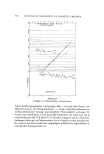
UPTAKE AND EXCRETION OF AEROSOL ANTIPERSPIRANT 651 Second, an estimate was made of the amount striking the forehead skin di- rectly. In a square inch this was 1760 x 10 -4 •c as a mean. This figure is prob- ably a little high since the nasal openings and mouth are probably somewhat less than one square inch, depending on how wide open the mouth was during exposure. Third, the amount absorbed may be estimated from the amount excreted in 9.4 hours. Very little was excreted in the urine, bile, or feces, but substan- tial quantities were excreted in the breath. The mean for monkeys C and D was 19.10 x 10 -4/•c. In each of the tissues where direct comparison could be made of the amount absorbed in monkeys A and B and the amount remaining in monkeys C and D, it was found that a 75-85% decline had occurred. Thus, it would be estimated that about 1500 x 10 -4 ,/•c was initially absorbed. Averaging these three estimates gives a mean of 1364 x 10 -4 ./•c. Formula III gives 0.g5% as the total absorbed portion of the spray. total radioactivity absorbed (mean) Formula III: % --- total radioactivity released in chamber X 100 Comparing this to the amounts reaching the lower respiratory tract calcu- lated from Formula I, it is evident that only about 10% of the absorbed total dose has reached the lower respiratory tract. The distribution of radioactivity in the lower respiratory system shown in Table I was quite uniform. The specific activity (counts per mg of tissue) in the trachea and bifurcation was a little higher than in the lungs. As previously mentioned, it did not seem to accumulate in any portion of the lungs. The amounts of radioactivity reaching the other nonrespiratory tissues was very small immediately after exposure. A little was found in the stomach but none in the blood or bile. The data g4 hours post-exposure in Table II show that only trace amounts were found in the blood and urine. Of the other organs, a small amount was found in the liver and stomach and smaller amounts in the kidneys and esophagus. Thus, very little activity left the respiratory tract. The radioactively labeled IPM was of high specific activity (376/•c/mg). Thus, the levels of activity in this table correspond to very small quantities of the tagged compound (ranging from 0.9,9, to 0.46/•g in these nonrespiratory tissues). The principal route of excretion was as carbon dioxide in the exhaled breath. The time course of this excretion for monkeys C and D is shown in Fig. g. As indicated above, about 85% of the dose initially found in the tissues had been excreted in g4 hours. The rate of excretion at the end of the g4-hour time period was still appreciable compared to the earlier rates. From this observation and from the very small amounts found in other tissues, it appears that most of the metabolism occurred in the respiratory tract.

652 JOURNAL OF THE SOCIETY OF COSMETIC CHEMISTS 18 17 16 15 C,• 14 • 13 12 •'q410 C• 9 8 •' 7 I •l 6 ,•1 5 :• 3 2 ß MONKEY C , ß MONKEY D ß 1 2 3 4 5 6 7 8 9 10 11 12 13 14 15 16 17 18 19 20 21 22 23 24 2• TIME IHRS.) Assays of the exhaled breath were also made for radioactivity other than CO2 (presumably unmodified IPM). A significant amount of this was found as shown in Fig. 3. Although IPM is not considered to be volatile, small amounts can evapor- ate. Because of its high specific activity in this test, its presence in the breath is not too surprising. An assay of the radioactivity on the nasal septum tissue, in fact, showed a decline of over 95% in 24 hours, which could be mainly via evaporation of IPM into the face mask used to collect the exhaled breath. In monkey D, in order to check on the possibility of absorption through the skin of the face and head, a mask was placed over the head, leaving holes only for the nose and mouth. Comparing these results with monkey C, no appreciable difference in relative tissue distribution patterns was noted. Thus, it appears that absorption through the skin was not an important route in these experiments. The total product absorbed in the 5 sec of exposure amounts to only i mg of the formulation concentrate. The toxicity of each of the ingredients con- tained therein is very low. The active ingredient, aluminum chlorhydrate, is incorporated into the product as a solid impalpable powder. In 1957, Cam- bell et al. (2) published an exhaustive review entitled "Aluminum in the En-
Purchased for the exclusive use of nofirst nolast (unknown)
From: SCC Media Library & Resource Center (library.scconline.org)