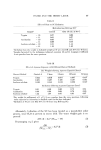
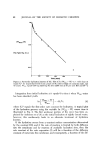
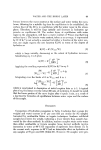
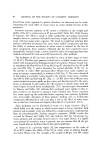
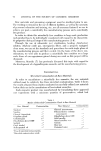
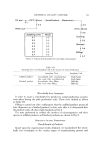
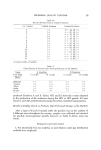
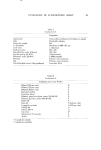
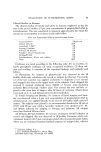
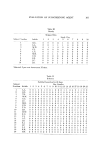
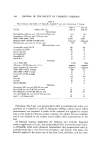
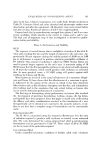
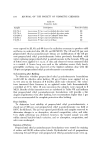
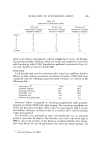
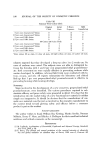
MICROBIAL QUALITY CONTROL 85 Table IX Results of B Enmlsion in Actual Production Lot Number Untilled Products Finished Products 1 (--) n•= 12, all (--) 2 (--) n: 12, all (--) 3 (--) n: 16, all (--) 4 (--) n = 8, all (--) 5 (--) n = 16, all (--) 6 (--) n = 8, all (--) 7 (--) n = 16, all (--) 8 (--) n = 16, all (--) 9 (--) n ---- 16, all (--) 10 (--) n = 8, all (--) 11 (--) n = 12, all (--) 12 (--) n = 4, all (--) 13 (--) n = 4, all (--) 14 (--) n = 4, all (--) •n equals number of samples. Table X Cheek Besults of Products after Prolonged Storage on the Markets Name A Enmlsion B Emulsion Time held 6 months 18 months 6 months 18 months Place Hokkaido (--) (--) (--) (--) Toyama (--) (--) (--) (--) Tokyo (--) (--) (--) Oaska (--) (--) (--) (--) Kyushu (--) (--) (--) (--) produced Emulsion A and B. Tables VIII and IX show the results obtained in the production of the emulsions during the 1971 to 1973 period. All were found to meet the predetermined standard level for microbial contamination. Results of Quality Check on Products After Prolonged Storage on the Markets After a lapse of 6 and 18 months while the product was on the markets of 5 different areas throughout the country, samples were collected and cheeked for possible microorganisms' growth however, as Table X shows, none was found. SUMMABY AND CONCLUSIONS 1. For microbial]y free raw material, uv and ethylene oxide gas sterilization methods were employed.

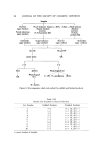
86 JOURNAL OF THE SOCIETY OF COSMETIC CHEMISTS 2. For a nficrobially free condition during the manufacturing processs, the following sterilizing systems were adopted: heating, disinfectant solution, and microporous filters. 3. To get a microbially free condition during the filling operation, full and proper use was made of the clean room, while establishing new control methods. 4. The assurance of a microbially free condition was obtained by the use of sampling and various test methods. Our purpose which was to produce an emulsion on a large scale in a micro- bially free state has been successfully attained. (Received July 12, 1973) I•EFERENCES (1) A. P. Dunnigan, Microbiological control of cosmetics, Drug Cosmet. Ind., 102, 43(1968). (2) S. Most and A. Katz, Cosmetic manufacturing sanitation, Arner. Perfttrn. Cosmet., 85, 67(1970). (3) C. W. Bruch, Cosmetics: sterility versus microbial control, Arner. Perfurn. Cosmet., 86, 45(1971). (4) C. Ishizeki, On the microbial contamination of cosmetics, ]. Japan Cosmet. Chern. Ass., 7, 1(1971). (5) C. R. Woodward, Jr., Some microbiological aspects of cosmetic manufacturing, Arner. Per[urn. Cosmet., 86, 45(1971). (6) J. G. Davis, Fundamentals of microbiology in relation to cleansing in the cosmetic in- dustry, Soap, Per[urn. Cosmet., 46, 37(1973). (7) E. P. Morrish, Shiseido's Evenese, A bio-safe, bio-clean cosmetic line, Drug Cosmet. Ind., 111, 46(1972).
Purchased for the exclusive use of nofirst nolast (unknown)
From: SCC Media Library & Resource Center (library.scconline.org)