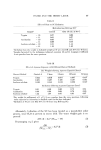
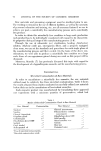
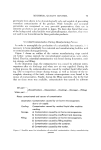
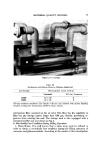
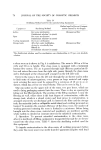
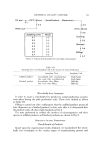
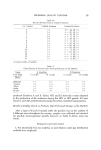
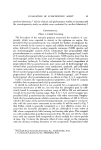
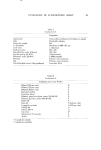
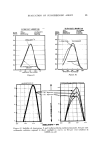
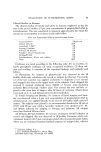
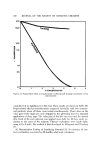
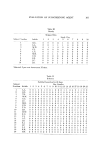
EVALUATION OF SUNSCREENING AGENT Table VII Amerscreen P Immersion Effect 105 1 per cent Amerscreen P Lotion Radiation (MEDS) 2.5 per cent Amerscreen P Lotion Radiation (MEDS) 5.0 per cent Amerscreen P Lotion Radiation (MEDS) Subject 6 6 6 1 2 1 1 2 2 1 0 3 1 1 0 4 2 1 1 5 1 0 0 6 2 2 1 Control 3+ 3+ 3+ plied to the fabrics and exposed to direct sunlight for 5 hours. All formula- tions produced slight yellowing, which was easily and completely removed by mild laundering, while PABA formulations produced a permanent deep yel- low stain. Results are shown in Table VIII. Field Trials Each formula type must be evaluated under actual use conditions to prove efficacy in both sunburn prevention and suntan formation. Field trials were conducted with the following sunscreen butter formulas as is shown in the following table. Amerscreen P* 1.0% 2.0% Solulan© PB-20* 40.0 40.0 Isopropy] palmirate 43.0 42.0 Cande]ilia wax 12.0 12.0 Carnauba xvax 4.0 4.0 Perfume and preservative q.s. q.s. Sunscreen butter is prepared by dissolving propoxylated ethyl p-amino- benzoate in Solulan PB-20 with slight heating. The remaining ingredients are added and the mixture heated to 85øC while it is mixed slowly until it is clear and uniform. Mixing is continued while it is cooled to 35øC, and the formula is then homogenized. The formulas were packaged in tubes and distributed over an 18-month period to more than 25 subjects. The formulas were used in the Swiss Alps at 3000 m and on the beaches of the Bahamas, Southern Florida, New Jersey, and Long Island. No special precautions were taken for initial exposure. All * Amerchol, Edison, N.J. 08817.

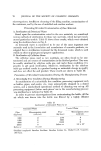
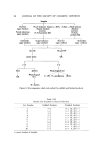
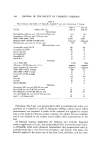
106 JOUBNAL OF THE SOCIETY OF COSMETIC CHEMISTS Table VIII Staining • Tests Cotton Cloth Original Initial 5 Hours Cloth Stain Exposure Mild Laundering 5 per cent Amerscreen P lotion 0 1 g 2.5 per cent Amerscreen P lotion 0 1 2 5 per cent PABA lotion 0 2 2 2.5 per cent PABA lotion 0 2 2 80 Cotton/20 Nylon Cloth 5 per cent Amerscreen P lotion 0 1 2 2.5 per cent Amerscreen P lotion 0 1 g 5 per cent PABA lotion 0 2 9. 2.5 per cent PABA lotion 0 2 g •Stain rating: (0) no stain, (1) clear oil stain, (2) light yellow oil stain, (3) amber oil stain. subjects reported that they developed a deep tan after 1 to 2 weeks use. No eases of sunburn were noted. The subjects were not able to distinguish be- tween the formulas with ! and 2 per cent propoxylated ethyl p-aminobenzo- ate. Both eoneentrat2ons were equally effective in preventing sunburn while suntan developed. In addition, informal field trials were conducted with lo- tions, ereams, and oils. All reports substantiate the laboratory and clinical find'ngs that 1 per cent propoxylated ethyl p-anfinobenzoate is effective in preventing burning while tanning develops. Summary Steps involved in the development of a new sunscreen, propoxylated ethyl p-aminobenzoate, were described. The various procedures required to sub- stantiate efficacy and prove safety were presented in detail. It is clear that the introduction into the market today of a new functional raw material is neither simple nor inexpensive. It should be obvious that the manufacturer of cos- metic raw materials must be just as involved as the cosmetic manufacturer in the current trend toward proving safety and efficacy before a consumer product is put on the market. ACKNOWLEDGMENT The author wishes to thank William Roy Kesting, Martin Smolin, Norman Milstein, Itenry F. Maso, and Shirley A. DeRagon for their excellent technical assistance and critical comments on the manuscript. REFERENCES (1) M. Luckiesh, Applications of Germicidal, Erythernal and Infrared Energy, Reinhold, New York, 1946. p. 50. (2) P. Bener, The diurnal and annual variations of the spectral intensity of ultraviolet sk!! and global radiation on cloudless days at Davos, 1590 rn.a.s.l., Contract AF
Purchased for the exclusive use of nofirst nolast (unknown)
From: SCC Media Library & Resource Center (library.scconline.org)