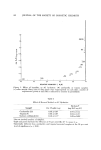
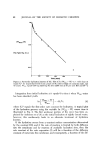
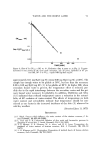
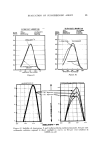
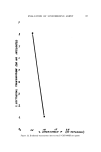
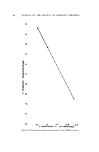
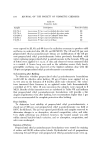
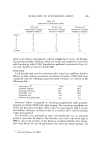
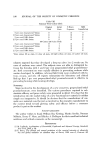
WATER AND THE HORNY LAYER 71 1.0 (Wma x -W) 0.1 (mg H20/m e S.C.) o.o• I i I I 0 100 200 300 400 Figure 3. Plot of In (Wmax- W) VS. t 1/2. Hydration data is same as in Fig. 2. Trypsin- harvested 8 mm punch of SC from male caucasian, age 45 years, hydrated at 97 per cent RH, 30 ø C to Wm•x equals 0.90 mg H,/mg SC approximately 0.11 mg H20/mg SC versus 0.06 mg H20/mg SC at 20øC. The sample has enough water to be pliable at 30øC, but less than the necessary 0.10 to 0.15 mg H20/mg SC (1) to be pliable at 20øC. At higher RH, when secondary bound water is present, the temperature effect is reduced, pos- sibly due to the rapid interchange between the secondary water and the pri- mary bound water necessary for pliability. In addition, Middleton and Allen (13) indicated that reduced temperature causes a reduction in the extensi- bility of SC exclusive of water content. The effects of temperature on both water content and extensibility indicate that temperature should be con- sidered as one factor in the increased incidence of dry skin (2) observed in cold dry weather. (Received June 11, 1975) REFERENCES (1) I. Blank, Factors which infiuepcc the water content of the stratum corneum, J. In- vest. Dermatol., 18, 433-40 (1952). (2) L. Gaul and G. B. Underwood, Relation of dew point and barometric pressure to chapping of normal skin, J. Invest. Dermatol., 19, 9-19 (1952). (3) T. S. Spencer, C. E. Linamen, W. A. Akers, and H. E. Jones, Temperature de- pendence of water content of stratum corncure, Brit. J. Dermatol., 92, 159-6d (1975). (d) A. M. Kligman and E. Christophers, Preparation of isolated sheets of human stratum corncure, Arch. Dermatol., 88, 702 (1963).

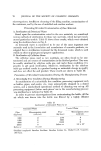
79. JOURNAL OF THE SOCIETY OF COSMETIC CHEMISTS (5) (6) (7) (s) (9) (10) (11) (12) (13) (14) (15) (16) J. F. Young, Humidity control in the laboratory using salt solutions-a review, J. Appl. Chem., 17, 241 (1967). J. Crank, The Mathematics of Diffusion, Oxford University Press, Ely House, Lon- don, 1956, Pp. 246-8. R. J. Scheuplein, Molecular structure and diffusional processes across intact epidermis, Final Comprehensive Report (Rep. No. 7), 1-81 (1963-67). R. L. Anderson, J. M. Cassidy, J. R. Hansen, and W. Yellin, Hydration of stratum corneum, Biopolymers, 12, 2789-2802 (1973). W. J. Moore, Physical Chemistry, Prentice-Hall Inc., Englewood Cliffs, N.J., 1965, Pp. 253-322. R. J. Scheuplein and L. J. Morgan, Bound water in keratin membranes measured by a microbalance technique, Nature, 214, 456-8 (1967). R. Anderson, J. M. Cassidy, J. R. Hansen, and W. Yellin, The effect of in vivo oc- clusion on human stratum corneum hydration-dehydration in vitro, J. Invest. Derma- tol., 61, 375-9 (1973). J. R. Hansen and W. Yellin, Water Structure at the Water-Polymer Inter[ace, Plenum Pnblishing, New York, N.Y., 1972, Pp. 19-28. J. D. Middleton, The mechanism of water binding in stratum corncure, Brit. J. Dermatol., 80, 437-50 (1968). E. I. Singer and J. Vinson, The water binding properties of skin, Proc. Sci. Sect. Toilet Goods Ass., 46, 29-33 (196,6). J. D. Middleton and B. M. Allen, The influence of temperature and humidity on stratum corneum and its relation to skin chapping, J. Soc. Cosmet. Chem., 24, 239-43 (1973). K. Walkley, Bound water in stratum corneum measured by differential scanning calorimetry, J. Invest. Dermatol., 59, 225-7 (1972).
Purchased for the exclusive use of nofirst nolast (unknown)
From: SCC Media Library & Resource Center (library.scconline.org)