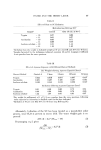
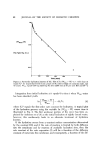
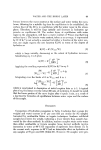
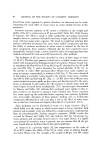
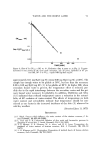
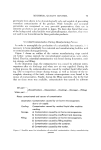
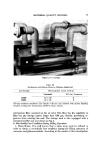
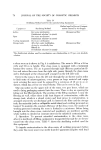
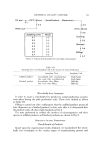
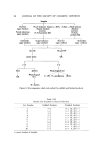
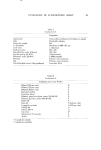
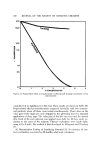
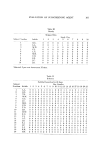
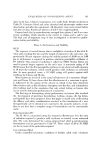
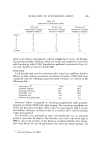
EVALUATION OF SUNSCREENING AGENT 1_03 daily for oe1 days. Clinical exanfinations were made daily. Results are shown in Table IV. Extensive blood and urine chemical and microscopic studies were done before and after the experiment. All laboratory tests were normal before and ,after gl days. Results are shown in Table V for a typical patient. Propoxylated ethyl p-aminobenzoate emerged from phases 1 and 9. as a sun- screen candidate, which absorbs in the correct uv region and is safe to use. The final and all-important step of this investigation is devoted to perfor- mance testing and stability. Phase 3--Performance and Stabilittj MED The respouse of normal human skin to sunlight is a function of the total E- viton units reaching the skin and the length of exposure to the sun's rays. Ap- proximately 9,0 rain exposure during the midday period of 10:00 am to 9,:00 pm in midsummer is requircd to produce minimum perceptible erythema at 40 ø latitude. This amount of radiation is called one MED. Suntan lotions are used to permit longer exposure to the sun's rays. A sunscreen rating of 10 MED means that the first perceptible erythema is not observed until exposure to 10 times the radiation, which wonld produce mild erythema on untreated skin. In more practical terms, a 10 MED rating will protect against mild erythema for 3 hours and 9,0 min. Many factors are involved in the actual effectiveness of a sunscreen. Riegel- man and Penna (9) have shown that the effectiveness of a sunscreen is great- ly influenced by the nature of the solvent in which it has been dissolved. Other factors such as film thickness absorption into the skin, and substantivity after bathing lead to the conclusion that only actual testing on human skin can be used to determine performance of a sunscreen. The first step in determining actual performance on human skin involved the development of prototype formulations. Lotions, creams, oils, lip balms, and lipsticks have been prepared. Since this paper is aimed only at discussing the efficacy and safety considerations involved in the introduction of a new therapeutically active chemical raw material to the cosmetic industry, it suf- fices to say here that a complete range of formulations can be conveniently made. Protective Index (PI) The PI (10) is a numerical rating for sunscreen effectiveness. It is the ratio of radiation required to produce mild erythema on treated versus untreated skin. PI's were determined for various propoxylated ethyl p-aminobenzoate formulations and are presented in Table VI. These values of 90 to 70 MED are far in excess of the protection required. Concentration Effect Under controlled laboratory conditions 6 healthy adult male volunteers

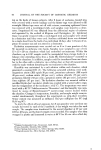
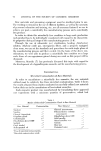
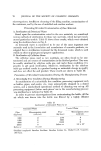
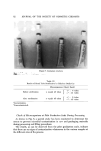
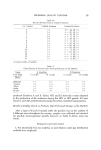
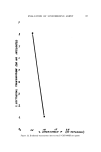
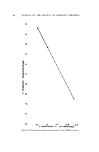
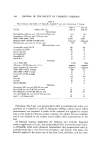
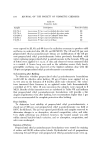
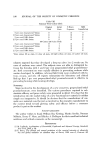
104 JOURNAL OF THE SOCIETY OF COSMETIC CHEMISTS Table VI Protective Index Sample Description Protective Index T27-78-3 Amerscreen P 2 per cent in alcohol glycerine water T27-78-4 Amerscreen P 5 lzer cent in alcohol glycerine water 30 T25-268-2 Amerscreen P 5 per cent in Carbopol lotion base 60 T32-64-2 Amerscreen P 5 per cent in Carbowax base 70 T32-56-1 Amerscreen P 5 per cent in oil base 20 were exposed to 20, 40, and 60 times the radiation necessary to produce mild erythcma on untreated skin (20, 40, and 60 MED). The 1.0 and 2.5 per cent propoxylated ethyl p-aminobenzoate lotions are modifications of the 5.0 per cent propoxylated ethyl p-aminobenzoate lotion previously described, with water replacing propoxylated ethyl p-aminobenzoate in the formula. Fifty brg of lotion were applied to 1 sq in. of skin and observed versus untreated skin as a control. A Xenon lamp was used as the radiation source. Only barely perceptible erythema was observed at the highest radiation dose with the 1.0 per cent propoxylated ethyl p-aminobenzoate concentration. Substan.tivity after Bathing To determine whether propoxylated ethyl p-aminobenzoate formulations would still be effective after bathing, 50 brg of lotion were applied tol sq in. test area on the forearms of 6 healthy adult male volunteers. The volun- teers immersed their forearms in an agitated water bath thermostatically controlled at 37øC. After 10 min immersion the subjects were exposed to 6 MED. Results of this immersion test are tabulated in Table VII and indicate that propoxylated ethyl p-aminobenzoate formulations will provide a fair degree of protection even after bathing, but concentrations higher than 1 per cent are recommended for complete protection after bathing. Heat Stability To determine heat stability of propoxylated ethyl p-aminobenzoate, a closed jar of 100 per cent propoxylated ethyl p-aminobenzoate was held at 105øC for 62 'hours. The jar was opened periodically and samples removed to determine changes in uv absorption, chemical composition, color, and odor. Very slight yellowing was detected however, the heated sample was still within normal batch-to-batch variation, and uv absorption, composition, and odor were unchanged. Staining of Fabrics Propoxylated ethyl p-aminobenzoate formulations were tested for staining of cotton and 80/20 cotton-nylon blends. Hydroalcohol and oil preparations containing 2.5 and 5.0 per cent propoxylated ethyl p-aminobcnzoate were ap-
Purchased for the exclusive use of nofirst nolast (unknown)
From: SCC Media Library & Resource Center (library.scconline.org)