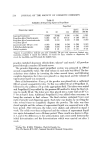
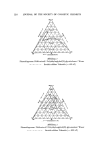
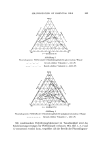
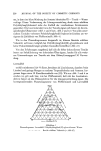
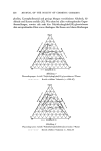
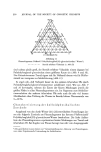
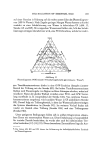
234 JOURNAL OF THE SOCIETY OF COSMETIC CHEMISTS Im Gegensatz dazu lassen sich jedoch diese kritischen Mischungsverh•iltnisse aus den Phasendiagrammen ablesen: Der 100% -Wert fiir Wasser (-• 0 % •itherisches iZil) wird reit dem Schnittpunkt des Phaseniiberganges klar/triib und der 90ø/0-Linie fiir Wasser verbunden. Die Verl•ingerung dieser Geraden gibt auf der linken Auigenlinie des Diagramms das kritische Mischungsverh•ilt- nis in Prozenten an. ZUSAMMENFASSUNG Die Anwendung yon Poly•ithylenglykol-glycerinfetts•iureestern zur Solu- bilisation •itherischer iZile wurde untersucht. Die reit Pfefl:erminz-, Lavendel-, Anis- und Nelken/51 erhaltenen Ergebnisse wurden mittels Phasendiagrammen dargestellt. Die F•ihigkeit yon Tensiden, diese iZile zu so!ubilisieren, nimmt reit Verkiirzung der Kohlenstofl:kette der Fetts•uren und mit Verl•ngerung der Polyoxy•ithylenkette zu. LITERATUR (1) Thoma, K., und Pfaff, G., Pharmaz. Ind., 37, 552 (1975). (2) Thoma, K., und Pfaff, G., Pharmaz. Ind., 37, 730 (1975). (3) Thoma, K., und Pfaff, G., Pharmaz. Ind., 37, 641 (1975). (4) Steinegger, E., und H•insel, E., Lehrbuch der allgemeinen Pharmakognosie, Springer-Verlag, Berlin-G•Sttingen-Heidelberg 1963. (5) Mihailova, D., Minkov, E., und Trandafilov, T., Pharmazie (DDR) 21,483 (1966). (6) O'Malley, W., Pennati, L., and Martin, A. N., J. Amer. pharmac. Assoc., sci. Edit. 47, 334 (1958). (7) Minkov, E., Mihailova, D., und Trandafilov, T., Pharmazie [DDR] 21,611 (1966). (8) Ell•, I., Pharmazie [DDR] 16, 415 (1961). (9) Ell•i, I., Pharmazie [DDR] 17, 444 (1962). (10) Nowak, G. A., Par[iimerie u. Kosmet. 50, 134 (1969). (11) Mitsui, T., and Machida, Y., J. Soc. Cosmet. Chemists 20, 199 (1969). (12) Nixon, J. R., U1 Haque, R. S., and Carless, J. E., J. Pharmacy Pharmacol. 23, 1 (1971). (13) Friberg, S., and Mandell, L., J. Amer. Oil Chemists' Soc. 47, 149 (1969). (14) Hall, N. A., J. pharmac. Sci. 52, 189 (1963). (15) Hall, N. A., and Soudab, R. A., Amer. J. Pharmacy 138, 245 (1966). (16) Ell•i, I., Mitt. dtsch. pharmaz. Ges. u. pharmaz. Ges. DDR 34, 193 (1964). (17) Saad, H. Y., and Shay, E.G., J. Soc. Cosmet. Chemists 23, 899 (1972). (18) Strianse, S. J., and Lanzet, M., Soap, Per[urn. Cosmet. 34, 461 (1961). (19) Ullmanns Encyklopiidie der technischen Chemie (W. Foerst, Herausgeber), Urban & Schwarzenberg, Bd. 2/1, Miinchen-Berlin 1961. (20) B6hme, H., Hartke, K., Deutsches Arzneibuch 7, Ausgabe 1968, mit Kommentar, Wis- senschaftliche Verlagsgesellschaft mbH, Govi-Verlag Frankfurt/M. Stuttgart 1969. (21) Winsor, P. A., Trans. Faraday Soc. 46, 762 (1950). (22) Winsor, P. A., Chem. Reviews 68, 1 (1968). (23) Mulley, B. A., and Metcalf, A.D., J. Colloid Sci. 19, 501 (1964). (24) Vogt, H., Pharmaz. Ztg. 105, 1288 (1960). (25) Shinoda, K., Solvent Properties o[ Sur[actant Solutions, Verlag Marcel Dekker Inc., New York 1967. (26) Ullmann, E., Thoma, K., und Fickel, O., Arch. Pharmaz. 303, 305 (1970).

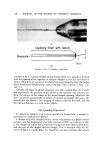
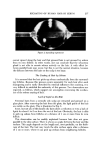
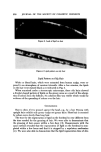
J. Soc. Cosmet. Chem., 27, 235-239 (May 1976) Recoating of Human Hair by Sebum Dr. HANS EBERHARDT* Synopsis-The results of two model experiments show that SERUM does not creep along the HAIR. Accordingly, the sebum which coats the hair does not originate from its FOLLICLE. It is assumed that the terminal hair picks up sebum mechanically from surrounding follicles. The hair and the S'EBACEOUS GLAND together form the pilosebaceous apparatus in both man and hairy animals. The hair protects the body from loss of warmth, while the sebaceous glands protect the hair by covering it with ]ipid. Therefore, we can as- sume that the sebum, which is present in the hair follicle, is coating the whole hair. Greasing of the hair, which takes place during its growth out of the sebum-filled follicle, is of minor importance, since the rate of hair growth is only 0.35 mm a day. Moreover, recoating of hair by sebum occurs within a few days. Therefore, creeping of the sebum along the hair, as has been assumed by some authors (1), (2), seems to provide a natural explanation for the process of hair greasing. INTRODUCTION The Creeping o[ Sebum Along the Hair The passive creeping of the sebum along the hair was examined in two experiments: the capillary experiment and the spreading experiment. These experiments will be discussed in the following two sections of this paper. EXPERIMENTAL AND RESULTS The Capillary Experiment A glass capillary was filled with freshly sampled, human sebum, and a hu- man terminal hair was threaded into the capillary. The temperature was held *Forschungslaboratorien der Dr. Karl Thomae GmbH, D-795 Biberach/Ri13, Bundesre- publik, Deutschland. 235
Purchased for the exclusive use of nofirst nolast (unknown)
From: SCC Media Library & Resource Center (library.scconline.org)