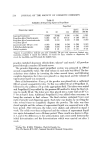
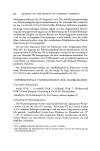
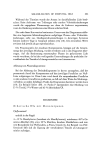
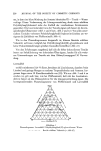
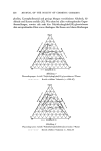
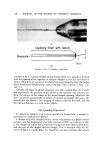
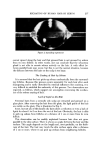
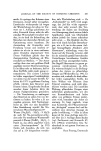
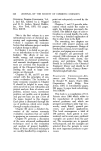
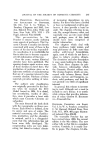
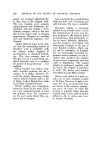
236 JOURNAL OF THE SOCIETY OF COSMETIC CHEMI?STS .... ?•'"..:.' ::•:'•4• :. ...... •']. •' -•:•... •4• ' .,.•.: 4•'• --'•--'•..•...•.•4•*•:•,.?•: :%.....::.:•.• .. ' :%:.]].• •... ' ...... ß .... ......'?.':.:' .... ..... ,•....:•:........•:•. '•'•-•r•.• •..:•:'• ....... ?.... (•) Capillary fi!lod with soburn .... ß ..... '-'"' Hair (b) constant at 35 ø C. Crystals of lipid soluble Sudan black were placed on the hair near the opening of the capillary to indicate whether or not any movement of sebum along the hair occurred. If sebum had crept along the hair, the Sudan black would have dissolved and colored the hair. This is shown i• Figs. i (a) and (b). Actually, the hairs remained unstained even after several days. In a modi- fied experiment, the pressure on the sebum in the capillary was raised to en- large the surface of the sebum in the funnel-shaped opening. Moreover, the hair was moved mechanically to imitate its natural movement. But again, the crystals did not dissolve. No creeping of sebum could be detected, and the hair did not function as a wick in the follicle. The Spreading Experiment To determine whether or not sebum spreads on human hair, a second ex- periment was conducted as follows. A_ droplet of freshly sampled human sebum was placed on a human termi- nal hair, and the temperature was kept constant at 35øC, as is shown in Fig. 2. The droplet of sebum did not spread over the. hair even after several days, and the size of the droplet did not change. This is identical with the be- haGor of lipids on textile fibers (7). Therefore, one may conclude that sebum

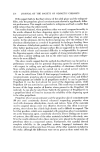
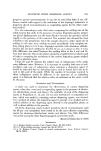
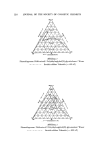
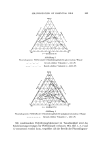
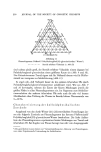
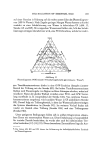
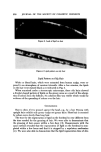
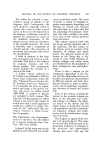
RECOATING OF HUMAN HAIR BY SEBUM 237 Figure 2. Spreading experiment cannot spread along the hair and that greased hair is not greased by sebum from its own follicle. In other words, one can conclude that the sebaceous gland is not able to secrete sebum actively on the hair. A wick effect be- tween parallel hairs may occur, but this is not the normal situation, because the distance between the hairs on the scalp is too large. The Coating of Hair by Sebum It is assumed that the hair picks up sebum mechanically from the surround- ing follicles. Because this process occurs separately for each hair after each shampooing and is easily disturbed by exten•al influences like combing, it is very difficult to establish the unformity of this process. Two observations are reported, as follows, which support our assumption concerning the mechan- ism of the sebum coating of hair. Lack of Lipid on the Hair Terminal hairs from a normally oily scalp are extracted and pressed on a glass plate. After removing the hair from the plate, the lipid prints of the hair are visible on the plate. This is illustrated in Fig. 3. Some, but not all, of this head's oily hairs show a reduction or even a lack of lipids for about 1 to 2 cm from the root of the hair. Obviously, the hair is able to pick up sebum from follicles at a distance of i cm or more from its own follicle. This observation can be readily explained because hair does not grow parallel to the skin surface. There is always an angle between the hair and the surface. This angle depends on the length and, most probably, on the thick- ness of the hair. The hair may touch the skin surface again after a distance of 1 cm or more, where it can pick up serburn from neighboring follicles.
Purchased for the exclusive use of nofirst nolast (unknown)
From: SCC Media Library & Resource Center (library.scconline.org)