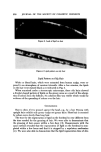
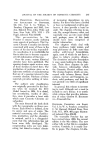
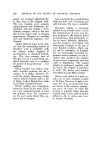
238 JOURNAL OF THE SOCIETY OF COSMETIC CHEMISTS Figure 3. Lack of lipid on hair Figure 4. Lipid pattern on oily hair Lipid Pattern on Oily Hair White or blond hairs, which were extracted from human scalps, were ex- posed to an atmosphere of osmium tetroxide. After a few minutes, the lipids on the hair were stained black as is indicated in Fig. 4. When examined under a stereoscopic microscope, these oily hairs showed a droplet-shaped pattern of lipids on the greasy areas as a result of the adsorp- tion of sebum from the follicles. No coherent film was visible which would be evidence of the spreading of sebum over the hair. CONCLUSIONS Hair is oilier, if it is pressed against the head, e.g., by a hat. Persons with upright hairs exhibit only greasy scalps not greasy hairs. Short hair is recoated by sebum more slowly than long hair. The time for the regeneration of lipid on the forehead is very different from the time needed for the greasing of hair. We were able to demonstrate that the greasing of hair occurs within a few days (3). Measurements with the same method revealed that the regeneration of lipid on the forehead is com- pleted within a few hours and that it is stopped by a regulatory mechanism (4). We were also able to demonstrate that the lipid regeneration time of skin

lIECOATING OF HUMAN HAIII BY SEBUM 239 on the forehead is the same as that of skin on the scalp (5). Hair can then pick up sebum from the oily skin until it is saturated with the lipid (3). This level is reached after a few days. The greasing mechanism of hair after shampooing may then be described as follows: after it is degreased by shampooing, the follicle is filled vith sebum until regulation by surface tension occurs. The hair in the follicle has no effect on this regulation because it does not change the surface area of the sebum in the follicle. It was shown by Kligman and Shelly (6) that follicles filled with sebum look like oily pools. The pools of strong excretors contain more sebum than those of weak excretors (4). The hairs pick up the sebum from these pools mechanically, i.e., by simple contact with the scalp, until the hairs are saturated with lipids. During greasing and in the steady state, sebum transfer from hair-to-hair, hair-to-skin, and skin-to-skin is also possible. When the hair cannot pick up any more sebum, the excretion of sebum is stopped by surface tension. Therefore, we conclude that the lipid pick up by hair is not regulated active by a special mechanism. The hair looses its sebum naturally, and continually picks up small quantities of sebum from the follicle and causes a weak but steady excretion of sebum on the hairy skin. This is the natural function of the sebaceous glands. (Received July 14, 1975) REFERENCES (1) A. Archibald and S. Shuster, The measurement of sebum secretion in the rat., Brit. I. Dermatol., 82, 146 (1970). (2) M. Gloor, •)ber den Einflu13 der Haarl•inge auf die Talgdriisensekretion am behaarten Kopf, Dermatol. Mschr., 160, 730 (1974). (3) H. Eberhardt and H. Kuhn-Bussius, Bestimmung der Riickfettungskinetik der Haare, Arch. Dermatol. Forsch., 252, 139 (1975). (4) H. Eberhardt, The regulation of sebum excretion in man, Arch. Dermatol. Forsch., 251, 155 (1974). (5) H. Kuhn-Bussius and H. Eberhardt, Bestimmung der Riickfettungskinetik der Haare, 2. Jahrestagung der Arbeitsgemeinschaft Dermatologische Forschung, Diisseldorf, 1974. (6) A.M. Kligman and W. B. Shelley, An investigation of the biology of the human sebaceous gland, J. Invest. Dermatol., 30, 99 (1958). (7) F. W. Minor, A.M. Schwartz, E. A. Wulkow, and L. C. Buckles, The migration of liquids in textile assemblies, Text. Res. J., 24, 931 (1959).
Purchased for the exclusive use of nofirst nolast (unknown)
From: SCC Media Library & Resource Center (library.scconline.org)