16 Betty Croshaw 44 Brown, M. R. W. Turbidimetric method for the rapid evaluation of antimicrobial agents :-- Inactiva- tion of preservatives by nonionic agents. J. Soc. Cosmet. Chem. 17 185 (1966). 45 Jacobs, G., Henry, S. M. and Cotty, V. F. The influence of pH, emulsifier and accelerated ageing upon preservative requirements of oil/water emulsions. J. Soc. Cosmet. Chem. 26 105 (1975). 46 Parker, M. S. The rapid screening of preservatives for pharmaceutical and cosmetic preparations. Soap terfum. Cosmet. 45 103 (1972). 47 Murray, E. A. A cosmetic preservative. Deterg. Spec. CT/7 31 (1971). 48 Scott, C. R. and Wolf, P. A. The antibacterial activity of a series of quaternaries prepared from hexamethylenetetramine and halohydrocarbons. Appl. Microbiol. 10 211 (1962). 49 Barnes, M. and Denton, G. W. Capacity tests for the evaluation of preservatives in formulations. Soap Perfum. Cosmet. 42 729 (1969). 50 Wallhaeusser, K. H. Die mikrobielle Kontamination yon Kosmetika. Parfuem. Kosmet. 53 305 (1972). 51 Rosen, W. E. and Berke, ?. A. Modern concepts of cosmetic preservation. J. Soc. Cosmet. Chem. 24 663 (1973). 52 Croshaw, B., Groves, M. J. and Lessel, B. Some properties of Bronopol, a new antimicrobial agent active against Pseudomonas aeruginosa. J. Pharm. Pharmacol. 16 Suppl. 127 T (1964). 53 Clark, N. G., Croshaw, B., Legetter, B. E. and Spooner, D. F. Synthesis and antimicrobial activity of aliphatic nitro compounds. J. Med. Chem. 17 977 (1974). 54 Saito, H. and Onoda, T. Antibacterial action of Bronopol on various bacteria, especially on Pseudo- monas aeruginosa. Chemotherapy (Tokyo) 22 1466 (1974). 55 Allwood, M. C. Inhibition of Staphylococcus aureus by combinations of non-ionic surface active agents and antibacterial substances. Microbios 7 209 (1973). 56 Schuster, G. Die Konservierung yon Shampoos und Schaumbademitteln. Seifen, Oele, Fette, Wachse 99 No. 18 489 (1973). 57 Stretton, R. J. and Manson, T. W. Some aspects of the mode of action of the antibacterial compound Bronopol (2-bromo-2-nitropropane-1, 3-diol). J. Appl. Bact. 36 61 (1973). 58 Moore, D. H., Chasseaud, L. F., Lewis, J. D., Risdall, P. C. and Crampton, E. L. The metabolism of the antibacterial agent Bronopol (2-bromo-2-nitropropane-1, 3-diol) given orally to rats and dogs. Food Cosmet. Toxicol. 14 183 (1976). 59 Brit. Pat. 1250725. 60 Von Koppensteiner, G. Nachweis und Bestimmung yon antimikrobiellen Wirkstoffen im turbi- dimetrischen Test. Pharm. Ind. 36 Nr. 6 442 (1974). 61 Anonymous. Rohm and Haas trade literature (1975). 62 Parker, M. S. Some aspects of the use of preservatives in combination. Soap, Perf urn. Cosmet. 46 223 (1973). 63 Garrett, E. R. A basic model for the evaluation and prediction of preservative action. J. Pharm. Pharmacol. 18 589 (1966). 64 Boehm, E. E. Combination of the esters of para-hydroxybenzoic acid. Am. Perfum. Aromat. 73 No. 1 37 (1959). 65 Parker, M. S., McCafferty, M. and MacBride, S. Phenonip, a broad spectrum preservative. Soap, Perfum. Cosmet. 41 647 (1968). 66 Boehm, E. E. and Maddox, D. N. Preservative failures in cosmetics with special reference to corn- batting contamination by Pseudomonas using binary and tertiary systems. Am. Perfum. Cosmet. 85 No. 3 31 (1970). 67 Boehm, E. E. and Maddox, D. N. Problems of cosmetic preservation. Manuf. Chem. Aerosol News. 42 No. 4 41 (1971). 68 yon Fenyes, C. K. Alcohols as preservatives and germicides. Am. Perfitm. Cosmet. 85 No. 3 91 (1970). 69 Grundy, W. E. Antimicrobial preservatives in Pharmaceuticals in Disinfection, Sterilization and Preservation (Ed. by C. A. Lawrence and S.S. Block) 566 (1968) (Lea and Fegiber,'Philadelphia). 70 Woodford, R. and Adams, E. Sorbic acid Am. Perfum. Cosmet. 85 No. 3 25 (1970). 71 Henley, W. O. and Sonntag, N. O. V. Formaldehyde and its donors as preservatives in cosmetic formulations. Am. Perfum. Cosmet. 85 No. 3 95 (1970). 72 Eckardt, W. Phenylmercuric compounds as preservatives for cosmetics. Am. Perfum. Cosmet. 85 No. 3 83 (1970). 73 Hale, L. J. and Inkley, G. W. A semi-automatic device for multiple inoculation of agar plates. Lab. Pract. 14 452 (1965).

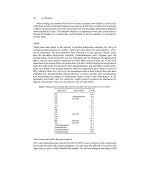
J. Soc. Cosmet. Chem. 28 17-20 (1977)¸ 1977 Society of Cosmetic Chemists of Great Britain Microbial contamination of cosmetic products Presented on 23 February 1976 at the Symposium on Microbiological Safety in Cosmetic and Toiletry products, Birmingham .:• ROSAMUND M. BAIRD Department of Medical Microbiology, ß The Medical College of St Bartholomew's Hospital, West Smithfield, London ECIA 7BE Synopsis !11 i:•:,.i I One hundred and forty seven cosmetic products purchased from five retail shops in 1974 were examined microbiologically. Viable bacteria were not recovered from ninety-nine products. Gram-negative rods ?.?..: were isolated from 6.1% of products and f'seudomonas spp. from 4'1% of products. ::. ß •:• i:: ..• Introduction '?.:' In recent years increasing interest has been shown in the susceptibility of cosmetics and i•:•:'i•i toiletry products to microbial contamination and the potential risk of infection to the user of those products. A number of workers have attempted to determine the incidence :.. i?•:of contamination the results from these surveys are conflicting and contamination rates ::i.:•-i•.i i? have been found to vary from 2'5•o to 43•o (1-8). There is even less information on the :::ilia:' possible health risk to the user of contaminated products. Two cases are often quoted from experience in hospitals (9, 10). This paper presents the results of an investigation into the microbial contamination of :i:'•i' unused cosmetic and toiletry products at the point of sale. ::•:•: •'Materials and methods :.:i': :::..A'total of 147 unused cosmetic products were purchased from five retail shops near this •: i•:?? hospital in July 1974. These comprised a wide range of preparations as shown in Table I. ..:Where possible aqueous products were bought in preference to oily products. One gram or 1 ml of product was homogenized in 20 ml of 4•o Lubrol W in Nutrient •:•!717 Broth (Oxoid) using a Stomacher 80 (Seward). Products containing halogen compounds ?/ .were homogenized in Nutrient Broth (Oxoid) containing 1•o sodium thiosulphate. !!'!i:?Phenolic products were diluted in 100 ml Nutrient Broth (Oxoid). All broths were ?: •ineubated aerobically at 37øC overnight, then sub-cultured to Horse Blood Agar (Oxoid), -I MacConkey Agar and Cetrimide Agar 0-03•o and incubated overnight at 37øC. Resulting ??/!:eølonies were identified some of the Gram-negative rods were sent to the Computer :i:.! Laboratory at Colindale for confirmation. Colony counts were only carried out on those •.::-: '.products from which Gram-negative rods were isolated. 17
Purchased for the exclusive use of nofirst nolast (unknown)
From: SCC Media Library & Resource Center (library.scconline.org)