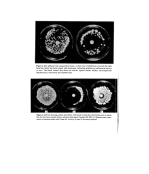
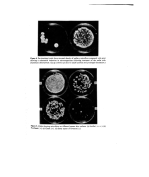
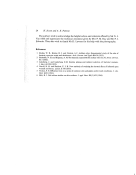
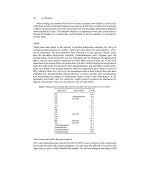
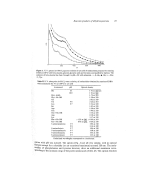
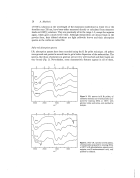
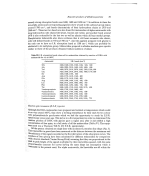
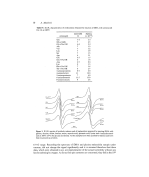
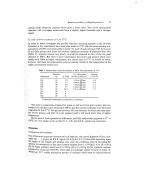
Reaction products of dihydroxyacetone 33 the rest of it was dialysed as usual, with a total yield of 35•o. The E.S.R. spectrum of the purified pigment was similar to that of a melanoidin prepared by refluxing (linewidth H=7 G, spin content=l-8 x 10•S/g. But the signal given by the reaction product before dialysis was quite different (Fig. 4), with a linewidth of 25 G and an intensity correspond- ing to 21 x10 •s spins/g. These striking data can be explained if one assumes that some free radicals were trapped when the reaction medium became viscous by evaporation and finally dried to a vitrous state. These species would then have been lost by reaction with water upon dissolution prior to purification, thus explaining the high loss in free spins. The linewidth of 25 G can also be explained by real free radicals since the spectra of such localized unpaired electrons are likely to exhibit a hyperfine structure (by inter- action with the protons of the molecule) which, although unresolved, would widen the signal significantly. But if, in the general case, purified melanoidins do not contain real free radicals, how can one account for their E.S.R. properties? In recent years, a number of polymers with conjugated double bonds have been found to contain from 10 •ø to 1020 free spins/g (12-15). Their E.S.R. signal is generally a single line of 5-10 G width (12) although a hyperfine structure has been reported in some cases (14, 16) and it can be observed also in solution (12, 16) showing that it must be due to an intrinsic property of the molecule. : This phenomenon has tentatively been explained by several kinds of theoretical con- : siderations (12). It could be due to a semi-conductor effect such as the one proposed to ': account for the paramagnetism of melanins (17, 18). Or it could be, that conjugated polymers in their fundamental electronic state possess, at least partly, the character of :' ':' triplet states (12). Or finally, the free spins observed may be bond alternation defects i:•:•. much like the ones predicted by calculation (19). According to this theory, the alter- nation between double (short) and single (long) bonds along a conjugated polymer chain, i'ii.'::.•i is disrupted by carbon atoms bearing a non-bonding molecular orbital occupied by a :•::•i•: single spin. Such unpaired electrons can travel rapidly through long series of conjugated ß ..i:/,:'double bonds and this deloca!ization is responsible for the lack of hyperfine structure in :•!i:i? the resulting E.S.R. spectra. Two of these defects may be formed through the rupture of one double bond by 5•:11:i.•i: thermal excitation or by lattice deformations (13), or even by photochemical excitation, a "Process which could explain the photoenhancement of melanin E.S.R. signals observed by .:11':ii:'i:iStratton and Pathak (20). In fact the paramagnetic behaviour of melanins should also i•i:::ii::'!be considered as an intrinsic property of their highly conjugated double bonds system, !:•/ and not as a proof of the existence of so-called free radicals in their molecules. In view of these theories, the E.S.R. properties of DHA melanoidins, together with ":•::!'151:i their I.R. absorption around 1600 cm -•, and their dark brown colour due to their non- 'i:!:::,:•: specific absorption in the visible, point out to a highly conjugated double bond structure. monomers of these macromolecules are still unknown, however, although they to be derived from the Schiff base formed by condensation of DHA with amino- ::::.? acids, probably after dehydration and eventually decarboxylation. In the case of the reaction of sugars, it has indeed been shown that the original condensation products lose water very easily to produce furrural derivatives (21-22). Only the alpha •..:!: :i.:Taminoacids are decarboxylated in the process and the non-alpha aminoacid correspond- :•:'i:'.:'.ing pigments exhibit the characteristic absorption band around 1710 cm -• But in any ?:'•??:• case, I.R. spectra show that the rest of the parent aminoacid molecule is always retained • •:•. ':::in DHA melanoidi.n polymers.

34 A. Meybeck Conclusion The pigments formed by reaction of DHA with aminoacids are very similar to melanins, and like these they can be regarded as highly conjugated polymers bound to exhibit intrinsic E.S.R. properties due to bond alternation defects. They still bear the side chains of the parent aminoacids although decarboxylations occur to some extent with alpha derivatives. The action of DHA on skin must start by condensation with the free aminoacids located on the surface and more probably within the horny cells (23), followed by poly- merization and eventually linking to Stratum Comeurn proteins through the participation of lysine side chains. It seems indeed very unlikely that this polymerization process could occur exclusively with basic aminoacids bound in polypeptide chains and therefore un- able to come close enough to one another. But the fixation of an already grown pigment on protein macromolecules is possible and has similarly been found to occur when wool keratin is immersed in the reaction medium of glycine with glucose (24). Finally, it should be noted that since DHA melanoidins possess the same free spin character as melanins, they too should be able to protect the skin from radiations through trapping of electrons and free radicals which are thought to be important intermediates in sunburn and ageing processes (25). Preliminary investigations of an eventual protective effect of DHA have been negative (26-27) but they should perhaps be resumed in view of these new results and those obtained by Fusaro et al. (28-32) with combinations of DHA and juglone or tawsone. References 1 Von Noorden, C. and Isaac, S. Die Zuckerkrankheit und ihre l•ehandlung 8 Ausg. Julius Springer, Berlin, 415 (1927). 2 Butcher, J., Bandelin, F. and Kanas, N. The reaction of dihydroxyacetone with proteins. Amer. Perf. 75 (12) 46 (1960). 3 Wittgenst½in, E. and Berry, H. K. Reaction of dihydroxyacetone (DHA) with human skin callus and amino compounds. J. Invest. Dermatol. 36 283 (1961). 4 Laden, K. and Zi½linski, R. The reaction of •-hydroxymeth¾1ketones with skin and aminoacids. /. $oc. Cosmet, Chem. 16 777 (1965). 5 Ellis, G. P. The Maillard reaction. Adv. Carbohydrate Chem. 14 63 (1969). 6 Blois, M. S., Zahlan, A. B. and Maling, J. E. Electron spin resonance studies on melanin. Biophys. J. 4 471 (1964) 7 Blois, M. S. On the spectroscopic properties of some natural melanins. J. Invest Dermatol. 47 162 (1966). 8 Mason, H. S., Ingram, D. J. E. and Allen B. The free radical property of melanins. Arch. Biochern. Biooehys. 86 225 (1960). 9 Tollin, G. and Steelink, C. Biological polymers related to catechol: electron paramagnetic resonance and infrared studies of melanin, tannin, lignin, humic acid and hydroquinones. Biochem. Biooehys. Acta. 112 337 (1966). 10 Green, D. B. and Happey, F. The in[rated specta of melanins (natural wool pigments). III e Congr•s oent. de la Recherche Textile Laini•re de France, Paris. I 283 (1965). 11 Charle, R. Pigmentation naturelie et artificielle des cheveux. In: Probl&nes Capillaires. Ed. by E. Sidi and C. Zviak), p. 79. Imprimerie Dermont, Paris (1966). 12 Nechtchein, M. Sur la nature des centres paramagn•tiques d6tect•s par RPE dans les polym•res conjugu6s. J. Pol. Sci.: Part C, 4 1367 (1963). 13 Holob, G. M., Ehrlich, P. and Allendoerfer, R. D. Electron spin resonance in crystallizable, high molecular weight polyphenylacetylene. Macromolecules, 5 569 (1972). 14 Byrd, N. R., Kleist, F. K. and Stareires, D. N. Electric and magnetic properties of polymeric organic semiconductors. J. Pol. Sci.: Part A-2, 10 957 (1972).
Purchased for the exclusive use of nofirst nolast (unknown)
From: SCC Media Library & Resource Center (library.scconline.org)