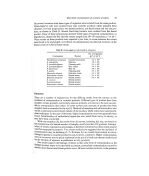
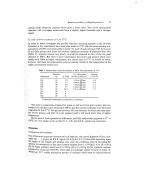
8 Betty Croshaw only a proportion of the total quantity of preservative is available in the aqueous phase where it is required. The remainder partitions into the oily phase or associates with the emulsifying agent, the other major component, and is thus inactivated. The ideal pre- servative should therefore have a low oil/water partition coefficient. It is therefore desirable that the oil/water partition coefficient (K• ø) of a preservative is known. The concentration in the aqueous phase (Cw) at equilibrium may then be calculated for any total concentration (C) and any oil/water ratio (•) as follows (31): + 1) K•%+l Thus, when the oil/water partition coefficient is low, most of the preservative is in the aqueous phase and an increase in the oil/water ratio in an emulsion increases the aqueous phase concentration. When the oil/water partition coefficient is high most of the pre- servative is in the oil phase and an increase in oil/water ratio reduces the concentration in the aqueous phase (6). High partition coefficient values are usually observed for vegetable oil/water systems and low values for mineral oil/water systems. This means that vegetable oil/water systems usually require a higher total concentration of preservative than do mineral oil/water systems (31). Attention has been drawn to the importance of the concentration of the preservative at the oil/water interface. In an emulsion partition of the preservative occurs between the oil, water and emulsifier and its effectiveness is determined largely but not completely by its concentration free in the water. The distribution of the emulsifier influences the distribution of the preservative. The above equation is modified to: c(o + 1) Cw- R where R is the ratio of total/free preservative in the water (31). Compatibility with other ingredients The ideal preservative should be compatible with all the ingredients of modern cosmetics and toiletries. This is a very tall order in view of the many additives used in present day preparations. Prior to the Second World War, almost all cosmetics and toiletries were stabilized by soaps, which made them alkaline, or by anionic surfactants many anionics have some antibacterial action and also tend to potentiate preservative action (32). Formu- lations containing nonionic surfactants are usually formulated at neutral or slightly acid pH, a factor which enhances microbial growth. Incompatibility with newer cosmetic ingredients and particularly with nonionic surfactants has accounted for the failure of some of the older preservatives such as the parabens which at one time were considered to be ideal agents (3). Barr and Tice (25) and Wedderburn (32) examined the effect of some nonionic surfactants on preservatives in common use at that time and found that many of them, including the parabens, substituted phenols and quaternary ammonium com- pounds were inactivated to some extent when the ratio of the nonionics to preservative exceeded certain critical values. Benzoic and sorbic acids, formaldehyde and organic mercurials were affected to a much less extent. A vast amount of literature has accumu- lated on interactions between nonionic surfactants and preservatives (see reviews 3, 33, 34).

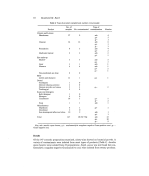
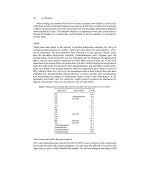
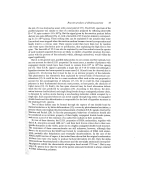
_Preservatives for cosmetics and toiletries 9 Other additives such as natural gums, thickeners, protein hydrolysates, carbohy- drates, fruit and vegetable juices, which are now frequently used in cosmetics, present additional problems since they may support growth of microorganisms and interact with some preservatives (34, 35, 36). Protein hydrolysates, for example, are particularly difficult to preserve (37, 38). The preservative should not complex with or be adsorbed by suspended solid ingre- dients of a cosmetic. Studies in this field have been carried out by Horn et al (39). A number of workers have reviewed methods, both physico-chemical and micro- biological, for studying interactions between preservatives and cosmetic ingredients (34, 40, 41, 42). Compatibility with packaging The ideal preservative must not be lost by passage through, or binding to, the packaging material. Interaction between preservatives and rubber has been well documented and the increasing use of plastic packaging has stimulated research into plastics/preservative interactions (see 3, 36). A satisfactory preservative should be non-corrosive to and retain its activity in the presence of metals and alloys such as aluminium and tin foil which are used as cap liners and in collapsible tubes. Colour, odour, taste The ideal preservative should be colourless, od0urless and tasteless at use concentrations. Cost ,. ß Finally, the ideal preservative should be cheap. When all these properties are considered it is not surprising that the ideal compound does not exist and probably will never be found. The best use of the currently available preservatives must therefore be made and it cannot be emphasized too strongly that preservation should be the concern of both the formulator and the microbiologist at an early stage in formulation development. Each formulation must be regarded as a separate entity with its own preservation problems. The effectiveness of the preservative should ::...be determined not only initially but throughout the shelf-life of the product. A preserva- tive which is satisfactory when the formulation is first prepared may become ineffective 'during its shelf-life for a number of reasons. It is good practice to test the preservative ..capacity of formulations at their maximum intended shelf-life. It may well be that in many instances the most satisfactory results will be obtained by using mixtures of pre- servatives. Various reviews of preservatives have been published, one of the most comprehen- sive is that of Gucklhorn (13). A list of some of the older preservatives which have been in use for some time so that their principal properties and uses have been established is shown in Table I. NEW PRESERVATIVES Over the last 10 years or so several new preservatives have appeared and some of these have yet still to be fully evaluated. These are considered in rather more detail here.
Purchased for the exclusive use of nofirst nolast (unknown)
From: SCC Media Library & Resource Center (library.scconline.org)