J. Soc. Cosmet. Chem. 28 395-401 (1977)¸ 1977 Society of Cosmetic Chemists of Great Britain The meohanism of skin pigment produotion P. A. RILEY Department of Biochemical Pathology, University College Hospital Medical School, University Street, London WC1 E6JJ Presented at the Joint Symposium with the Pharmaceutical Society of Great Britain "Cosmetic and Pharmacological Aspects of Colour" 9-ll November 1976, at Stratford upon Avon. Synopsis The general metabolic pathways leading to the production of pheomelanins and eumelanins are outlined. This paper surveys the evidence that two types of oxidation by tyrosinase are involved, namely oxygen addition to monophenols (cresolase activity) and dehydrogenation of diphenols (catecholase activity). Highly reactive quinones are formed as intermediate metabolites and it is suggested that they are of importance as possible sources of perturbation of cell metabolism. DEFINITION OF MELANIN The most widespread surface pigment in the animal kingdom is melanin. The term 'melanin' was first applied by Berzelius in 1830 to mean any dark pigment, without any specific chemical implications other than those of relative insolubility. Subsequent attempts to derive a more specific chemical definition have foundered on the difficulty that the detailed structures of most melanoid pigments are unknown. Indeed, the structures which have been suggested for melanins have largely been pigments of the imagination. An important fact about melanins is that they absorb light over a large portion of the spectrum. A definition based on their spectral properties is probably the most useful. The biological importance of melanins is related to the fact that they absorb light throughout the visible spectrum and that means that the light absorbed includes radiation which has very low quantal energy and therefore only small electron energy transitions are involved. The smallest energy transitions are from non-bonding to anti-bonding pi-orbitals (n•) and these occur in amide and carbonyl bonds. Melanins also strongly absorb in the ultraviolet spectrum and this involves transitions of electrons from bonding to anti-bonding pi-orbitals (=•*). Pi-orbitals occur in unsaturated carbon-bonds, and transitions from bonding to anti-bonding orbitals are facilitated by conjugation, especi- ally when the p/-electrons are delocalised, as in aromatic rings. The effect of this is that, as the degree of conjugation increases, lower and lower quantal energies are required for absorption. This effect is called bathochromicity. Thus, we may define melanins as batho- chromic aromatic substances which contain oxygen and nitrogen. Melanins are quinonoid polymers of somewhat uncertain structure. They are generally classified according to their predominant component which in most cases is an oxidation 395

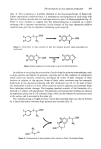
396 P. A. Riley product of the amino acid tyrosine. Two major subdivisions are recognised: pheomelanins and eumelanins. The pheomelanins are distinguished from eumelanins by their content of sulphur. They are derived from a combination of tyrosine oxidation products with cysteine which give rise to yellowish trichochromes of small molecular weight ( 1000 daltons), and reddish brown macromolecular pigments. Eumelanins, by contrast, are black or brown insoluble pigments derived from the polymerisation of tyro sine oxidation products. THE METABOLIC PATHWAY OF MELANOGENESIS The essential steps in melanogenesis consist of the enzymatic oxidation of tyrosine and its derivatives, linked to a series of spontaneous reductions. The initial oxidation consists of the addition of oxygen in the ortho position of the aromatic ring (Fig. 1). The oxidation product which is formed is 3,4-dihydroxyphenylalanine (dopa). Dopa, in common with most diphenols, readily undergoes oxidation to give rise to the corresponding quinone: the reaction consists of a dehydrogenation which is also catalysed by the enzyme tyrosin- ase. This dehydrogenation is an oxygen-requiring reaction and the oxidation of the diphenolic substrate is linked to the reduction of molecular oxygen to water. As far as the dehydrogenation reaction is concerned tyrosinase shows relatively low substrate speci- ficity with respect to the side chain. It has been shown that 5,6 dihydroxyindole is oxidised by tyrosinase and some non-physiological substrates are also oxidised, some of which (such as the hydroxylated derivatives of anisole) may have therapeutic implica- tions. Where dopa is the substrate the product is dopa quirtone (Fig. 2). co OH HO •COOH HO [0] • HO • NH 2 Figure 1. Oxidation of tyrosine to dopa. HO• CO HO OH -2H O• cOOH 0 •".• NH 2 Figure 2. Dehydrogenation of dopa to form dopa quinone. Like most quinones, dopa quinone is a highly reactive molecule, a feature which is made use of in the defensive sprays of some arthropods (1). Quinones readily condense with amino groups and will form cross-links with proteins and the reactivity of quinones may also generate undesirable deleterious effects if unrestricted access is permitted to potential substrates in the cell such as membrane lipids (see below). The spontaneous reduction steps involved in the generation of tyrosine oxidation products consist of four major reactions: reductive cyclisation, redox exchanges, reductive addition and reductive polymerisation. Indolene formation occurs by the addition of the side chain amino group to the sixth ring carbon with simultaneous reduction of dopa quinone. This gives rise to cyclo-dopa
Purchased for the exclusive use of nofirst nolast (unknown)
From: SCC Media Library & Resource Center (library.scconline.org)