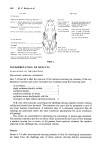
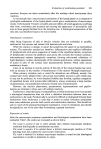
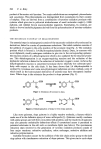
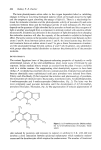
404 Rodney P. R. Dawber The term photodynamic action refers to the oxygen dependent lethal or inhibiting changes in living or non-living biological systems which are brought about by the light and the exogenous agent absorbing the energy of light (1). There is a relationship be- tween the molecular structure and the photodynamic activity of psoralens (2) and some correlation between these and the biological activity of such substances (3). The latter depends on the quantum of light absorbed by the psoralen molecule and the emergence of light at another wavelength from a component in intimate contact with sensitive cellular structures (4). Evidently any deviation in the character of light absorption from changing the molecular structure will alter the capacity of the molecule to exhibit its biological effect. The active centres in the psoralen molecule are: the valence bond between carbon atoms 3 and 4 those between carbon atoms 5 and 8 the intact lactone ring the furan and coumarin fusion at carbon atoms 6 and 7 to give a linear furocoumarin structure and the unsaturated linkage between carbons 4' and 5' (2). In general, any substitution with groups other than methyl diminishes or destroys the photoactivity of the psoralen molecule. DEVELOPMENT The ancient Egyptians knew of the pigment-enhancing properties of topically or orally administered extracts of the wild umbelliferous plant Ammi majux if followed by sun exposure. Indian medical history reveals an extract from the plant Psoraea coryli/blia used in a similar manner--for repigmenting what descriptively appears to have been vitiligo. P. cotTlifolia has since been shown to contain psoralen. Extracts froin such plants became chemically more sophisticated until pure psoralens were isolated from them. Fahmy and Abu-Shady (5) first reported the isolation and pharmacology of psoralens, the most potent of which proved to be psoralen, 4-methylpsoralen, 5,8-dimethylpsoralen, 5-methoxypsoralen and 8-methoxypsoralen (Methoxsalen P•g. 2). The latter was the most commonly used psoralen derivative until the development of 4,5',8-trimethyl- psoralen (Trisoralen Trioxsalen, Fig. 2). The augmentation of melanin pigmentation of O' 0 '• 0CH 3 CH 3 0 CH 3 CH• Figure 2. (a) 8-methoxypsoralen (Methoxsalen). (b) 4,5',8-trimethylpsoralen (Trisoralen Triox- salen). skin induced by psoralens and exposure to natural or artificial U.V.R. (320-400 nm) involves a close interaction between epidermal melanocytes which synthesise melano- somes and the keratinocytes which acquire the melanosomes. The number of functional

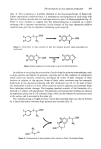
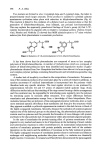
oe)•hancement of pigmentation 405 melanocytes increases as a result of proliferation and/or activation of melanocytes and increased arborization of melanocyte dendrites is usually also observed. The number of functional melanocytes increases within days and may remain raised for up to 60 days. There also appears to be an increase in the synthesis of melanosomes associated with a more rapid 'turnover' of epidermal keratinocytes, i.e. more epidermal cells containing more pigment than normal. Wt:ether this increase in pigmentation is due solely to direct stimulation of melanogenesis or 'sub-clinical' inflammation also---post-inflammatory hyperpigmentation--is not clear. The latter mechanism is not likely to be operative after topical application of a psoralen since generally speaking this mode of administration provides a more potent photosensitizing stimulus. METABOLISM Pure psoralens have been in use for almost 30 years but until recently very little was known of their metabolism after oral ingestion. Trisoralen, Methoxsalen and Psoralen are rapidly metabolized in the liver and excreted in several forms. Trisoralen is hydro- genated at the 4', 5' positions and excreted either as a carboxylated or aldehyde derivative of dihydrotrisoralen hydroxylation at the 3 position may occur leading to excretion of a glucuronide derivative. The metabolism of Psoralen involves glucuronidation, hydroxy- lation in the 3 position of the lactone ring and conversion to furocoumaric acid. In both •nan and animaAs, plasma levels are maximum between two and three hours and photo- sensitivity greatest 2 to 4 h after an oral dose, whilst 90• is excreted within 8-12 h. CLINICAL EFFECTS The increased pigmentation that follows topical or oral psoralens and graded UVR exposure has been studied by many groups. Arnold (6) showed that patients who nor- mally fail to tan and burn easily develop pigmentation within 2 to 6 months cf commen- cing 10 mgs Methoxsalen daily. 20 mgs Methoxsalen daily produces overt pigmentation of the skin within days of commencing treatment (7). Vitiligo patients receiving oral Trisoralen therapy always notice increasing pigmentation of the normal skin (8). Tri- soralen has a much greater pigment-inducing tendency than Methoxsalen and this is a major reason for preferring Methoxsalen for the treatment of psoriasis with long wave ultra-violet radiation (U.V.R. or P.U.V.A.) therapy. Imbrie et al. (8) have shown that the increased pigmentation and thickening of the stratum corneum produced by psoralens and U.V.R. act as protection against potential sunburn and possibly against skin cancer (10) though the latter, despite being theoretically likely, remains unproven. There is no doubt that psoralens and graded U.V.R. can lead to repigmentation of vitiliginous skin. The combination of 10 rags Trisoralen daily followed by exposure to long-wave U.V.R.' ('blacklight', U.V.A.) is probably the most potent repigmenting regime but in white and light-skinned individuals deepening pigmentation of normal skin very early in the course of treatment suggests that Methoxsalen is a better choice in all but negroid subjects. The follow-up studies of Kenney (11) have shown that much of the pigment regained during treatment had not receded 8-14 years later. In the decade 1950-60 psoralens were used in great quantities and largely from a failure to standardize both the psoralen used (particularly topical preparations) and the duration of U.V.R. exposure, burning was unfortunately common. The fact that psora- lens were widely thought of as 'suntan pills' also tended to encourage their misuse.
Purchased for the exclusive use of nofirst nolast (unknown)
From: SCC Media Library & Resource Center (library.scconline.org)