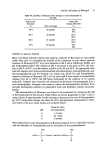
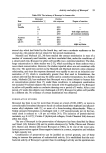
Activity and safety of Bronopol Table VII. Acute toxicity of Bronopol to mice and rats Species Sex Route LD50 mg/kg Mouse male oral 374 female oral 327 Mouse male i.p. 34.7 female i.p. 32.8 Rat male oral 307 female oral 342 Rat male i.p. 22.0 female i.p. 30.2 i.p. =intraperitoneal. 17 Carcinogenicity A carcinogenicity study was carried out in mice by application of 0.3 ml of aqueous- acetone solutions containing 0.2 or 0'5•o Bronopol to the shaved backs three times weekly for 80 weeks. The concentrations were selected after a preliminary tolerance study showed that 1 • or more evoked a local skin reaction. Bronopol did not alter the spontaneous turnour profile either locally or systemically. A 2-year toxicity and tumorogenicity test, in which rats received 10, 40 or 160 mg/kg daily in the drinking water, provided no evidence to suggest that the administration of Bronopol affected tumour incidence. There was no indication of toxicity at 10 mg/kg/day, whereas the higher dose levels adversely affected growth, food intake and survival rate. Renal changes associated with diminished water intake, histological reactions in stomach and gastric lymph nodes probably due to irritancy from prolonged exposure to Bronopol, and an exacerbation of spontaneous morphological alterations in the salivary gland were also observed at the higher dose levels in a dose-related manner. Reproduction Studies The effect of Bronopol on reproduction was investigated in rats and rabbits. In rats dosed from day 1 to 20 of pregnancy with 10, 30 or 100 mg/kg daily by oral intubation, no embryotoxic or teratogenic effects were seen even though the dams had a dose-related retardation in bodyweight gain and some died from gastric and lung lesions. A slight delay in calcification of the foetal skeleton was observed at the highest dose level. Daily application to the clipped dorsal skin of rats of 0.5 or 2•o aqueous solutions of Bronopol thickened with 2'5•o methylcellulose in a dose of 1 ml/kg from day 6 to 15 of pregnancy had no adverse effects on the dams or foetuses apart from causing local skin reactions at the site of application. Oral administration of 1, 3.3 or 10 mg/kg daily to rabbits from day 8 to 16 of preg- nancy also failed to produce embryotoxic or teratogenic effects though the highest dose level suppressed weight gain by the does during the dosing period. Bronopol, 20 or 40 mg/kg daily, given orally to rats from day 15 of gestation and throughout lactation did not affect parturition, litter size or postnatal survival and development of the young. Fertility and general reproductive performance of rats were unimpaired by these dose levels given to males from 63 days before mating and females from 14 days before mating up to day 12 of pregnancy or until the litters were weaned

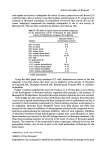
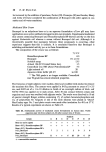
18 D. M. Bryce et al. 21 days oeost oeartum. In this study bodyweight gain of the males that received 40 mg/kg daily was slightly reduced. Mutagenicity Bronopol did not exhibit mutagenic activity under in vitro or in vivo conditions. It was tested using Salmonella typhimurium in the 'Ames' system and in the host-mediated assay in mice in a dominant lethal assay in mice, the only noteworthy finding was anti- fertility arising from toxicity rather than dominant lethality. Irritancy and Contact Sensitivity Animal Studies. Preliminary studies on irritancy and contact sensitisation have been reported by Croshaw et al. (3). Bronopol was tested for local effects to the mucous membrane of the eye in rabbits. A concentration of 0'5•o in normal saline was non-irritant when applied once daily for four successive days, whereas solutions in polyethylene glycol 400 were irritant at 5•o but not at 2•o following a single application. Skin irritancy was investigated by application of Bronopol in a variety of solvents to the non-abraded, clipped and shaved backs of rabbits for 6 h, with or without occlusion. Acetone solutions of Bronopol were non-irritant at 1•o when given as a single applica- tion under occlusion though highly irritant at 0'5•o on repeated application without occlusion. Similar results were obtained with Bronopol in 2'5•o aqueous methylcellulose solution tested under these conditions at 0'5•o concentrations. Bronopol in polyethylene glycol 300 was non-irritant at 5•o as a single application with occlusion. These findings indicate that the irritancy of Bronopol to the skin is dependent upon the vehicle employed, thus it would be advisable to test each new formulation containing Bronopol for local effects on topical application. Bronopol was without skin-sensitising activity in the guinea pig when tested as a 1 •o solution in acetone by the ear-flank method (Stevens (22)), whereas dinitrochloro- benzene was strongly positive. Human Studies. The skin irritant effect of Bronopol was investigated both on volunteers and on patients attending a contact dermatitis clinic. The volunteer study showed that Bronopol is slightly irritant to human skin at 1 •o in soft paraffin (petrolatum), and at 0'25•o in aqueous buffer at pH 5.5. The study con- sisted of a closed patch test using 1 cm lint squares backed with Blenderm surgical tape on the forearms of ten subjects. Concentrations of 0, 0.5, 1 and 2•o Bronopol in soft paraffin and of 0, 0'05, 0.1 and 0'25•o in aqueous buffer at pH 5-5 were used. Any skin reaction after 24 h was graded from 0 (= normal skin) to 5 (= marked erythema with vesicles and induration). The results are shown in Table VIII. The study carried out on patients attending a contact dermatitis clinic showed that Bronopol is a mild irritant when applied in yellow soft paraffin (yellow petrolatum) at 0'25•o. No evidence of sensitisatlon was seen in this study nor was there any suggestion of cross-sensitisation with any other substance, including formalin. The compound was applied as one of a battery of closed patch tests used in that clinic to screen the patients for a potential allergen. The patches were applied for 48 h and examined on the second and fourth days after the application. Of the 149 patients studied, three showed a slight erythema on the
Purchased for the exclusive use of nofirst nolast (unknown)
From: SCC Media Library & Resource Center (library.scconline.org)