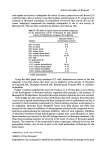
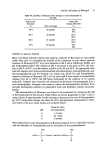
Activity and safety of Bronopol 23 Bronopol is most stable under acid conditions, although it demonstrates high anti- bacterial activity over a wide pH range. The mode of decomposition has been studied in detail, and a number of the decomposition products identified. The assay methods described are capable of estimating Bronopol in many formulations at its normally used levels, the sensitivity of the methods is dependent upon the nature of the formulations in certain cases levels as low as 5 ppm can be assayed. Bronopol is generally used as a preservative in formulations at levels between 0.01 and 0.1 •o. Animal toxicity studies and human patch tests have demonstrated the safety of Bronopol when used at these concentrations. In particular, no evidence of human skin sensitisation has been obtained at these levels. Bronopol has been shown to be an effective antibacterial agent in a range of formula- tions including shampoos, skin creams and sprays and bath products. Many of the ingredients used in such products have been shown to have little or no effect on the antibacterial activity of Bronopol, although compounds containing sulphydryl groups are antagonistic to its activity. ACKNOWLEDGMENTS The authors wish to acknowledge the assistance of the following staff of The Boots Company Limited in the production of the data included: Dr D. F. Spooner (micro- biology) Mr E. L. Crampton (chemistry) Mr D. A. Elvidge, the late Mr C. Vickers, and Mr J. S Wragg (analysis) Dr P. C. Risdall and Miss M. M. Sutton (toxicology) and Mr K. G. Jackson and Dr D. P. Stokes (formulation). In addition, the authors wish to thank Dr C. D. Calnan, Institute of Dermatology, University of London and Professor H. I. Maibach, Department of Dermatology, University of California for their help in the completion of the human skin studies. REFERENCES 1 Hodge, E. B., Dawkins, J. R. and Kropp, E. A new series of antifungal compounds. J. Am. Pharrn. Ass., Sci. Ed. 43 501 (1954). 2 Zsolnai, T, Versuche zur Entdecktmg neuer Fungistatika. II. Nitro-verbindungen. Blochem. Pharmac. s 287 (1961). 3 Croshaw, Betty, Groves, M. J. and Lessel, B. Some properties of Bronopol, a new antimicrobial agent active against Pseudomonas aeruginosa. J. Pharrn. Pharmac. 16 Suppl., 127T (1964). 4 Clark, N. G., Croshaw, Betty, Legetter, B. E. and Spooner, D. F. Synthesis and antimicrobial activity of aliphatic nitro compounds. J. Med. Chem. 17 977 (1974). 5 Morse, L. J. and Schonbeck, L. E. Hand lotions, a potential nosocomial hazard. New. Engl. J. Med. 278 376 (1968). 6 Sykes G. and Smart, R. Preservation of preparations for application to the skin. Am. Perfurn. Cosmet. 84 45 (1969). 7 Smart, R. and Spooner, D. F. Microbiological spoilage in pharmaceuticals and cosmetics. J. $oc. Cosmet. Chem. 23 721 (1972). 8 Malcolm, S. A. and Woodroffe, R. C. S. The relationship between water-borne bacteria and shampoo spoilage. J. Soc. Cosmet. Chem. 26 277 (1975). 9 Tenenbaum, S. The significance of pseudomonads in cosmetic products. Am. Perfum. Cosmet. 86 47 (1971). 10 Thomas, M. J. and Majors, P. A. Animal and human microbiological safety testing of cosmetic products. J. Soc. Cosmet Chem. 24 135 (1973). 11 Marples, R. R. and Kligman, A.M. Methods for evaluating topical antibacterial agents on human skin. Antimicrob. Agents Chernother. $ 323 (1974).

24 D.M. Bryce et al. 12 Onoda, T. and Saito, H. Influence of a new antibacterial agent, Bronopol,upon the growth of cultured cells. Chemotherapy (Tokyo) 22 196 (1974). 13 Hale, L. J. and Inkley, G. W. A semiautomatic device for multiple inoculation of agar plates. Lab. Pract. 14 452 (1965). 14 Bryce, D. M. and Smart, R. The preservation of shampoos. J. $oc. Cosmet. Chem. 16 187 (1965). 15 Brown, M. R. W. Turbidimetric method for the rapid evaluation of antirnicrobial agents - Inactiva- vation of preservatives by non-ionic agents. J. $oc. Cosmet. Chem. 17 185 (1966). 16 Stretton, R. H. and Manson, T. W. Some aspects of the mode of action of the antibacterial com- pound Bronopol (2-bromo-2-nitropropane-l,3-diol). J. appl. Bact. 36 61 (1973). 17 King, M. B., Knox, R. and Woodroffe, R. C. S. Investigation of antituberculous substances- an agar diffusion method using Mycobacterium smegmatis. Lancet i 573 (1953). 18 Kabay, A. Rapid quantitative microbiological assay of antibiotics and chemical preservatives of a non-antibiotic nature. AppL Microbiol. 22 752 (1971). 19 Moore, D. H., Chasseaud, L. F., Lewis, J. D., Risdall, P. C. and Cramp(on, E. L. The metabolism of the antibacterial agent Bronopol (2-bromo-2-nitropropane-l,3-diol) given orally to rats and dogs. Fd. Cosmet. Toxicol. 14 183 (1976). 20 Moore, D. H., Chasseaud, L. F., Bucke, D. and Risdall, P. C. The percutaneous absorption and disposition of the antibacterial agent Bronopol in rats and rabbits. Fd. Cosmet. ToxicoL 14 189 (1976). 21 Noakes, D. N. and Sanderson, D. M. A method for determining the derreal toxicity of pesticides. Brit. J. Indust. Med. 26 59 (1969). 22 Stevens, M. A. Use of the albino guinea-pig to detect the skin sensitizing ability of chemicals. Brit. J. Ind. Med. 24 189 (1967). 23 Marzulli, F. N. and Maibach, H. I. Antimicrobials: experimental contact sensitization in man. J. $oc. Cosmet. Chem. 24 399 (1973). 24 Marzulli, F. N. and Maibach, H. I. The use of graded concentrations in studying skin sensitizers: experimental contact sensitization in man. Fd. Cosmet. ToMcol. 12 219 (1974). 25 Maibach, H. I. Dermal sensitization potential of 2-bromo-2-nitropropane-l,3-diol (Bronopol). Con- tact Dermatitis 3 99 (1977). 26 Schuster, G. Die Conserviemng von Shampoos und Schaumbademitteln. $eifen-Ole-Fette-Wachse 99 489 (1973). 27 Tuttle, E., Phares, C. and Chiostri, R. F. Preservation of protein solutions with 2-bromo-2-nitro- 1,3-propanediol (Bronopol). Am. Perfum. Cosmet. 85 87 (1970). 28 Barnes, M. and Denton, G. W. Capacity tests for the evaluation of preservatives in formulations. Soap, Perrum. Costa. 42 729 (1969). 29 Parker, M. S. Some aspects of the use of preservatives in combination. Soap, Perfum. Costa. 46 223 (1973). 30 Proserpio, G. Protection des cosm6tiques par des m61anges synergiques de pr6servateurs •i dosage microbiocide. Parrum. Cosmet. $avons 2 305 (1972). 31 Jacobs, G., Henry, S. M. and Cotty, V. F. The influence of pH, emulsifier, and accelerated ageing upon preservative requirements of o/w emulsions. J. Soc. Cosmet. Chem. 26 105 (1975).
Purchased for the exclusive use of nofirst nolast (unknown)
From: SCC Media Library & Resource Center (library.scconline.org)