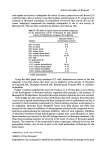
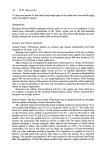
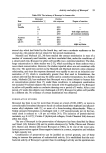
Activity and safety of Bronopol 21 Alcoholic Deodorant Spray An experimental alcoholic deodorant spray formulation containing 0.12• w/w Bronopol was found to be stable after one-year's storage at room temperature and 37 ø in a lacquered tinplate can, and showed a broad spectrum of antibacterial activity. Composition of the spray was as follows: •o w/v Diethyl Phthalate BPC 0.330 (v/v) Propylene glycol 0.167 Denatured ethanol B grade 750P 29.320 Perfume 0.083 Bronopol 0.100 Propellant 11/12 (1: 1)to 100 This formulation was packed into internally lacquered tinplate cans soldered with solder 2/98 and fitted with a standard valve. The can fill was 128 g. Samples were then placed on storage test at room temperature and 37øC, and examined at regular intervals over a period of one year. Chemical assays were carried out using an adaptation of the t.l.c. system described earlier. The results showed that no decomposition of the Bronopol had occurred. No corrosion of the container was observed. Microbiological assessments were carried out by spraying the formulation on to a 13 mm Whatman A.A. disc and allowing to dry. The discs were then placed on to agar seeded with various test bacteria and Candida albicans. The zones of inhibition were recorded after 18 h at 37øC. The results obtained after one-year's storage are shown in Table X. Table X. Antibacterial activity of Bronopol in an alcoholic spray formulation after one year storage at room temperatue and 37øC Diameter of zone of inhibition (+ 13 mm disc) in mm Sample 1 Sample 2 Test organism (containing Bronopol (containing initially at 0.12•o w/w) no Bronopol) Temperature of storage Room temperature 37 ø 37 ø $taph. aureus 8452 29 30 13 $taph. aureus FDA 35 35 13 Staph. albus NCTC 7944 28 29 13 Esch. coli NCTC 5934 26 26 13 Proteus vulgaris NCTC 4635 26 26 13 Ps. aeruginosa 10S 28 28 13 Candida albicans 239 13 13 13 Personal Hygiene or Foot Spray An experimental hygiene spray formulation containing Bronopol was found to be stable in a lacquered aluminium can and showed more antibacterial activity than a similar formulation containing chlorhexidine, even after 3 months storage at elevated temperature.

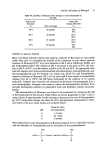
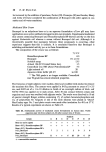
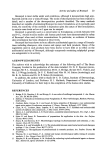
22 D.M. Bryce et al. The following formulation was chosen to represent a typical hygiene spray: Talc 399 (Whittaker, Clark and Daniels Inc.) Bronopol Perfume Propellant l l (I.C.I. Ltd) Propellant 12 (I.C.I. Ltd) to % w/w 0.500 0.075 0.100 39.325 100 Crystalline Bronopol was passed through a micro-mill to obtain the necessary reduction in particle size, the material subsequently passed through a 250 mesh screen sieve. The iron content of the Bronopol was 7 ppm and no evidence of discolouration was evident after 5 months storage at room temperature. Particle size analysis of the talc showed 98.7% less than 15 I•m. The above formulation was packed into an internally lacquered aluminium monobloc can fitted with a standard valve. The can fill was 64 g. Samples were placed on storage test at room temperature and 37øC, and were examined at regular intervals over a period of 3 months. Chemical assays were carried out using an adaptation of the t.l.c. system described earlier. The results showed that no decomposition of Bronopol had occurred. No corro- sion of the container was observed. Microbiological assays were carried out using the method described for the alcoholic deodorant spray formulation. The results obtained after three months storage are shown in Table XI. Table XI. Antibacterial activity of Bronopol and chlorhexidine in a hygiene spray formulation after 3 months storage at room temperature and 37øC Test organism Temperature of storage Diameter of zone inhibition (+ 13 mm disc) in mm Sample 1 Sample 2 Sample 3 (containing Bronopol (containing chlorhexidine (containing initially at initially at neither biocide) 0.075% w/w) 0.075% w/w) Room Room temperature 37 ø Room temperature 37 ø temperature 37 ø $taph. aureus 8452 30 25 14 15 15 14 $taph. aureus FDA 32 22 15 15 13 13 $taph. albus NCTC 7944 31 24 14 14 13 13 Esch. coli NCTC 5934 21 21 13 13 13 13 Proteus vulgaris NCTC 4635 23 21 13 13 13 13 Ps. aeruginosa 1 OS 26 22 13 13 13 13 Candida albicans 239 13 13 16 16 13 13 Further microbiological tests were carried out with samples which had been stored at room temperature and 37øC for 6 months. Although these tests were only qualitative, a similar pattern of activity to that observed after 3 months was obtained. CONCLUSIONS Bronopol has been shown to possess a wide spectrum of antibacterial activity. Its activity against Gram-negative organisms, particularly Ps. aeruginosa, is greater than that of most other antibacterial and preservative agents.
Purchased for the exclusive use of nofirst nolast (unknown)
From: SCC Media Library & Resource Center (library.scconline.org)