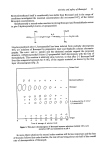
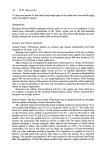
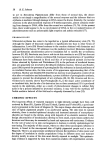
Activity and safety of Bronopol 11 Bromonitroethanol itself is considerably less stable than Bronopol and in the range of conditions investigated the maximal concentrations did not exceed 0'5•o of the initial Bronopol concentrations. Simultaneously a second-order reaction involving Bronopol and formaldehyde occurs to give 2-hydroxymethyl-2-nitro- 1,3-propanediol: NO• iH• OH I H20 HOCH2•C CH'•OH+ CH•O • HOCH• C CH•OH +HBr I I Br NO• 2_hydroxymethyl-2-nitro-l,3-propanediol has been isolated from partially decomposeu 10•o w/v solutions of Bronopol by preparative layer and Sephadex column chromato- graphy. The n.m.r. and i.r. spectra and the elemental analysis support the proposed structure. 2_Hydroxymethyl-2-nitro-l,3-propanediol itself decomposes with the loss of formaldehyde. This reaction is relatively slow, however, so that after 2-3 Bronopol half lives this compound accounts for 8-10•o of the organic material, as shown by the thin layer chromatogram (Fig. 3). Solvent front 0 0 0 O 0 o o OOoooooo o o o 0 0 0 o o o o 0 0 0 0 o ø o oo oo000o0 o o o o o 0 o o o o o • o o---o 0 0 CL Time of storage of solution (min) Bromonitroethanol Bronopol 2-hy droxymet hyl- 2 -nitro - 1,3-propanediol Origin Figure 3. Thin-layer chromatogram of Bronopol aqueous solutions (initially 10•o w/v) stored at 100 ø and maintained at pH 6 In more dilute solutions the second order reaction will be less important and the loss of bromine follows first order kinetics, the rate of loss being about one-half of the overall rate of decomposition of Bronopol.

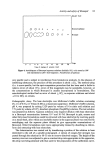
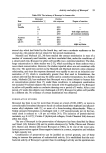
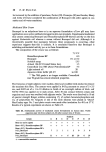
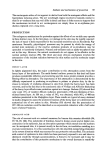
12 D.M. Bryce et al. A number of reactions involving formaldehyde occur simultaneously. The overall result is that the formaldehyde concentration tends to a maximum which is lower than an equimolar ratio. The rate of formation of formaldehyde relative to the rate of decom- position of Bronopol was not markedly affected by pH over the range investigated. An additional mode of decomposition results in the formation of nitrite but not nitrate. The rate of formation of nitrite tends to follow second-order kinetics and is slower than the overall decomposition of Bronopol as measured by g.l.c. No information has been obtained on the route by which the nitro group is lost and the final organic products have not been identified. Their physical properties suggest, however, that some may be polymeric. It should be noted that in the presence of certain secondary and tertiary amines and amides, nitrite can form nitrosamines which may be carcinogenic. In the opinion of the authors, it is advisable that formulators using Bronopol, or any other substance giving rise to nitrite, take steps to ensure that if nitrosamines are pro- duced, their presence does not represent a health hazard to the user. The gaseous decomposition products of Bronopol have been examined by mass spectroscopy. Only three major peaks were found the first of which could be attributed to nitrogen plus a trace of ethylene at m/e 28 and the second to nitric oxide at m/e 30. The only constituent of the third peak, at m/e 44, which could be identified was the radical CH•NO. Neither carbon monoxide nor carbon dioxide could be detected. Thin-layer chromatograms of stored solutions of Bronopol were sprayed with starch/ potassium iodide solution, which would locate components including those containing the aliphatic nitro group. At least seven components were detected (Fig. 3), three of which were identified. The origin contained sodium bromide and sodium nitrite. Bio- autography, on the other hand, showed only two active zones corresponding to Bronopol and bromonitroethanol (Fig. 4). It is difficult to explain the g.l.c. and microbiological results on the basis of the above observations since the bromonitroethanol and formaldehyde present are not sufficient to account for the difference between them. Analytical Methods The methods described in this section have been used to obtain the results recorded in the preceding sections, and to assay Bronopol in the types of formulations in which it is likely to be incorporated. Pure Bronopol has been assayed by the determination of its bromine content, by the determination of its nitrogen content and by g.l.c. of the acetylated and of the trimethyl- silylated material, the methods using g.l.c. being the most specific. In formulations, Bronopol has been estimated by t.l.c., by a polarographic procedure, by a micro- biological procedure and by g.l.c. The procedure by t.l.c. has been applied to ointments (at a concentration of 0.1Yo), to barrier creams (at concentrations of 0.1 and 0'2Yo) and to aerosol concentrates (at a concentration of 0.05•o). G.l.c. has been applied to aqueous formulations (at concentrations of from 5 to 50 ppm). The polarographic procedure has been applied to ointments, suppositories, creams and gels (all at a concentration of 0'2•o) and has also been used to estimate Bronopol in buffered aqueous solutions and in blood serum. The microbiological procedure has been applied to creams, including barrier creams (at concentrations of 0.1 and 0'2•o), to liquid shampoos and also to buffered aqueous solutions. The polarographic method estimates the alkyl nitro group and therefore, although an acceptable procedure for freshly-prepared formulations, is not
Purchased for the exclusive use of nofirst nolast (unknown)
From: SCC Media Library & Resource Center (library.scconline.org)