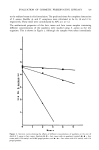
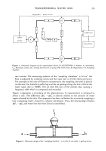
334 JOURNAL OF THE SOCIETY OF COSMETIC CHEMISTS ß diffusion properties through S.C. are modified by desorption. ethe increase of water vapor pressure gradient through the horny layers modifies the ToeWL. For some years devices have been designed which allow ToeWL to be measured under equilibrium conditions (2,3,4). We believe that the best system should have the following characteristics: 1. The measuring device should not alter the physical and chemical properties of S.C. This involves using an air flow sufficiently small to avoid any modification of the local microclimate of the skin surface (5). 2. Too large a measuring surface combines areas having different values of TEWL, resulting in the determination of an average TEWL value. With too small a surface, we may only measure a particular zone (e.g., pores) (6). Furthermore, in the case of small surfaces, an edge effect might become prevalent. 3. Measuring should be differential, i.e., should be able to record TEWL differences between two distinct zones. This is particularly necessary in case of minute variations. 4. Lastly, measurement should not take more than two or three minutes to avoid stressing the volunteer. The device we have used and describe below complies with these four requirements. EXPERIMENTAL TECHNIQUE The measuring system The principle on which the apparatus is based is the variation of dielectric permittivity (e) of water vapor air mixture, filling a resonant cavity, as a function of the amount of water vapor. e is measured in a frequency range (X band) where description and measurements of these phenomena have been made during the past few years. The permittivity variation is obtained by measurement of the resonant frequency shift of a cavity filled with the mixture under study. Our device (Figure 1) has the following characteristics: The working frequency is 8.5 GHz. The Klystron, cooled by an air blower, provides a frequency modulated wave through two parallel mounted resonant cavities. By means of a linear frequency modulation of the Klystron near the resonance frequency of the cavities, detectors D1 and D2 give the resonance curves of cavities C• and C2. The frequency modulation is 100 Hz. During one period, detection devices identify the summits of the resonance peaks. An internal clock computes the time interval between the two frequen- cies. A statistical treatment averages this time interval on 10, 100 and 1000 measure- ments. This result is digitally displayed on a counter. A numerical analog converter is used to record the signal. This signal is an ultrasensitive and accurate index of the difference in the air humidity of the two cavities. Alternatively, there is a differential system composed of a pump which blows room air, through plastic tubes and two "sampling chambers" (Figure 2), into the

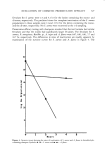
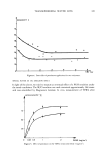
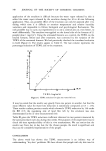
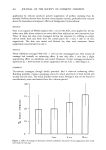
TRANSEPIDERMAL WATER LOSS 335 FREQUENCY MODULATION POWER SUPPLY , tnz I COMPUTER RECOR Figure 1. Schematic diagram of the experimental device. K: KLYSTRON, I: Isolator, A: Attenuator, C•,2: Resonant cavities, D•,2: Crystal detectors, P: air pump, FM: Flow meter, H: Hygrometer, S C: Sampling chamber. two cavities. The measuring surfaces of the "sampling chambers" is 30 cm 2. Air flow is adjusted by metering valves and the main rate is 20 l/hr (liters per hour). For example in the case of forearm measurement, the sampling chamber is placed on the arm, the bottom is pulled up and the air passing along the skin collects the water vapor due to TEWL. The air then fills one of the cavities thus causing a frequency shift which is computed and recorded. Figure 3 represents a recording of the phenomenon. A measurement is achieved in about 2 min. The difference •xF• --•XF0 is directly related to the amount of water vapor released by the skin. Our apparatus has been calibrated by accurately weighing a box containing water, closed by a plastic membrane. Thus, the relationship between •xF• --•xF0 and water loss has been directly established. a • __.b Figure 2. Schematic design of the "sampling chamber." a: air inlet b: air outlet, c: pull-up screw.
Purchased for the exclusive use of nofirst nolast (unknown)
From: SCC Media Library & Resource Center (library.scconline.org)