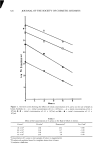
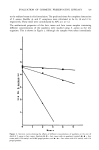
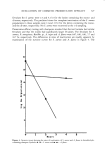
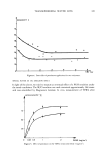
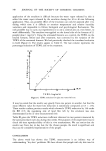
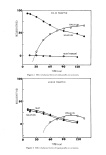
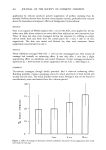
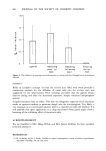
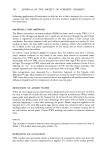
lOO lOO I , I I , I 30 60 90 120 TIME(M•N) Figure 2. Effect of physical forms of solid paraffin on occlusivity. LIQUID PARAFFIN N• _ EMULSION . SOLUTION • i I 30 60 ! 120 TIME(MIN) Figure 3. Effect of physical forms of liquid paraffin on occlusivity.

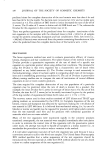
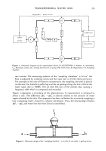
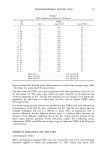
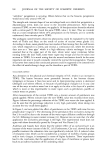
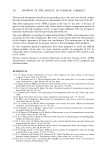
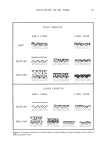
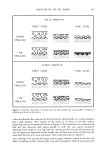
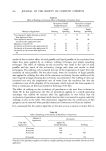
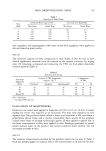
350 JOURNAL OF THE SOCIETY OF COSMETIC CHEMISTS evaporate the water completely from the emulsion samples coated on the skin. The occlusivity of solid paraffin in the emulsion form increased markedly with time and exceeded that in the solution form at around 80 to 90 min after the application. On the other hand, the occlusivity of liquid paraffin in the emulsion form initially increased with time but peaked out at around 100 min after the application and then decreased gradually. Since it is possible that the variation of the occlusivity of oil films is caused by the difference in the states of the oil films on the skin surface, the state of oil films was examined. The results of this examination are schematically shown in Figure 4. When solid paraffin was applied to the skin surface in the neat form, non-continuous oil film was formed as shown in Figure 4. Solid paraffin in the neat form was not, therefore, a barrier to water loss. When solid paraffin was applied in the solution form, however, crystalline solid paraffin was precipitated and a tight solid film was formed upon the evaporation of the solvent. This solid film was an effective barrier to water loss however, it was so fragile that cracks in the film occurred with skin movement. This is the reason why solid paraffin in the solution form showed a high occlusivity at beginning which then decreased with time. Because the emulsion particles were of solid state, their coalescence did not occur even if the emulsion was broken by the evaporation of water when solid paraffin was applied in the emulsion form. But creaming of the emulsion advanced and the particles tended to pack themselves closely, resulting in a gradual formation of a continuous, aggregated flexible film. This is the reason for the observation that the occlusivity of solid paraffin in the emulsion form increased with time. In the case of liquid paraffin, no appreciable differences were observed in the residual states of the oil films formed by the neat form and solution form. A liquid film with a weak occlusive effect was formed on the skin surface in both cases of the application forms. In spite of the formation of this occlusive film, the occlusive effect decreased with time. This could be due to the thinning of the liquid film that was observed with time. Partial destruction of the liquid film by increased vapor pressure of water and the migration of water through the liquid layer (12) could also account for the observation of this phenomenon. The occlusivity of liquid paraffin in the solution form was slightly higher than that in the neat form, which was caused by the difference in the wettability in both forms. Liquid paraffin in the solution form was easy to spread over the skin surface due to its low surface tension. When liquid paraffin was applied to the skin in the form of emulsion, both coalescence and creaming were observed with time, forming a continuous oil film. Thus, the occlusivity of liquid paraffin in the emulsion form increased until the formation of the continuous oil film was completed and it then decreased with time because of the same reasons described above. The effect of the emulsion types on the occlusive effect was also studied using o/w and w/o type liquid paraffin emulsions. Table 1 summarizes the results. Since the evaporation rate of water was faster in the o/w emulsion than w/o emulsion, the o/w emulsion began to show its occlusivity earlier than the w/o emulsion and it also reached to the maximum occlusivity earlier than the w/o emulsion. The pattern of the occlusivity-time curve observed was similar for both types of the emulsions, although there existed a time lag. The maximum occlusivity obtained with the w/o emulsion was slightly higher than that obtained with the o/w emulsion. There were no appreciable differences that were observed in the residual states of both types of the emulsions on the skin surface. As mentioned previously, a continuous oil
Purchased for the exclusive use of nofirst nolast (unknown)
From: SCC Media Library & Resource Center (library.scconline.org)