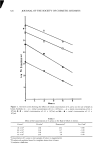
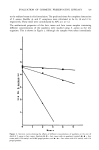
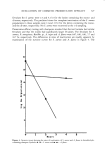
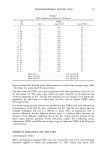
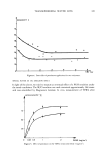
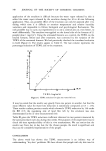
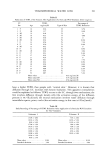
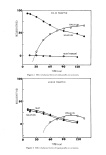
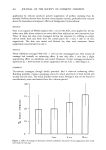
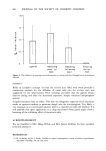
EVALUATION OF COSMETIC PRESERVATIVE EFFICACY 329 The addition of BHI broth to lotion increased the D-value for S. aureus over that observed with lotion containing no broth. It is believed that the broth protected the bacteria, either by inactivating a portion of the preservative, because it is reported that proteins interfere with parabens and quaternary ammonium compounds (8), or by supplying the bacteria with nutrients that enabled them to be more capable of withstanding the stress imposed by the lotion preservative system. Although the amount of BHI broth added here was more than would be used for most broth culture inoculations in preservative testing, this level was chosen to demonstrate the effect of culture media on the performance of the test. It would not be surprising to find that BHI broth and other culture media affect the rate of die-off of other organisms in cosmetic products the use of culture media inocula should therefore be avoided in preservative efficacy testing. It is recommended that only saline suspensions of test organisms be used for cosmetic preservative efficacy testing. The data presented in Figure 1 demonstrated that the rate of inactivation of $. aureus in lotion was independent of the concentration of organisms present because similar D-values were obtained for 0.1-ml inocula which produced initial concentrations of 1.5 ( 10 3 tO 1.8 ( 10 6 S. aureus/ml lotion. This indicates that the concentration of challenge organisms in the inoculum is not critical--at least up to the point at which the preservative system becomes overloaded and its capacity to inactivate the test organisms is exceeded. Although some test procedures require repeated challenges of cosmetic products to determine adequacy of preservation (1,3), the value of repeated challenges is questioned. Discounting the effect of dilution that occurs on repeated challenges, the data presented here suggest that the rate of inactivation of S. aureus would be the same with 10 challenges of 10 5 S. aureus/ml as with one challenge of 10 6 S. aureus/ml. It is recommended that the rationale behind the repeated challenge tests be reconsidered in light of this. It is believed that the most useful information will be obtained if experiments are directed towards finding: 1) the effect of abuse, such as dilution of the product, on preservative efficacy 2) the concentration of organisms required to overwhelm the preservative system or 3) the D-value for test organisms in the product. The linear regression method was useful for determining the effect of formulation changes in the antimicrobial properties of cosmetic products. This was demonstrated by finding different D-values for S. aureus in lotion formulated with glyceryl monolaurate or with glyceryl dilaurate and in face creams containing different concentrations of methyl- and propyl-paraben. The analyses performed to date indicate that there are constant relationships between the D-values obtained for different bacteria in a given product. Thus, it is possible to predict product stability for a number of organisms when one establishes the rates of inactivation of these organisms in relation to that of a standard test organism. For example, tests with lotions containing parabens and Quaternium-15 demonstrated that the mean D-values for S. aureus, P. aeruginosa and Bacillus sp. were 2.5, 0.6 and 0.7 hr, respectively. S. aureus was chosen as the standard test organism for use in lotions because the rate of inactivation was slow enough so that several APC could be determined over a period of hours. In addition, the preservative systems in other lotions were considered adequate for pseudomonads and bacilli when they were found to be satisfactory for S. aureus.

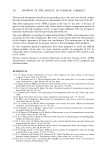
330 JOURNAL OF THE SOCIETY OF COSMETIC CHEMISTS The relationship between the D-values for bacteria, such as S. aureus, and molds needs to be established to determine if the rate of death of molds can be predicted from the D-values obtained for S. aureus in a product. If experiments show that this is possible, the preservative testing could be set up using only bacteria and the results could be obtained in 48 hr. The reliability of any test method depends on the precision, sensitivity and accuracy of the method. In microbiological testing, the precision generally depends on the skill and care exercised by the analyst. The correlation coefficient was used as an indicator of precision and was used to determine the goodness of fit of the data to the linear regression. The running average of the correlation coefficient was -0.99, and the 95% confidence limits were _+0.03. In practice, all analyses were considered to be unac- ceptable and were repeated if the correlation coefficient was outside of limits. An attempt was made to minimize the variation between different analyses by handling all samples in the same manner. The sensitivity of the method depended on the ability of the recovery system to allow growth of the viable organisms present in the test samples. The LBT and TSALT agar were used because they are recommended by the CTFA (3) and because it is believed that this recovery system provides the most reliable recovery of organisms present in the test materials examined. The linear regression method has been used to determine the preservative efficacy of over 150 samples of creams, lotions, shampoos and hair conditioners using S. aureus, P. aeruginosa, Bacillus sp., A. niger or A. flayus as test organisms. A perfect correlation was observed between the predicted time for complete destruction of the test organisms and the time observed to recover 10/ml on product resamplings with all products except for protein-containing shampoos and hair conditioners. Even though the linear regression method predicted complete destruction of the populations of test bacteria in less than 24 hr, low levels of bacteria were recovered at the 24-hr sampling. This observation was made using all of the test bacteria on several occasions and is thought to be due to the protein in these products. It is reported that protein interferes with the preservative efficacy of formaldehyde (8), and it is possible that the protein affords some protection to the bacteria so that there is tailing (i.e., departure from linear die-off in the semi-log plots shown in the survivor curves) that results in recovery of the organisms past the predicted times for complete destruction. Further study is needed to understand the lack of correlation observed here. As with all methods of preservative efficacy testing, the usefulness of the test depends on the choice of appropriate test conditions, test organisms and acceptance criteria. It is desirable to use the organisms with the greatest resistance to the preservative system (i.e., organisms with the largest D-values in the product being examined) in order to establish that the product is adequately preserved. Unfortunately, there is always the possibility that more resistant organisms exist in nature, or that the consumer will abuse the product so that microbial growth can occur. It is possible to set meaningful guidelines for accepting or rejecting a product based on the performance of its preservative system because the linear regression method provides a quantitative measure of the rate of die-off of test organisms. It is proposed that the preservative system for each cosmetic meet minimum requirements for inactivation of three classes of organisms: 1) pathogenic microorganisms, such as
Purchased for the exclusive use of nofirst nolast (unknown)
From: SCC Media Library & Resource Center (library.scconline.org)