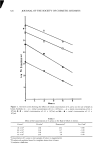
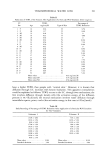
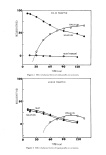
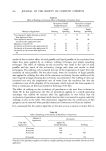
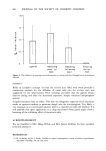
372 JOURNAL OF THE SOCIETY OF COSMETIC CHEMISTS Table III Moisture Enhancement Over Basal TWL t Time After mg/cm-2/hr-t Application (Min) Lotion % Increase Urea PEG Conc Lotion Urea PEG Conc 30 0.06 0.10 0.21 60 0.06 0.11 0.20 90 0.07 0.12 0.21 120 0.09 0.14 0.24 180 0.11 0.17 0.26 Average 0.43 19 31 66 134 0.43 20 37 67 143 0.32 25 43 75 114 0.28 36 56 96 112 0.30 48 74 113 130 -- -- 30 48 83 127 •All values represent averaged data of the four days of study. After 15 min most of the water present in the products had evaporated by both gross inspection and measurement. After 30 min the highest reading generated by the hydroscopic products was 0.03 mg/cm2/hr, a small artifact. Readings taken beyond 30 min which are above control values represent moisture available to the horny layer. Each product added moisture to a different degree. None were occlusive. This allowed for rank ordering of the moisturizers. The products were tested on four separate days and the rank orders were compared by an analysis of variance for ranked data (Friedman's test). The rankings were consistently maintained from day to day (p 0.01). To investigate the possibility that the moisturizers had both moisture enhancing and occluding properties a wipe-off test was done at the end of the study. Moisture detectable at the skin surface diminished toward basal values suggesting no occlusive moisture was going undetected. DISCUSSION A method to indirectly, but objectively study skin moisturizers is available. The technique does not measure the absolute in vivo moisture content, but when more water is present it is detected. Four common moisturizers were studied. None were found to be occlusive and their moisture enhancing capacities vary greatly. How do they add water to the stratum corneum? None of the products produce the kind of damage to the horny layer required to increase TWL (7,9,10). An increase in sensible sweating is, likewise, not a normal reaction to application of these products. The water present in the products themselves was given ample opportunity to evaporate before the tests were run (30 min). Could the increase in TWL measurements represent an effect on stratum corneum which allows an increase in insensible water loss ? Yes, in fact, one way to do just that is to hydrate the horny layer which in turn allows a greater transpirational water loss (11). Whether this is the mechanism of action or the humectants present in these products are able to impart water to keratin, the net effect is hydration of the stratum corneum. REFERENCES (1) I. H. Blank, Factors which influence the water content of the stratum corneum,J. Invest. Dermatd., 18, 433-440 (1952).

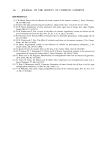
SKIN MOISTURIZATION ASSAY 373 (2) D. Spruit, Interference of some substances with water vapor loss of human skin, Amer. Perfum. Cosmet., 86, 27-32 (1971). (3) H. Baker, Experimental studies on the influence of vehicles on percutaneous absorption, J. $oc. Cosmet. Chem., 20, 239-252 (1969). (4) R. L. Rietschel, A method to evaluate skin moisturizers in vivo, J. Invest. Dermatol., 70, 152-155 (1978). -- (5) R. L. Rietschel and T. S. Spencer, Correlation between mosquito repellent protection in time and insensible water loss from the skin,J. Invest. Dermatol., 65, 385-387 (1975). (6) F. A.J. Thiele, H. G. W. M. Hemels and K. E. Malten, Skin temperature and water loss by skin, Trans. St.John's Hosp. Dermatol. Soc., 58, 218-223 (1972). (7) M. Shahidullah, E.J. Raffle and W. Frain-Bell, Insensible water loss in dermatitis, Brit. J. Dermatol., 79, 589-597 (1967). (8) D. Spruit and K. E. Malten, Epidermal water-barrier formation after stripping of normal skin, J. Invest. Dermatol., 45, 6-14 (1964). (9) P. Frost, G. D. Weinstein, J. W. Gothwell and R. Wildnauer, Icthyosiform dermatoses: III. Studies of transepidermal water loss, Arch. Dermatol., 98, 230-233 (1968). (10) Z. Felsher and S. Rothman, The insensible perspiration of the skin in hyperkeratotic conditions, J. Invest. Dermatol., 6, 271-278 (1945). (11) K.J. Buettner, The moisture of human skin as affected by water transfer, J. Soc. Cosmet. Chem., 16, 133-143 (1965).
Purchased for the exclusive use of nofirst nolast (unknown)
From: SCC Media Library & Resource Center (library.scconline.org)