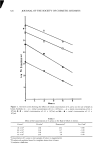
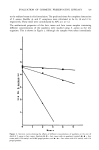
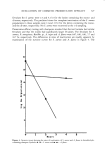
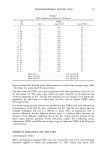
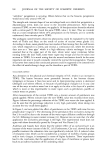
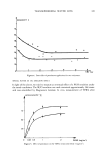
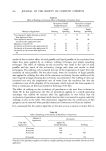
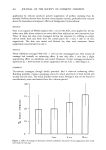
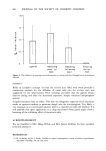
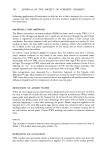
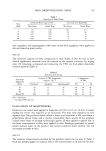
ANTIPERSPIRANT ACTION OF ALUMINUM SALTS 359 simultaneously in all three sites. The degree of anhidrosis was assessed 24 hr after the last exposure and again 7 days and 14 days later. Applications by iontophoresis , Since metallic salts are electrolytes, it is reasonable to suppose that under a positive electrical force, the cation would be efficiently propelled into the ducts. Aqueous solutions of aluminum chloride, aluminum hydroxychloride and aluminum sulfate at concentrations of 0.1%, 1.0%, 5.0%, 10.0% and 20.0% were applied iontophoretically to the volar forearms of three subjects with a current density of 0.3 mA/cm 2 for 5 min. A disc of filter paper, 15cm in diameter (Whatman #3, Whatman Ltd., England) was saturated with the test solution and placed beneath the anode. The indifferent electrode was grasped by the palm which contained a wet gauze pad. In another four subjects, 5% and 20% aluminum chloride, respectively, was iontophoretically applied for 15 rain to the same site on two consecutive days. To prevent epidermal damage, a current density of only 0.15 mA/cm 2 was used. Iontophoresis with physiological saline and patches of 5% and 20% aluminum chloride without current served as controls. As always sweat suppression was determined 24 hr after the last exposure. RESULTS Effect of Occlusion Occlusion of sites treated with 20% aluminum chloride greatly enhanced the anhidrotic effect, averaging about 77.5% (S.D. _+ 20%). This compares to a 37.5% suppression (S.D. + 18%) with the perforated cup. The difference is highly significant (p 0.01). Sweat inhibition in the chamber exposure averaged 72.5% (S.D. _+ 25%) comparable to Saran Wrap. © Short- term exposure With repeated short-term occlusive exposures, sweat inhibition increased with each treatment, becoming complete after twice-daily applications for four days (eight 15omin exposures). Repeated open applications were less effective, about 65% within three days. However, continued applications for another four days did not enhance the anhidrosis beyond this level. Figure 1 summarizes data on the degree and duration of the anhidrosis established by different occlusive schedules. A 24-hr application induced a solid anhidrosis (97.5%). Repeated 15-rain applications as well as one 3-hr exposure produced about a 77.5% sweat suppression. However, the durations were different. Fifteen-minute applications recovered at a strikingly faster rate, the antiperspirant effect having worn off almost completely by two weeks. After seven days the 24-hr exposure showed a higher degree of sweat suppression than 3 hr (about 75%). By 14 days the residual anhidrosis was about 30% and the difference had disappeared. Iontophoresis Surprisingly, iontophoretic application for 5 min did not result in sweat suppression. Two 15-rain low-current iontophoretic applications induced a somewhat greater degree of anhidrosis than the control sites (Table I). Saline iontophoresis caused no sweat suppression.

360 JOURNAL OF THE SOCIETY OF COSMETIC CHEMISTS lOO 75 50 25 24 h 7d 14d Figure 1. Degree of anhidrosis and duration after: occlusion for 24 hr ( [] ) occlusion for 3 hr ( [] ), and 15 min occlusive exposures twice daily for three days ( [] ). Table I 15-Minute Exposures with and without Iontophoresis Once Daily for Two Days Subject # Iontophoresis Patch (0.15 mA/cm 2) • Sweat Inhibition AIC!3: 5• 20• 5• 20• 25.0 37.5 0.0 25.0 12.0 25.0 0.0 12.5 0.0 50.0 0.0 12.5 --- 37.5 --- 12.5 Hean: 12.5 37.5 0.0 15.6
Purchased for the exclusive use of nofirst nolast (unknown)
From: SCC Media Library & Resource Center (library.scconline.org)