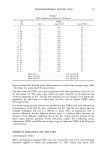
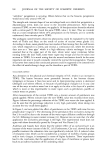
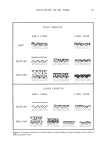
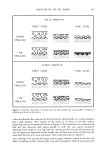
346 JOURNAL OF THE SOCIETY OF COSMETIC CHEMISTS were applied to the skin directly in their neat form and also in the form of their chloroform solution or emulsion. Various emulsions were examined by changing the types of emulsion and particle size distributions. The occlusivity was then examined with these different types of oil samples. The present paper discusses the desirable state of oil films and suitable physical forms of oils for the application from the standpoint of skin care. EXPERIMENTAL MATERIALS Solid paraffin with a melting point of 48øC, petrolatum, and liquid paraffin obtained from Wako Pure Chemical Industries, Ltd., were used as oil ingredients they were of pure grade. Various forms of samples including neat, solution, and emulsion of these oils were prepared. Liquid paraffin with or without 5% of polyoxyethylene stearyl ether was used as neat samples. Solid paraffin with or without 5% of polyoxyethylene stearyl ether was ground into a powder form and employed as neat samples of solid paraffin. The solutions of these oils were prepared by dissolving them in chloroform of extra-pure grade. Oil-in-water emulsions of liquid paraffin and solid paraffin were prepared and stabilized with 5% of polyoxyethylene stearyl ether. O/W type emulsions of these oils having a different particle size distribution were also prepared using a different ratio of emulsifier mixtures of polyoxytehylene (20) sorbitan monooleate and sorbitan monooleate. Using 5% of sorbitan sesqui-oleate, a w/o type emulsion of liquid paraffin was prepared and used. All of the emulsifiers used were commercial materials of Kao Atlas Co. A Coulter Counter (Model TA-II, Coulter Electronics Inc.) was used to determine the particle size distribution of o/w type emulsions and their mean droplet diameter was calculated. The subjects used for this experiment were 32 healthy human males and females ranging in age between 18 and 31. PROCEDURE Measurement of TE Samples containing 4.5 to 5.4 mg of oil ingredient to be examined were applied with a microsyringe to a 1.5 cm x 1.5 cm area of the inner surface of the forearm in each subject. Each sample was spread to form its film with the microsyringe in a certain manner without rubbing. TEWL of the treated skin of the individual subiects was measured intermittently for 2 hr after the application of the samples using an electronic hygrometer, Evaporimeter EP-I (Servo Med in Sweden) equipped with a sensor having a diameter of 10 ram, at 21 to 23øC and 35 to 48%RH. TEWL of untreated skin adiacent to the treated skin was also measured as control at the same time. In order to discuss the occlusivity in relation with the individual skin conditions, the skin surface temperature and casual lipid level were also determined on the forearm in each subject using a usual method (9). Observation of Oil Film The residual state of oils on the skin surface was observed with time using a stereomicroscope (Wild, M-8) after the application of the samples. An additional

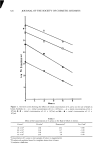
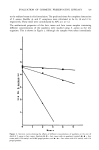
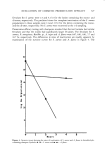
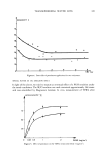
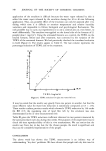
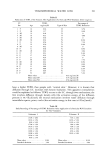
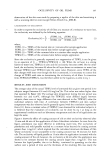
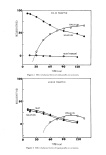
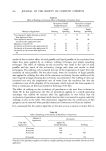
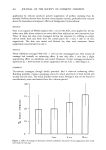
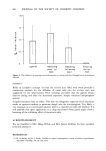
OCCLUSIVITY OF OIL FILMS 347 observation of the skin was made by preparing a replica of the skin and examining it with a scanning electron microscope (Nihon Denshi Co., JSM-II). CALCULATION OF OCCLUSIVITY: In order to express the occlusivity of oil films as a measure of a resistance to water loss, the occlusivity was defined by the following equation. Occlusivity (%) = [1 -- (TEWL (1)/ (TEWL (C)/] •,TEWL (2)/x [TEWL (3)/1 x 100 (1) where TEWL (1) = TEWL of the treated skin at t minutes after sample application TEWL (2) = TEWL of the treated skin before sample application TEWL (3) = TEWL of the untreated skin at t minutes after sample application TEWL (C) = TEWL of the untreated skin before sample application Since the occlusivity is generally expressed as a suppression of TEWL, it can be given by an equation of [1 - TEWL(1)/TEWL(2)] x 100. When the oil layer is a strong barrier to water loss, TEWL(1) is zero and the occlusivity becomes 100%. On the other hand, the occlusivity becomes 0% when the oil layer shows no resistance to water loss because TEWL(1) and TEWL(2) take the same value. However, since TEWL of the skin changes with time even though the skin is untreated, it is necessary to correct this change of TEWL with time in determining the occlusivity of oil films. A correction term, TEWL(C)/TEWL(3), was therefore added to the equation, as seen in eq. 1. RESULTS AND DISCUSSION The average value of the casual TEWL level of untreated skin at given test period in 32 subjects ranged between 0.51 and 0.59 mg/cm2/hr. This value was rather higher than that reported by Baker (10). The average skin temperature during the test period was between 31.1 and 32.8øC. Although the TEWL(C) value differed largely between subjects, there was no large difference that was observed in the TEWL(C) value for individual subjects with time. A correlation between TEWL(C) and skin surface temperature was also observed and it generally agreed with the correlation reported by Grice (11). Since a constant value of TEWL(C) was observed for individual subjects, it is believed that the evaluation of occlusivity can be done by eq 1 as long as the experimental conditions such as laboratory temperature and site of oil application are kept the same. Figure 1 shows the effect of coating amount of oils on their occlusivity observed after 15 min and 60 min of the application of their chloroform solutions. As seen from the figure, petrolatum was most effective in inhibiting water loss. The occlusivity of petrolatum and solid paraffin reached to a constant value beyond the coating amount greater than 3 mg/cm 2, which implied that the calculated minimum thickness of film whose occlusivity is not susceptible to the coating amount was 30 microns for both oils. The occlusivity of liquid paraffin at 15 min after the application increased with the coating amount of the oil however, the occlusivity at 60 min after the application was shown to be constant beyond the coating amount larger than 2 mg/cm 2. This was because the liquid paraffin, due to its fluidity, continued its spreading on the skin surface over a period of time and the thickness of the resulting film was nearly the
Purchased for the exclusive use of nofirst nolast (unknown)
From: SCC Media Library & Resource Center (library.scconline.org)