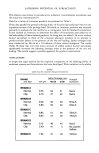
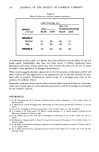
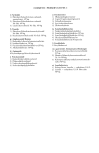
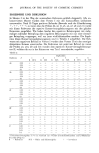
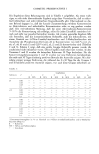
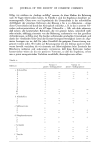
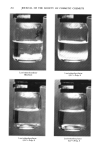
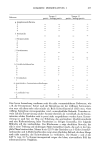
LATHERING POTENTIAL OF SURFACTANTS 235 This dilution was chosen to provide active surfactant concentrations somewhere near the actual use concentration (3). Data for a variety of consumer products are presented in Table I. These data parallel the general lathering ability of the principal surfactant listed on the ingredient section of the package label. Our work on consumer products was intended primarily to evaluate the test method as a comparative tool for finished formulations. It also enabled us, however, to determine the effect of formulation post-additives on the latherability of these finished products. In doing this, we added 1.5% active sodium lauroyl sarcosinate to three of the consumer shampoo products in an attempt to produce thicker lathers in the presence of the oily soil loading. Lather drainage trials were conducted on 200 ml of a 1:10 dilution of these treated shampoos. The results (Table II) show that even this minor amount of added sodium lauroyl sarcosinate significantly increased the lathering drainage times in the presence of the oily soil loading. This would suggest a possible approach for product improvement. CONCLUSION A simple and rapid method for the empirical comparison of the lathering ability of surfactant systems and formulations has been developed. Wide variations in the ability Table 1 Lather data for consumer shampoo formulations. BRAND Lather Drainage, sec.-- Principal and Type 10% pH No Oil w/Oil Surfactant BRAND A Normal 6.55 53 51 NaLS Oily 6.70 47 52 NaLS BRAND B Normal 6.20 50 49 NH,•LS Oily 6.60 50 40 NH,•LS BRAND C Normal 6.85 51 24 TEALS Oily 6.65 47 22 TEALS BRAND D Normal 6.15 46 45 NaLS Oily 5.40 41 5 Na Laureth Sulfate BRAND E 7.65 47 25 TEALS

236 JOURNAL OF THE SOCIETY OF COSMETIC CHEMISTS Table II Effect of additive on consumer shampoo formulations. Lather Drainage, sec. With 1.5% "as is" Na lauroyl sarcosinate BRAND and Type No Oil w/Oil No Oil w/Oil BRAND C Normal 51 24 52 51 Oily 47 22 53 51 BRAND E 47 22 50 50 of surfactants to form close, rich lathers have been observed and the affect of oily soil loads noted. Latherability data have not been found to follow traditional foam generation and decay results which may have formed the basis for the use of many so-called "foam-additives" in shampoo formulations. These results suggest alternate approaches to the formulation of. shampoos which will lather well on the first application or are targeted for use on oily hair. Indeed, we have been able to produce formulations which exced 70 s drainage time even in the presence of synthetic sebum. Hopefully, methods of this nature which examine lather instead of foam at concentra- tions more closely akin to actual shampooing practice will be developed and adopted by the cosmetic industry. REFERENCES (1) H. W. Zussman and W.J. Lennon, Acylated amino acids in shampoos, J. Soc. Cosmet. ½hem., 6, 407-415 (1955). (2) L. Moldovanyi and W. Hungerbuhler, Sarkosinate als kosmetische grundstoffe, Kosmetica, 3, 135-142 (1975). (3) G. E. Neu, Techniques of foam measurement, J. Soc. Cosmet. ½hem., 11,390-414 (1960). (4) J. j. Parran, E. W. Lang and D. D. Whyte, Cream shampoo, U.S. Patent number 2,979,465 to the Procter & Gamble Co., April 11, 1961. (5) D. H. Powers and C. Fox., The role of detergents in shampoos, J. Soc. Cosmet. Chem., 10, 116-122 (1959). (6) M. Sorkin, G. Shapiro and G. S. Kass, The practical evaluation of shampoos, J. Soc. Cosmet. Chem., 17, 539-551 (1966). (7) A. W. Reng, Formulation of shampoo preparations with special properties, Cosmet. & Toiletties, 93 (8), 21-32 (August 1978). (8) D. A. Shaw, The extraction, quantification and nature of hair lipid, Int. J. Cosmet. Sci., 1 (5), 2•1-302 (October 1979).
Purchased for the exclusive use of nofirst nolast (unknown)
From: SCC Media Library & Resource Center (library.scconline.org)