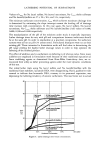
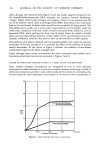
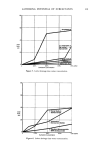
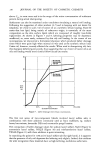
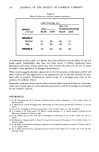
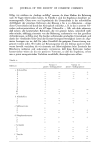
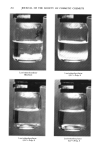
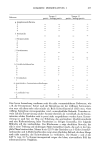
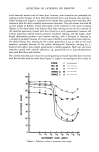
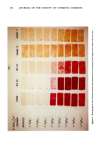
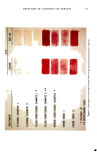
236 JOURNAL OF THE SOCIETY OF COSMETIC CHEMISTS Table II Effect of additive on consumer shampoo formulations. Lather Drainage, sec. With 1.5% "as is" Na lauroyl sarcosinate BRAND and Type No Oil w/Oil No Oil w/Oil BRAND C Normal 51 24 52 51 Oily 47 22 53 51 BRAND E 47 22 50 50 of surfactants to form close, rich lathers have been observed and the affect of oily soil loads noted. Latherability data have not been found to follow traditional foam generation and decay results which may have formed the basis for the use of many so-called "foam-additives" in shampoo formulations. These results suggest alternate approaches to the formulation of. shampoos which will lather well on the first application or are targeted for use on oily hair. Indeed, we have been able to produce formulations which exced 70 s drainage time even in the presence of synthetic sebum. Hopefully, methods of this nature which examine lather instead of foam at concentra- tions more closely akin to actual shampooing practice will be developed and adopted by the cosmetic industry. REFERENCES (1) H. W. Zussman and W.J. Lennon, Acylated amino acids in shampoos, J. Soc. Cosmet. ½hem., 6, 407-415 (1955). (2) L. Moldovanyi and W. Hungerbuhler, Sarkosinate als kosmetische grundstoffe, Kosmetica, 3, 135-142 (1975). (3) G. E. Neu, Techniques of foam measurement, J. Soc. Cosmet. ½hem., 11,390-414 (1960). (4) J. j. Parran, E. W. Lang and D. D. Whyte, Cream shampoo, U.S. Patent number 2,979,465 to the Procter & Gamble Co., April 11, 1961. (5) D. H. Powers and C. Fox., The role of detergents in shampoos, J. Soc. Cosmet. Chem., 10, 116-122 (1959). (6) M. Sorkin, G. Shapiro and G. S. Kass, The practical evaluation of shampoos, J. Soc. Cosmet. Chem., 17, 539-551 (1966). (7) A. W. Reng, Formulation of shampoo preparations with special properties, Cosmet. & Toiletties, 93 (8), 21-32 (August 1978). (8) D. A. Shaw, The extraction, quantification and nature of hair lipid, Int. J. Cosmet. Sci., 1 (5), 2•1-302 (October 1979).

j. Soc. Cosmet. Chem., 31,237-252 (September/October 1980) Analysis of nitrosamines in cosmetic raw materials and finished product by high pressure liquid chromatography IRA E. ROSENBERG, JOHN GROSS, and TONY SPEARS, Clairol Incorporated, 2 Blachley Road, Stamford, CT 06902, and PETER RAHN, IVaters Associates, Milford, MA 01757. Received March 31, 1980. Synopsis The analysis of N-nitrosodiethanolamine (NDE1A) in di- and triethanolamine and selected alkanolamides of diethanolamine using both normal and reverse phase high pressure liquid chromatography is described. The possibility of extending the method to cosmetic finished products is demonstrated. Accuracy and precision of the methods, along with limits of detection, approach those achieved by a thermal energy analyzer. The use of a radial compression separation system for achieving increased baseline resolution is discussed. INTRODUCTION From the beginning of the early 1950's, nitrosamines have gained considerable scientific attention and, to date, a majority of those tested have been shown to cause cancer in laboratory test animals (1-4). In most areas where nitrosamines have been found, both the amine and nitrosating source were known. For example, nitrite, a preservative for the prevention of bbtulism when used in cured meat products, gave rise to low levels of nitrosamines. In the metal industry, sodium nitrite and di- and tri-ethanolamine are present in commercially available cutting fluids. The findings of Fan and co-workers that these formulations contained N-nitrosodiethanolamine (NDEIA) was a surprise only because the nitrosamines formed in a product with a basic pH (5). The scope of nitrosamine formation has been further enhanced by the finding that formaldehyde can catalyze the formation of NDEIA above pH 7 (6). These findings clearly indicated that nitrosation could occur in acidic, neutral, or basic media. In 1977, Fan and Fine presented data showing the presence of trace amounts of NDEIA in some cosmetics, creams, and lotions (7). These findings were significant for several reasons. First, although amines and their derivatives are important formula ingredients for the cosmetic chemist, nitrite or nitrosating agents are rarely used in cosmetics. Second, when preservatives which can liberate nitrite such as 2-bromo- 2-nitro-l,3-propanediol (Bronopol) were present, the cosmetic products contained high 237
Purchased for the exclusive use of nofirst nolast (unknown)
From: SCC Media Library & Resource Center (library.scconline.org)