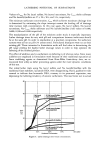
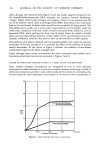
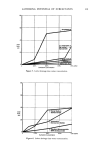
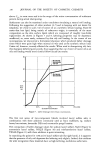
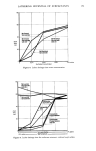
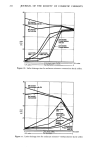
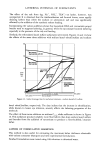
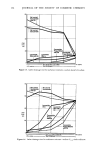
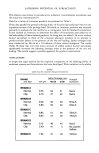
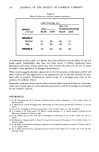
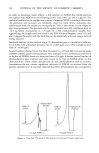
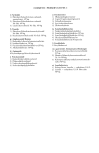
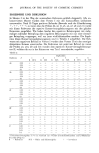
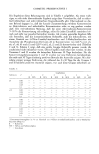
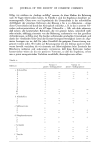
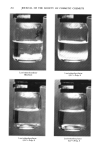
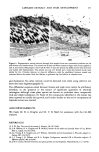
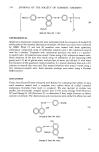
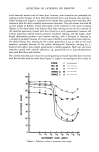
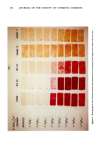
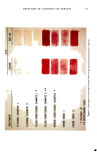
278 JOURNAL OF THE SOCIETY OF COSMETIC CHEMISTS n-octyl treated swatches suggests that less cationic is on the wool, to react with dye. This is consistent with sorption studies (11), which show that short chain cationics have a lower affinity for keratin than larger cationics. This experiment suggests that Red 80 is a better replacement for Rubine, and in fact may even be superior because of its low staining on control swatches. Our final test consisted of comparing Red 80 to Rubine on wool swatches treated with several current hair products, most containing cationic conditioning agents. Figure 3 depicts the results of this experiment. Cleaning shampoos I and II are based on TEA-lauryl sulfate and ammonium lauryl sulfate respectively and neither product contains a cationic surfactant or polymer. As expected, neither of these products shows significant staining with either Red 80 or Rubine dye. On the other hand, creme rinses I and II are both based on stearalkonium chloride, and both of these products produce the expected staining reaction. Similarly, clear conditioning shampoo II contains an amine oxide and opaque conditioning shampoo contains quaternium-19, and both produce staining with either Red 80 or with Rubine. The apparent anomaly is clear conditioning shampoo I. This product contains both amine oxide and quater- nium-19 and does not show significant staining. This shampoo also contains ammonium lauryl sulfate as the primary surfactant, as opposed to the other two shampoos which produce swatch staining. Opaque conditioning shampoo is an amphoteric based system, and conditioning shampoo II is an amphoteric-nonionic based system. Apparently, these latter two shampoo systems permit deposition of cationic surfactant or polymer onto the keratin, as opposed to the anionic based shampoo which must inhibit deposition of cationic as evidenced by the lack of staining. Nevertheless, the same conclusions are permitted by use of either Red 80 or Rubine dye. CONCLUSION Since Red 80 has similar staining characteristics to Rubine with fully formulated products or with individual cationic components, we recommend it as a replacement for Rubine dye for detecting cationic conditioning agents on keratin substrates. REFERENCES (1) Direct Fast Rubine WS, C.I. No. 35790. no longer available. (2) G. V. Scott, C. R. Robbins, and J. D. Barnhurst, Sorption of Quaternary Ammonium Surfactants by Human Hair,J. Soc. Cosmet. Chem., 20, 135-152 (1969). (3) Colour Index, 3rd Edition, Volume 4, The Society of Dyers and Colorists (1971). (4) Sirius Red F3BA New, C.I. No. 35780, Verona Dyestuffs, Union, NJ Used although equivalent products are offered by Sandoz Colors & Chemicals, E. Hanover, NJ and by American Color & Chemical Corp. Charlotte, NC. (5) Atlantic Resin Fast Brown 3RL, C.I. No. 35760. Atlantic Chemical Corp., Nutley, NJ. (6) Purchased from Eastman Organic Chemicals, Rochester, NY. (7) Purchased from Test Fabric Inc. of Middlesex, NJ. (8) Purchased from De Meo Bros., 135 Fifth Ave., New York, NY. (9) Orange II, C.I. No. 15510. Eastman Kodak Co., Rochester, NY. (10) Orange G, C.I. No. 16230. Eastman Kodak Co., Rochester, NY. (11) J. Steinhardt and E. Zaiser, Combination of Wool Protein with Hydroxyl IonsJ. Biol. Chem., 183, 780-802 (1950).

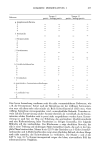
Book Review HANDBOOK OF WATER-SOLUBLE GUMS AND RESINS, Edited by Robert L. Davidson McGraw-Hill Book Compa- ny, New York, 1980, XIV + 657 pages. Price: $39.50. This book is, in some respects, a successor to the 1962 classic "Water Solu- ble Resins" edited by R. L. Davidson and M. Sittig. And a worthy successor it is! In addition to synthetic polymers, cellulose ethers and modified starches, it deals also with many natural gums (from alginates to xanthan) on more than tripled number of pages (with smaller print). It is a large volume packed with wealth of informa- tion, and though one could find more detailed publications on specific poly- mers, as a whole the book should prove an invaluable compendium. From the enclosed biographies of the 33 contributors it is apparent that each is an accomplished expert in the area which he authored. Following a short introduc- tion there are twenty three chapters on individual water-soluble polymers (prod- ucts of animal origin are excluded). As it can be expected, the style and the format of presentation vary somewhat, as does also the extent of material coverage, rang- ing from 8-16 pages on some natural gums to 84 pages on starch. A general pattern is followed of providing ency- clopedic description of chemical struc- ture and properties, then manufacturing, physical properties (with particularly strong emphasis on solubility and rheo- logical characteristics), toxicology, and applications. A very broad range of uses, from adhesives to water treatment, is covered, both industrial and commercial applications are included with general examples, as well as specific formulations and recipes. Food, pharmaceuticals, cos- metics/toiletries (referenced in all but five chapters), inks, paper products and textiles are the main areas discussed, but others such as petroleum recovery, agri- cultural and building products are not neglected. Some very recent develop- ments (e.g., starch graft copolymer-- super slurper) are included. Most chapters end with an appropriate list of references, in some of them most of the quoted literature is from the 50's and 60's, but in others, recent references, up to 1978 or even 1979 are cited. The main illustrative material for each chapter is usually given for the products made by the author's company (a major manufacturer), others are mentioned in lists of tradenames that almost all chap- ters have. Still a few curious omissions occur, e.g., in the tradename glossary for the chapter on polyacrylic acid and its 279
Purchased for the exclusive use of nofirst nolast (unknown)
From: SCC Media Library & Resource Center (library.scconline.org)