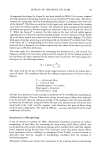
244 JOURNAL OF THE SOCIETY OF COSMETIC CHEMISTS Mercury Drop Electrode. A three electrode system was employed, including a Pt counter electrode and saturated calomel or silver/silver chloride reference electrode. The chromatograph used was a Waters Associates ALC/GPC 244 Liquid Chromato- graph equipped with a Model U6K injector and Model 440 UV detector operated at 254 nm. A Waters Associates/a-Bondapak C•8 reverse phase column, 30 cm x 3.9 mm i.d., or a PARTISIL©SAX anion exchange column, 25 cm x 4.6 mm i.d., were used for all separations. REAGENTS The sodium salt of 2-pyridinethiol-l-oxide, 2-pyridinethiol, 2,2'-dithiobis-pyridine, 2-pyridinesulfonic acid, 2-pyridinesulfonic acid-l-oxide and 2,2'-dithiobis-pyridine- 1,1'-dioxide were prepared and purified by the Biocides Group, Chemicals Division, Olin Corporation. 2-Pyridinesulfinic acid 1-oxide, previously unreported, was synthe- sized specifically for this study and is described elsewhere in this paper. Acetonitrile (UV) was obtained from Burdick & Jackson Laboratories and the tetrabutylammonium hydroxide, 40% aqueous, from Aldrich Chemicals. The pH of the test solutions was maintained with 0.02M buffers prepared in distilled deionized water from potassium biphthalate and hydrochloric acid (pH 4.1) potassium dihydrogen phosphate and sodium hydroxide (pH 7.1) sodium tetraborate and sodium hydroxide (pH 10.0). A 0.2M phosphate buffer at pH 6.9 and 0.2M borate buffers at pH 8.1 and 9.1 were also used. All reagents were analytical reagent grade. PROCEDURES Solutions containing approximately 100 ppm and 500 ppm of NaPT were prepared by transferring appropriate aliquots of intermediate strength stock solutions into 500 ml volumetric flasks and raising to volume with buffer. After thorough mixing, these solutions were transferred to 16 oz. amber bottles. Solutions were stored in the dark at 5øC and at 40øC. The possibility of unwanted photolytic reactions was thus minimized. NaPT solutions were prepared either from a 40% aqueous production sample or from the analytical standard grade. Aliquots were taken for analysis at the time of preparation and at several intervals during the study. Duplicate analyses were performed at each sampling interval. The concentration of NaPT was determined by sampled d.c. polarography. A 10 ml aliquot of sample solution was transferred to the polarographic cell and deoxygenated for 5 minutes. The polarogram was then obtained from + 0.1V to -0.4V vs. a saturated calomel electrode (SCE). An anodic wave with E¾2 = --0.24V rs. SCE was observed. Aliquots of a standard solution were then added to the cell and corresponding polarograms recorded. Wave heights for all polarograms were measured using a previously recorded buffer blank polarogram as the point of origin. The sample concentration was determined from the resulting standard calibration plot. The two maj or reaction products, 2,2'-dithiobis-pyridine-l,l'-dioxide (disulfide), and 2-pyridine- sulfinic acid-l-oxide (sulfinic acid), were determined chromatographically. Injections of 10/zL were used and quantitation was accomplished by external standard calibration plots of peak heights rs. concentration. The disulfide was determined on a/z-Bondapak C•8 column, 30 cmx 3.9 mm i.d. The mobile phase was 15:85 acetonitrile/water,

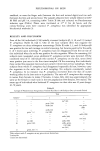
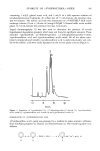
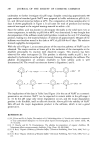
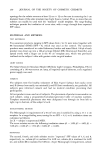
STABILITY OF 2-PYRIDINETHIOL-1-OXIDE 245 containing ! mL/L glacial acetic acid, and 5 mL/L of a 40% aqueous solution of tetrabutylammonium hydroxide. At a flow rate of 1.5 mL/minute the retention time was 4.0 minutes. The sulfinic acid salt was determined on a PARTISIL © SAX anion exchange column (25 cm x 3.6 mm i.d.) using 0.2M pH 7.4 borate buffer as the mobile phase. At 2.0 mL/minute the retention time was 3.0 minutes. Liquid chromatography (1) was also used to determine the presence of several hypothesized degradation products which were not found in significant amounts. These included 2-pyridinethiol 2,2'-dithiobis-pyridine 2,2'-dithiopyridine-pyridine-l-oxide 2-pyridinesulfonic acid, and 2-pyridinesulfonic acid-l-oxide. All of the above men- tioned compounds and notably 2-pyridinesulfonic acid-l-oxide (structurally very sim- ilar to the sulfinic acid) were easily separated on the reverse phase column (Figure 1). 3 4 2 ! i i o 3 6 9 min. Figure l. Separation of 2-pyridinethiol (1), 2,2'-dithiobispyridine-l,l'-dioxide (2), 2-pyridinesulfinic acid-l-oxide (3), 2-pyridinesulfonic acid-l-oxide (4), and 2-pyridinethiol-l-oxide (5). PREPARATION OF 2-PYRIDINESULFINIC ACID 2-Pyridinesulfinic acid-l-oxide was prepared by a method to make aromatic sulfinates from disulfides proposed by Danehy and Parameswaran (2). The overall equation is as follows: •S--S• + 2N.OH + 3H202 -'-- 2 •SO2- Na++ 4H20 (1) i i i o o o
Purchased for the exclusive use of nofirst nolast (unknown)
From: SCC Media Library & Resource Center (library.scconline.org)