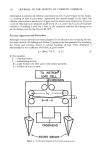
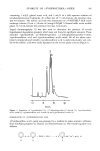
232 JOURNAL OF THE SOCIETY OF COSMETIC CHEMISTS chlorination in solutions of chlorine concentrations of 0, 10, and 50 ppm. In this, 0 ppm, i.e., soaking of tress in pure water, represented the control sample. In the other, the chlorine concentration was fixed at 50 ppm, and the tresses were subjected to 10 and 20 cycles of chlorination in solutions at pH levels of 2, 4, and 8. Each cycle of treatment consisted of soaking a tress for 1 hour in the treatment solution and drying in an air-circulating oven for one hour at 40-50øC. Friction Apparatus and Procedure Although several methods have been proposed in the literature for measuring friction, the twist method of Lindberg and Gralen (5) presents the best potential for simulating the forces and contacts found in normal handling of hair. They developed a relationship for the coefficient of friction,/a, given below. /• = (/37rn)-•(ln T2- In T•) (2) In this equation, T• = entering tension T 2 = withdrawing tension /3 = angle between the fiber axes in the twisted assembly n = number of turns to twist. TO INSTRON LOAD CELL ,ECIMEN L2 i CROSSHEAD KNOWN WEIGHT Figure 2. A schematic diagram of the friction testing device.

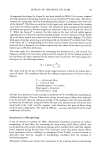
EFFECTS OF CHLORINE ON HAIR 233 An apparatus developed by Gupta (6), and used initially by Wolf (2) on sutures, adapted the twist method of measuring friction for use on the Instron © tensile tester. The device consists of a metal plate with six frictionless pulleys (Figure 2) clamped in the lower jaw of the Instron ©. The fibers are attached to the upper jaw, and twist inserted by crossing each other the desired number of times. The strands are then arranged around pulleys and fitted into grooves. Known weights are attached to fiber ends to give the value of T•. When the Instron © is started, the fiber ends in the load cell are pulled against opposing forces of friction and pretensioning weights. As this continues, tension builds up in the fibers until it overcomes the force of friction and causes slippage. The fibers hold again, then slip, producing a stick-slip profile on the Instron © recorder chart. From it the values of T 2 corresponding to the static and the kinetic frictional forces can be read and used in Equation 2 to obtain, respectively, the values of the static (its) and the kinetic (ttk) coefficients of friction. The twist angle /• is determined by measuring the horizontal (L 0 and vertical (L2) distances between the four lower pulleys and the length, D, of the twisted section of the hair fibers, the latter measured to the nearest mm on each test. The twist angle,/•, is then given by the following relation: L2 /• = 2 arctan- (3) L• -- D The value of/• for all sets of fibers tested ranged between 0.199-0.215 radians (for 2 turns of twist). The conditions selected for making measurements of friction were as follows: T• = 3 gf on each fiber n = 2 turns of twist Crosshead speed = 0.5 in/min. Chart speed = 10 in/min. Full scale load = 20 gf. All tests were performed under standard conditions (70 ø F, 65% RH) after equilibration of fibers for at least 24 hours. Values of tts and ]'•k for each pair of fibers were obtained from the Instron © charts by taking an average of 20 readings at 0.02 inch intervals after an initial run of 0.08 inch. Using new fibers for each test, measurements of friction were made both in the "with" and the "against" scale directions, five pairs of fibers being used for each configuration. The value of DFE (tq -- ttw) was calculated from the static coefficients of friction. Examination of Morphology It was of interest to examine the effect chlorination treatments produced on surface morphology of hair fibers. By examining the areas along which fibers rubbed, one could determine the extent of physical damage which resulted from small but realistic forces imposed during friction tests. This could give some idea about similar effects from operations such as combing or untangling of hair. Finally, it was of interest to determine how well the changes in morphology correlated with the changes in frictional properties. Three pairs of fibers were chosen for examination in the scanning electron microscope
Purchased for the exclusive use of nofirst nolast (unknown)
From: SCC Media Library & Resource Center (library.scconline.org)