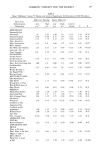
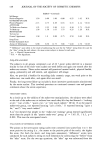
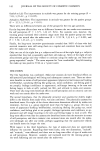
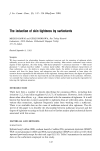
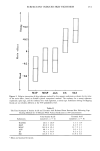
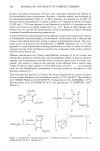
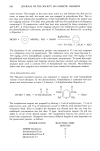
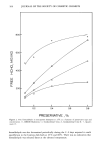
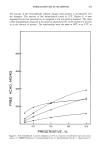
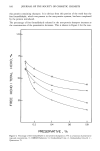
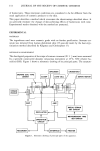
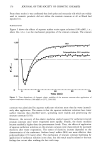
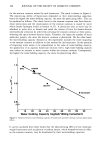
158 JOURNAL OF THE SOCIETY OF COSMETIC CHEMISTS bination of analytical techniques, he drew some conclusions regarding the stability of five formaldehyde donor preservatives. Recently, a bisulfite method was developed by the Bundesgesundheitsant (B.G.A.) in West Germany and adopted by the EEC for determining free formaldehyde in cosmetic products (4). Aqueous solutions of formalin (1.03% and 1.77%) were analyzed in our laboratory by the B.G.A. procedure and the results were found to be biased negatively by 23-37%. Based on these findings, this method was not used for the determination of free formaldehyde in anionic shampoos containing formaldehyde-releasing preservatives. A simple method for determining free formaldehyde in water is the quantitative reaction of formaldehyde with hydroxylamine hydrochloride. Hydrochloric acid is liberated and titrated with sodium hydroxide, giving a measure of formaldehyde present. This tech- nique is used to determine free formaldehyde in DMDM Hydantoin, per se. It is also applicable to other formaldehyde-releasing preservatives in water. It cannot be used in shampoos because of the interferences caused by the components of the cosmetic product with the hydrochloride salt. Feldman demonstrated the Conway microdiffusion technique to be an accurate and reproducible method for determining "free formaldehyde present in aqueous solutions together with formaldehyde reversibly bound to proteins, amino acids, and other com- pounds. The method is based on the principle of gas diffusion from a relative large volume of solution under analysis to a very small volume of water ..... and continued until the free formaldehyde concentration of the test solution is the same as in the absorbent solution (5)." This technique was applied to a study of four donor preservatives at various concentra- tions in anionic shampoos, with and without protein, at 23øC and 60øC. These products were DMDM Hydantoin [GLYDANT©], Imidazolidinyl Urea [GERMALL 115©], Imidazolidinyl Urea II [GERMALL II©], and Quaternium 15 [DOWICIL 200 ©] (Figure 1). CH2OH I H :•C•...'"N• ¸ A. H2OH CH 2 NH-C-NH // N 0 \ CH•OH -- B, 0 CH2OH II I HOCH2NH-- C --N CH20H I 0 N N /CH 2 CH=CHCI CI- 0 \ CH20H C. D. Figure 1. Formaldehyde releasing preservatives. A. DMDM Hydantoin B. Imidazolidinyl Urea C. Imidazolidinyl Urea II D. Quaternium 15.

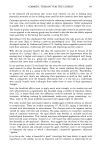
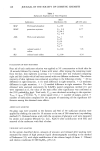
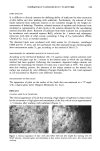
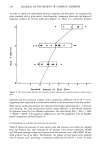
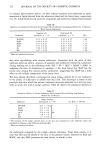
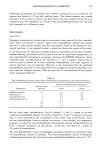
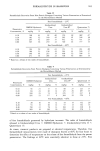
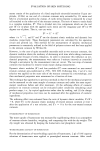
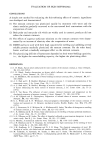
FORMALDEHYDE IN SHAMPOOS 159 EXPERIMENTAL APPARATUS A Perkin-Elmer Model 595 UV/visible spectrophotometer was used for all absorbance measurements the cell pathlength was 1 cm. The polypropylene Conway microdiffusion dishes utilized (Fisher Scientific Catalog No. 08-764-15) have a center trapping solution ring and two annular moats (outer diameter: 59 mm). CHEMICALS DMDM Hydantoin, Imidazolidinyl Urea, Imidazolidinyl Urea II, and Quaternium 15 were used as received. All other chemicals including formalin were reagent grade and were used without further purification. Formalin, per se, was not analyzed prior to its use. However, aqueous solutions of formalin at concentrations of 0.1-0.8% containing formaldehyde were assayed for free and total formaldehyde. Recoveries of 100% were obtained in both cases, indicating the concentration of reagent grade formalin to be correct. Distilled water was passed through a NANOpure © (Barnstead Co.) purification system before use. SHAMPOO PREPARATION Master batches of unpreserved protein and non-protein shampoos were formulated at room temperature according to the compositions given in Table I. Preservatives were added at levels of 0.10, 0.20, 0.40, and 0.80%. Table I Compositions of Anionic Shampoos Used for Formaldehyde Assays Weight Percent Component Protein Non-Protein Water 59.30 61.80 TEA Lauryl Sulfate 25.00 25.00 Cocoamphocarboxyglycinate 5.00 5.00 Lauramide DEA 5.00 5.00 PEG-50 Lanolin 3.00 3.00 Phosphoric Acid, 85% 0.20 0.20 Hydrolyzed Animal Protein 2.50 - Preservative Q.S. Q.s. SAMPLE TREATMENT A portion of each shampoo was analyzed immediately at 23øC. Another aliquot was kept at 60 --- IøC for four hours in a water bath and then permitted to cool to 23øC by itself. FREE FORMALDEHYDE ASSAY Four microdiffusion dishes were prepared for each sample by placing approximately 4 g of shampoo in each moat and 200 I•l of distilled water (trapping solution) in the
Purchased for the exclusive use of nofirst nolast (unknown)
From: SCC Media Library & Resource Center (library.scconline.org)