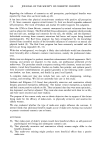
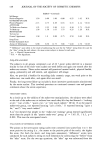
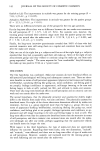
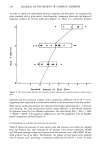
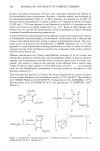
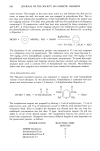
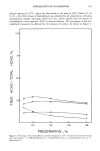
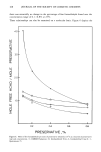
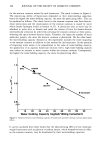
168 JOURNAL OF THE SOCIETY OF COSMETIC CHEMISTS there was essentially no change in the percentage of free formaldehyde found over the concentration range of 0.1-0.8% at 23øC. These relationships can also be examined on a molecular basis. Figure 6 depicts the Lfl 4.0 3.0 2.0 1.O I I I I 0.2 0.4 0.6 0.8 PRE S ERVAT IVE , ø/o Figure 6. Moles of free formaldehyde per mole of preservative released at 23øC as a function of preservative type and concentration. O, DMDM Hydantoin [•, Imidazolidinyl Urea •, Imidazolidinyl Urea II +, Quaternium 15.

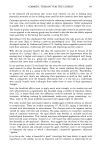
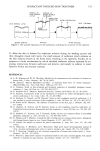
FORMALDEHYDE IN SHAMPOOS 169 moles of free formaldehyde released per mole of preservative at 23øC as a function of preservative concentration and type in the shampoo. DMDM Hydantoin and Imid- azolidinyl Urea each contain two methylol groups while Imidazolidinyl Urea II has four. The molar percentage of free formaldehyde found for these three materials is about the same over the concentration range studied. An average of 1.3 moles of free formaldehyde per mole of preservative was found at 0.1%. This represents 65% of the formaldehyde in DMDM Hydantoin and Imidazolidinyl Urea, but only 33% for Imidazolidinyl Urea II. The fact that only 33% of the bound formaldehyde present in Imidazolidinyl Urea II was found as free formaldehyde is based on the observation that only two of the four methylol groups are formaldehyde donors under the conditions of the Hantzsch reaction employed. The relationship of free molecular formaldehyde versus concentration for Quaternium 15 is analogous to DMDM Hydantoin and Imidazolidinyl Urea, even though Quater- nium 15 has six bound formaldehyde moities. At 0.1% concentration, four of the six formaldehyde moities are released, which is 66% of the total available. CONCLUSIONS The microdiffusion technique has been shown to be a reliable method for determining free formaldehyde in anionic shampoos containing formaldehyde-derived preservatives. The order of formaldehyde release is the same at 23øC and 60øC for the four preservatives studied: Imidazolidinyl Urea DMDM Hydantoin Imidazolidinyl Urea II Qua- ternium 15. The amount of free formaldehyde found in the presence of protein is reduced substantially, indicating a complexation between the protein and formalde- hyde. ACKNOWLEDGEMENT The authors wish to thank T. A. Girard, Vice President, Glyco Inc., for his assistance and guidance in this study. REFERENCES (1) C. H. Wilson, Fluorometric determination of formaldehyde in cosmetic products, J. Soc. Cosmet. Chem., 25, 67-71 (February 1974). (2) E. P. Sheppard and C. H. Wilson, Fluorometric determination of formaldehyde-releasing cosmetic preservatives,J. Soc. Cosmet. Chem., 25, 655-666 (December 1974). (3) D. H. Liem, Analysis of antimicrobial compounds in cosmetics, Cosmetics and Toiletries, 92, 59-72 (March 1977). (4) Identification and determination of free formaldehyde, Official Journal of the European Communities, L 185/18 (June 6, 1982). (5) M. I. Feldman, Determination of free formaldehyde in the presence of its compounds with amino acids and proteins, Biochemistry, 23, 867-872 (1958). (6) M. Tanenbaum and C. E. Bricker, Microdetermination of free formaldehyde, Analytical Chemistry, 23, 354-357 (February 1951).
Purchased for the exclusive use of nofirst nolast (unknown)
From: SCC Media Library & Resource Center (library.scconline.org)