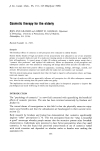
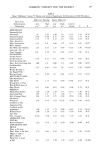
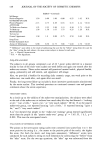
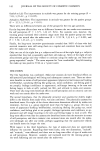
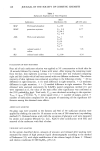
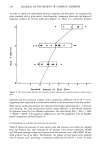
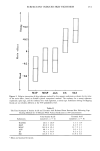
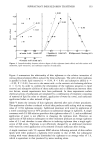
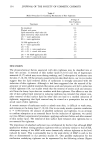
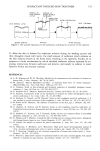
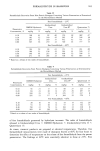
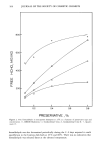
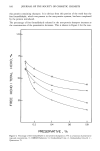
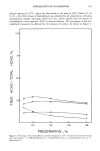
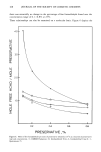
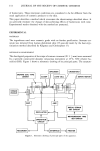
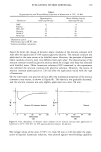
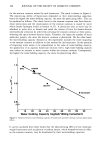
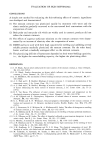
162 JOURNAL OF THE SOCIETY OF COSMETIC CHEMISTS 15.4%, 21.6%, and 71.7% for DMDM Hydantoin, Imidazolidinyl Urea, Imidazoli- dinyl Urea II, and Quaternium 15, respectively. These values were determined applying the lutidine technique to aqueous solutions of the preservatives. Shampoo samples were selected at random and analyzed for total formaldehyde by the lutidine method to verify that the shampoos were prepared correctly. For anionic shampoo samples containing 0.1-0.8% of preservatives, the Hantzsch (lutidine) procedure has a relative precision of _ 7%. The recovery of total formaldehyde was 88-130% (average: 100 _ 8%). Non-protein shampoos containing 0.10-0.80% formalin were used to demonstrate the accuracy of the microdiffusion technique for free formaldehyde (Table III). Recoveries Table III Formaldehyde Recovery From Non-Protein Shampoo Determined by the Microdiffusion Technique Formaldehyde, ppm Temperature, øC Formalin, % Theory Assay Recovery, % 23 0.10 377 360 95.5 23 0.20 754 678 89.9 23 0.40 1508 1553 103.0 23 0.80 3016 2980 98.8 60 0.10 377 360 95.5 60 0.20 754 696 92.3 60 0.40 1508 1501 99.5 60 0.80 3016 2873 95.3 Average 96.2 ranged from 89.9-103% the average recovery was 96.2%. As shown below, protein complexes with formaldehyde. Therefore protein-containing shampoos could not be used to determine recoveries or accuracy of the method. The precision of the micro- diffusion procedure was established by analyzing multiple samples of shampoos con- taining each preservative. The relative precision found was -7% (one standard devia- tion) for formaldehyde concentrations between 50-3000 mg/kg. Reproducibility was also tested by preparing three non-protein shampoos, each con- taining 0.40% of DMDM Hydantoin. The average concentrations of free formaldehyde in these three shampoo preparations, each analyzed four times for free formaldehyde, were 294, 314, and 306 mg/kg. These values agree within the 7% relative precision of the colorimetric procedure, indicating the system to be reproducible from preparation to preparation. RESULTS All data measured are presented in Tables IV and V as free formaldehyde found (mg/ kg) and as percent free formaldehyde. The latter is an expression of the ratio of free formaldehyde determined to the total formaldehyde in the shampoo. The data for free formaldehyde in the non-protein shampoo at 23øC are shown in Figure 2. As the concentration of each preservative is increased in the shampoo, the amount

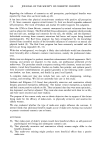
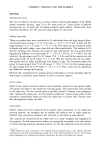
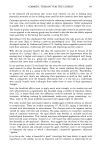
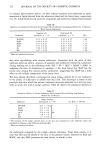
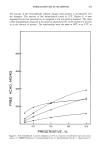
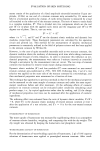
FORMALDEHYDE IN SHAMPOOS 163 Table IV Formaldehyde Recoveries From Non-Protein Shampoos Containing Various Preservatives as Determined by the Microdiffusion Method Free Formaldehyde - 23øC Imidazolidinyl Imidazolidinyl DMDM Hydantoin Urea Urea II* Quaternium 15 Preservative Concentration, % mg/kg % mg/kg % mg/kg % mg/kg % 0.10 108 61 92 60 150 69 482 67 0.20 183 52 140 45 262 61 546 38 0.40 294 42 230 37 452 52 731 25 0.80 505 36 270 22 740 43 777 14 Free Formaldehyde - 60øC 0.10 104 59 94 61 153 71 431 60 0.20 186 53 138 45 264 61 526 37 0.40 306 44 213 35 448 52 596 21 0.80 471 34 285 23 738 43 855 15 * Based on a release of two moles of formaldehyde. Table V Formaldehyde Recoveries From Protein Shampoos Containing Various Preservatives as Determined by the Microdiffusion Method Free Formaldehyde - 23øC Imidazolidinyl Imidazolidinyl DMDM Hydantoin Urea Urea II* Quaternium 15 Preservative Concentration, % mg/kg % mg/kg % mg/kg % mg/kg % 0.10 36 21 17 11 58 27 122 17 0.20 84 24 36 12 125 29 187 13 0.40 160 23 74 12 235 27 237 8 0.80 292 21 117 9 384 22 278 5 Free Formaldehyde -60øC 0.10 28 16 19 12 33 15 142 20 0.20 53 15 36 12 57 13 192 13 0.40 150 21 78 13 183 21 218 8 0.80 269 19 120 10 355 20 278 5 * Based on a release of two moles of formaldehyde. of free formaldehyde generated by hydrolysis increases. The order of formaldehyde released is Imidazolidinyl Urea DMDM Hydantoin Imidazolidinyl Urea II Quaterniurn 15. At times, cosmetic products are prepared at elevated temperatures. Therefore, free formaldehyde measurements were made of shampoos heated at 60øC for four hours to determine the effect of temperature on the release of free formaldehyde from the parent preservative. The findings at 60øC were essentially identical to those at 23øC. Free
Purchased for the exclusive use of nofirst nolast (unknown)
From: SCC Media Library & Resource Center (library.scconline.org)