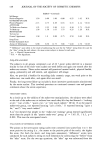
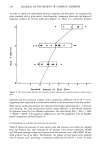
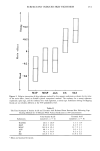
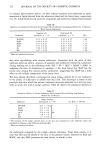
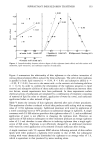
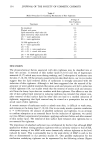
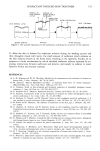
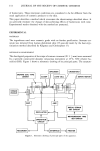
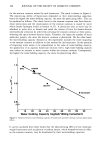
180 JOURNAL OF THE SOCIETY OF COSMETIC CHEMISTS for the stratum corneum treated by each humectant. The result is shown in Figure 9. The plasticizing ability of humectants depended on their water-holding capacities hence the higher the water-holding capacity, the more the plasticizing effect. This can be explained as follows. The elastic forces in the stratum corneum arise from keratin- chain interactions and the plasticization of the stratum corneum is caused by water which breaks hydrogen bonds in keratin (4,15). A plasticizer such as water may be adsorbed at polar sites in keratin and mask the centers of force for keratin-keratin intermolecular attraction by selectively solvating the stratum corneum at these points, widening the space between keratin chains. Therefore, the larger the number of water molecules present, the more the stratum corneum is plasticized. On the other hand, the water-holding capacity obtained in this experiment includes the water migrating to the stratum corneum in addition to that retained by the humectant. As the quantity of migrating water seems to be proportional to the value of water-holding capacity, the application of an aqueous humectant solution with a high water-holding capacity may induce an increase in water content within the stratum corneum. Consequently, the higher the water-holding capacity, the more the plasticizing effect. 1,0- DPG••itol PEG 200 ß Na-PCA • actate I I I I I I I I I 0 10 20 30 40 50 60 70 80 90 Water Holding Capacity (mgH20/100mg humectant) Figure 9. Relation between water-holding capacity of humectants and their stratum corneum plasticizing effects. It can be concluded from these results that the skin-softening effects of low molecular weight humectants such as glycerin or sodium lactate, which themselves have no effect on the stratum corneum, may be determined by their water-holding capacities.

EVALUATION OF SKIN SOFTENING 181 CONCLUSIONS A simple new method For evaluating the skin-soFtening eFFects oF cosmetic ingredients was developed and demonstrated: (1) The stratum corneum was plasticized rapidly by treatment with water and the elastic modulus gradually recovered to the non-treated level concomitant with the evaporation oF water. (2) Both polar and non-polar oils which are widely used in cosmetic products did not soften the stratum corneum. (3) The eFFects oF aqueous surFactant solutions on the stratum corneum were charac- terized by an increase oF elasticity after the evaporation oF water. (4) DMSO and lactic acid with their high capacities For swelling and unfolding several soluble proteins markedly plasticized the stratum corneum. On the other hand, Formic acid had a markedly astringent eFFect on the stratum corneum. (5) The plasticizing abilities oF humectants depended on their water-holding capacities, i.e., the higher the water-holding capacity, the higher the plasticizing effect. REFERENCES (1) I. H. Blank, Factors which influenced the water content of the stratum corneum, J. Invest. Dermatol., 18, 433-440 (1952). (2) I. H. Blank, Further observations on factors which influence the water content of the stratum corneum, J. Invest. Dermatol., 21, 259-271 (1953). (3) J. D. Middleton, The mechanism of water binding in stratum corneum, Brit. J. Dermatol., 80, 437- 450 (1968). (4) A. C. Park and C. B. Baddiel, Rheology of stratum corneum. I. A molecular interpretation of the stress-strain curve, J. Soc. Cosmet. Chem., 23, 3-12 (1972). (5) A. C. Park and C. B. Baddiel, Rheology of stratum corneum. II. A physicochemical investigation of factors influencing the water content of stratum corneum, J. Soc. Cosmet. Chem., 23, 13-21 (1972). (6) B. F. Van Duzee, The influence of water content, chemical treatment and temperature on the rheological properties of stratum corneum, J. Invest. Dermatol., 71, 140-144 (1978). (7) A.M. Kligman and E. Christophers, Preparation of isolated sheets of stratum corneum, Arch. Dermatol., 88, 702-705 (1963). (8) G. L. Wilkes and R. H. Wildnauer, Structure-property relationships of the stratum corneum of human and neonatal rat. II. Dynamic mechanical studies, Biochim. Biophys. Acta, 304, 276-289 (1973). (9) G. J. Putterman, N. F. Wolejsza, M. A. Wolfram and K. Laden, The effect ofdetergents on swelling of stratum corneum, J. Soc. Cosmet. Chem., 28, 521-532 (1977). (10) C. R. Robbins and K. M. Fernee, Some observations on the swelling of human epidermal membrane, J. Soc. Cosmet. Chem., 34, 21-34 (1983). (11) S. G. Elfbaum and K •. Laden, The effect of dimethyl sulfoxide on percutaneous absorption: A mech- anistic study. Part II, J. Soc. Cosmet. Chem., 19, 163-172 (1968). (12) E. Menefee, A mechanical model for wool, Textile Res. J., 38, 1149-1163 (1968). (13) J. H. Bradbury and G. V. Chapman, An investigation by light microscopy of the swelling of wool fibers, Textile Res. J., 33, 666-668 (1963). (14) J. H. Gradburg, G. V. Charpman and N. L. R. King, The chemical composition of wool. III. Analysis of cuticle, skin flakes and cell membrane materials, IWTRC, Section I, 359-364 (1965). (15) M. Takahashi, K. Kawasaki, M. Tanaka, S. Ohta and Y. Tsuda, "The Mechanism of Stratum Corneum Plasticization With Water," in Bioengineering and the Skin, R. Marks and P. A. Pine, Eds. (MTP Press, 1981), pp 67-73.
Purchased for the exclusive use of nofirst nolast (unknown)
From: SCC Media Library & Resource Center (library.scconline.org)