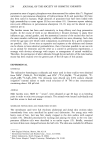
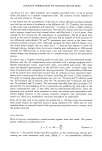
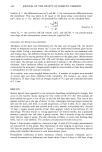
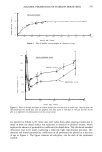
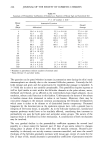
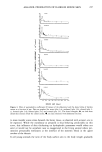
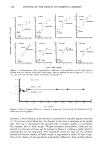
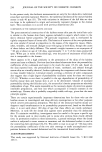
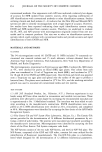
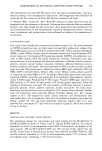
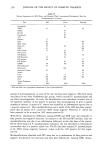
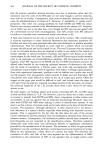
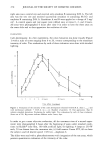
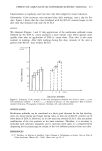
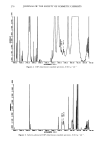
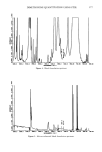
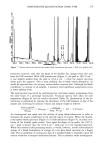
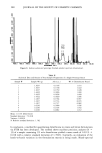
248 JOURNAL OF THE SOCIETY OF COSMETIC CHEMISTS lOO 50 lOO 50 4 days dorsal • ß ,., ß ,.--abdominal ,, -water •-water 2 4 6 8 53 days dorsal 5/ ,,.• bdomina / e.- ..•" ß • • water i i i i 2 4 6 8 lOO 5o lOO 5o 5 days dorsal • •' '•- abdominal ,, ß ß ß water. •-water i i i 2 4 6 8 210 days dorsal •?'.." •/:•-abdominal -• water 2 4 8 8 100 50 lOO 50 20 days .ß..• •oo 50 dorsal '•C'. ' • /: ...,.--abdominal / ß / lo ,. / •water i i i 2 4 6 8 270 days dorsal • '• abdominal / : .,, •---water i i i i , 2 4 6 13 lOO 5o 25 days dorsal "'•ßß ./•' ,• •- abdominal / .. •water i i i 2 4 6 8 360 days dor s al• ,' •. ab d omin a I • w?er i i 2 4 6 ALKYL CHAIN LENGTH Figure 4. Semologarithmic plots of permeability coefficients of the abdominal and the dorsal skins of hairless mice as a function of the alkyl chain length. Data are graphed for mice of ages of 4, 5, 20, 25, 53, 210, 270, and 360 days, shown as sub-plots 4-a through 4-h. 0.6 I HALE MICE 0.4 •.- . DORSAL SKIN ADOME. 0.2 o I I I I i i , I i 0 40 80 120 160 200 240 280 320 360 J 4OO AGE (DAYS) Figure 5. Plot of •r-values (dP/dn) as a function of mouse age. Data for both the abdominal and the dorsal skin sites are graphed. decreases, a factor bearing on the systemic accumulation of topically applied chemicals (1). For an area of prescribed size, the decrease in this ratio is enormous as the animal ages. One way to demonstrate the increased risk to younger animals is to normalize the transport data to body weight. Weight-normalized permeability coefficients are plotted as a function of mouse age for butanol in Figure 6, yielding a profile which is representative for all compounds. The normalized values are large for the newborn animals and decline rapidly till adult weight is approached at about 50 days of age. Even in the absence of real age-related permeability differences, these profiles indicate

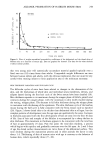
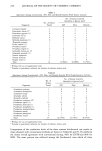
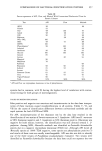
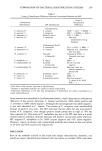
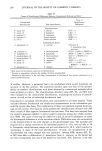
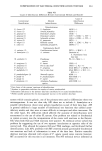
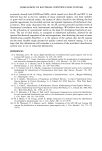
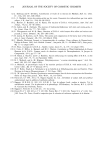
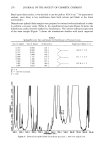
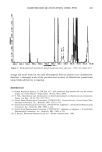
ALKANOL PERMEATION OF HAIRLESS MOUSE SKIN 249 40 BUTAi•0L • 32 v 24 x Q_ •) •.e •& . ABDOMINAL SKIN $ • 8 0 0 40 80 120 •60 200 240 280 320 360 400 ?QUSE ACE (DAYS) Figure 6. Plots of weight-normalized permeability coefficients of the abdominal and the dorsal skins of hairless mice as a function of mouse age. Data are graphed for butanol. The data for the other alcohols evidence similar profiles. that very young mice will systemically accumulate material applied topically over a fixed area ten (10) times faster than adults. Comparable weight differences are seen between human infants and adults, with the obvious implication that one must be very careful when treating infants to limit application area to the minimum necessary. SKIN THICKNESS VARIATION AND THE HAIR CYCLE The follicular cycles of mice have been related to changes in the dimensions of the skin, and the thicknesses of whole skin and individual strata (epidermis, dermis, and adipose layers) during the first hair cycle of the Swiss mouse have been detailed (26). Skin thickness expands to its maximum during the anagen phase of follicle growth and contracts during the catagen phase, with the minimum in skin width reached during the resting, telogen phase. The decrease in full skin thickness during the telogen phase is concurrent with thickening of the epidermis. The skin thickness cycle of the hairless mouse during the half cycle is fully consistent with the Swiss mouse cycle as reported (26). Figure 2 shows dorsal skin to be thicker than abdominal skin at all ages, but the complex patterns of development over the age span are qualitatively the same. Increases in thickness associated with the first development of hair are seen over the first 10 days of life. Loss of hair and atrophy of the follicles is accompanied by a sharp decline in skin thickness. The minimum in thickness appears to be concurrent with the total loss of hair at approximately 25 days. Past this point the total skin thickens, a process which begins with rapidity and gradually continues over the life span. At 2 and 5 days of age the dorsal surface measurements are twice those of the abdominal surface. This ratio declines during the maturation process and in older animals the factor is only about 1.4. Thickening of skin of mature mice with age is contrary to the behavior of human skin, which reportedly thins (27-30).
Purchased for the exclusive use of nofirst nolast (unknown)
From: SCC Media Library & Resource Center (library.scconline.org)