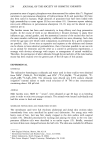
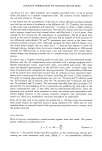
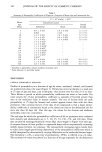
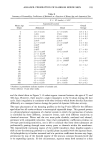
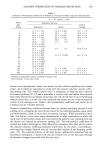
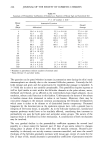
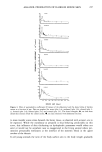
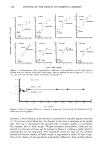
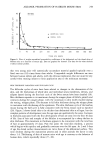
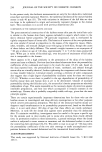
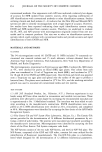
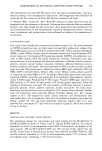
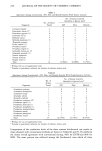
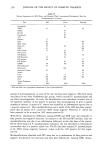
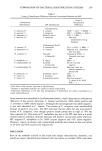
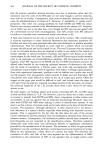
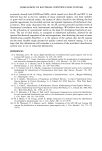
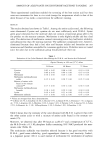
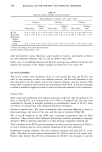
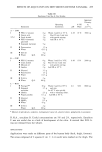
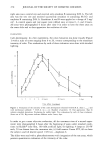
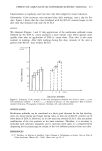
256 JOURNAL OF THE SOCIETY OF COSMETIC CHEMISTS Table I Agreement Among Conventional, API, Flow and Minitek Systems With Enteric Cultures No. of Strains Correctly Identified to Species Level a No. of Strains Organism Tested API Flow Minitek C itrobacter freundii 4 4 4 4 Enterobacter cloacae (1) •' 4 4 2 2 Enterobacter gergoviae (1) 8 3 6 4 Escherichia coli (2) 2 2 1 2 Klebsiella oxytoca 4 4 4 2 KlebsMla pneumoniae (1) 6 5 6 6 Morganella morganii 1 1 1 1 Proteus vulgaris (1) 1 1 1 1 Providencia stuartii 1 1 1 1 Providencia rettgeri (1) 2 2 2 1 Salmonella cholerae-suis (1) 1 1 1 1 Salmonella enteritidis (1) 1 1 1 1 Serratia liquefaciens 2 2 2 2 Serratia marcescens 3 1 3 3 Shigella sonnei (1) 1 1 1 0 Total 41 33 (80%) 36 (88%) 31 (76%) Without the use of supplemental tests. Number in parenthesis indicates the number of reference strains used. Table II Agreement Among Conventional, API, Flow, and Minitek Systems With Nonfermentative Cultures No. of Strains Correctly No. of Identified to Species Level a Strains Organism Tested API Flow Minitek A cinetobacter anitratus 1 0 1 0 Acinetobacter haemolyticus 1 0 0 0 Acinetobacter lwofjS' 1 1 1 1 Alcaligenes odorans 1 1 1 1 Moraxella urethraIls 1 0 0 0 Pseudomonas aeruginosa (2) •' 7 7 7 5 Pseudomonas cepacia (1) 15 15 15 15 Pseudomonas fluorescens (1) 6 6 6 5 Pseudomonas maltophilia (1) 4 3 1 3 Pseudomonas pseudoalcaligenes 3 0 0 0 Pseudomonas putida 7 7 5 5 Pseudomonas putrefaciens 2 1 1 1 Pseudomonas stutzeri 4 1 4 4 Total 53 42 (79%) 42 (79%) 40 (75%) Without the use of supplemental tests. Number in parenthesis indicates the number of reference strains used. Comparisons of the correlation levels of the three systems biochemical test results to those obtained with conventional methods are shown in Tables III and IV. FL exhibited the closest overall agreement with conventional testing, 96% for ENTB and 90% for NFB. The same pattern was reflected among the biochemical tests which all three

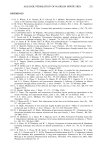
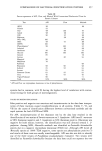
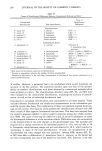
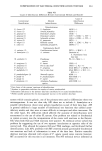
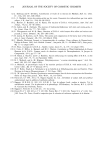
COMPARISON OF BACTERIAL IDENTIFICATION SYSTEMS 257 Table III Percent agreement of APT, Flow, and Minitek With Conventional Biochemical Tests for Enteric Cultures Test APT Flow Minitek ADH 90 80 Gelatin 93 H2S 98 100 95 Tndole 98 98 95 LDC 90 95 90 Malonate 98 90 NO3-NO 2 100 100 ODC 98 93 88 ONPG 100 98 Phenylalanine • 98 100 95 Adonitol 98 98 Arabinose 98 98 95 Glucose 100 100 100 Tnositol 85 78 Lactose 85 93 Mannitol 98 Mellibiose 78 Raffinose Rhamnose 98 98 Sorbitol 95 95 Sucrose 95 Simmons Citrate 83 95 Urea 46 93 Voges-Proskauer 98 Total 92% 96% 98 98 93 95 93 49 71 90% a API and Flow use tryptophane deaminase in lieu of phenylalanine. systems had in common, with FL having the highest level of correlation with conven- tional testing for both groups of microorganisms. CAUSES OF MISIDENTIFICATIONS False positive and negative test reactions and inconsistencies in the data base interpre- tation of these reactions caused misidentifications in all systems. Tables V, VI, and VII list the causes of identification differences between conventional methods and the rapid systems for both ENTB and NFB. For API, misinterpretation of the rhamnose test by the data base resulted in the identification of two strains ofSerratia marcescens as S. liquefaciens. API listed S. marcescens as 98% rhamnose negative and S. liquefaciens as 30% rhamnose positive. Rhamnose was negative for both strains however, the identification was still directed toward S. li- quefaciens. Among NFB, Moraxella urethraIls was identified as Pasturella-Actinobacillus species due to a negative tryptophane deaminase (TDA) test. Although API listed all Moraxella species as 100% TDA negative, some species are phenylalanine positive (7) and results of these tests are usually interchangeable. API was also not able to identify any of the three strains of Pseudomonas pseudoalcaligenes evaluated. Two strains were identified as Pasturella-Actinobacillus because the data base could not separate the two
Purchased for the exclusive use of nofirst nolast (unknown)
From: SCC Media Library & Resource Center (library.scconline.org)