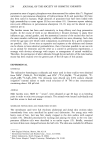
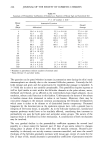
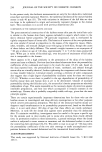
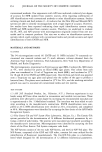
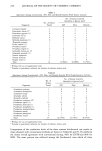
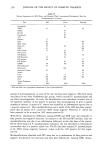
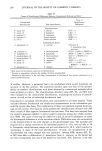
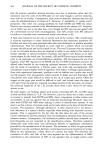
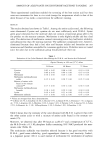
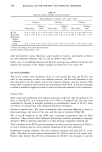
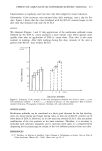
260 JOURNAL OF THE SOCIETY OF COSMETIC CHEMISTS Table VI Causes of Identification Differences Between Conventional Methods and Flow a Cause of Conventional Identification Identification Flow Identification Differences Enterobacteriaceae E. cloacae (1) •' S. fonticola LDC (+) E. cloacae (1) S. liquefaciens LAC (-) E. gergoviae (1) K. pneumoniae ODC (-) E. gergoviae (1) Serratia fonticola SORB ( + ) E. coli (1) Serrati• odorifera ODC (-) Nonfer•entative Bacilli A. haemolyticus (1) A. anitratus Omission of A. haemolyticus from data base M. urethraIls (1) P. fluorescens/putida GLU( + ), XYL( + ), MALT( + ) P. maltophilia (3) P. paucimobilis DNA( - ), URE( - ), XYL( + ) P. pseudoalcaligenes (2) P. fluorescens/putida GLU (+), MANN (+), P. pseudoalcaligenes (1) A. xyloseoxidans XYL (+)c P. putida (1) P. aeruginosa ACET ( + ), 42øC ( + ) P. putida (1) P. picketti 42øC (-), LAC (-), MANN ( - ), MALT ( - ) P. putrefaciens (1) P. dimunta H2S (-) a •irst choice of the systems' spectrum of identifications. b Number in parenthesis indicates the number of strains misidentified. c Information deficiencies in the data base interpretation of biochemical test results contributed to or caused misidentification. of another. However, a parameter had to be established which would determine the accuracy of the five systems. The parameter decided upon was that of the systems' ability to correlate identifications with those obtained by conventional methods which were accepted as correct. The identifications obtained using API, FL, and MT were then compared to the conventional identification, evaluating the accuracy of identifi- cation, as well as that of individual biochemical tests. Inaccuracies in microbial identifications were encountered in all three systems. These included aberrant biochemical test results and inconsistencies in the information pro- vided by system data bases. The combination of these two problems exposed shortcom- ings in each system. The majority of the problematic identifications obtained with API were a result of false negative biochemical test reactions. This may have resulted from the system's apparent inability to detect positive reactions among the weakly sacchro- lytic NFB. The cause of this may be related to a lack of nutritive substances in either the biochemical substrates or in the inoculum vehicle. Difficulties were also encountered in the interpretation of the color changes in the decarboxylase tests. The manufacturer requires red or orange reactions to be considered positive at 24 h, and red only at 48 h. Frequently colors between orange and red were observed at 48 h, which resulted in. uncertainty in many of the final identifications. At best, the interpretation of the decarboxylase test color changes was very subjective. Among NFB, neither API, FL, or MT were able to differentiate A. haemolyticus from A. anitratus, as the former had not been incorporated into any of the respective data bases. API, however, is the only

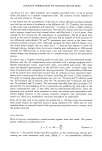
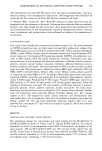
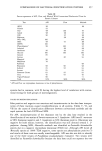
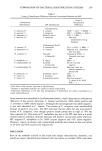
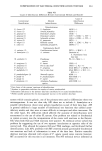
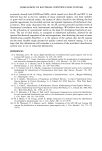
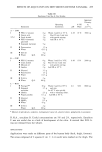
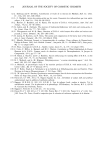
COMPARISON OF BACTERIAL IDENTIFICATION SYSTEMS 261 Table VII Causes of Identification Differences Between Conventional Methods and Minitek a Cause of Conventional Minitek Identification Identification Indentification Differences E nterobacteriaceae E. cloacae (1) b S. liquefaciens ADH ( - ) E. cloacae (1) Serratia plymuthica ADH ( - ) E. gergoviae (1) Enterobacter aerogenes URE ( - ) E. gergoviae (2) Enterobacter vulneris CIT(- ), ODC(- ), VP(- E. gergoviae (1) Salmonella arizonae H2S( + ), ODC( - ), VP( - K. oxytoca (2) K. pneumoniae IND (-) P. rettgeri (1) Klebsiella ozaenae IND( - ), LDC( - ), PA( - S. sonnei (1) Salmonella paratyphi-A ONPG ( - ) Nonfermentative Bacilli A. anitratus (1) Cardiobacterium hominis IND (-), MAC (-)c A. haemolyticus (1) A. anitratus Omission of A. Haemolyticus from data base PA (+), MAC (-) M. urethraIls (1) Pseudomonas species P. aeruginosa (1) P. stutzeri P. aeruginosa (1) Not in data base d P. fluorescens (1) P. aeruginosa P. maltophilia (1) Not in data base P. pseudoalcaligenes (3) Moraxella species P. putida (1) P. pseudoalcaligenes P. putida (1) P. stutzeri P. putrefaciens (1) A lcaligenes-Pseudomonas species URE (+)c URE (+), N2 (+)c ANADEX (+), ONPG(+) ANA DEX ( + ), SUC ( + ), XYL (+) ADH ( - ) AER DEX (-) STAR ( + ) AER DEX (-) First choice of the systems' spectrum of identifications. Number in parenthesis indicates the number of strains misidentified. Information deficiency in the systems' data base contributed to or caused misidentification. Profile number generated by the microorganism was not in the systems' data base. system which contains gelatin, one of the primary tests used to differentiate these two microorganisms. It was not clear why API chose not to include A. haemolyticus as a possible identification choice since gelatin liquefaction is part of their data base. API in general exhibited a large number of biochemical test reactions that yielded unsat- isfactory results and that were at times difficult to interpret and often inaccurate. On the other hand, few difficulties which affected the outcome of identifications were encountered in the use of either FL system. One problem not related to biochemical or system accuracy was the interpretation of the center well reactions in the Enteric- Tek when both H2S and TDA reactions were positive. FL technical service solved this problem by suggesting the use of two separate inoculations at opposite sides of the central well. This allowed for separate H2S and TDA readings, and facilitated further identifications. Like API, problems with MT centered around questionable biochemical test reactions and lack of information in areas of the data base. Positive anaerobic dextrose reactions obtained with strains of P. cepacia caused some concern however, MT accounted for this reaction in all instances. The MT technical service informed us
Purchased for the exclusive use of nofirst nolast (unknown)
From: SCC Media Library & Resource Center (library.scconline.org)