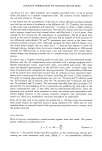
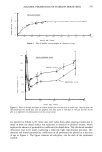
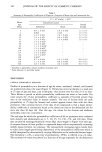
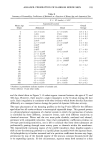
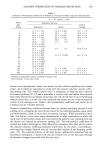
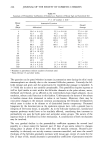
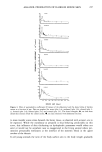
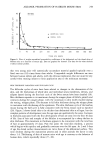
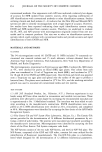
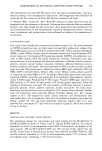
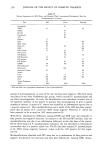
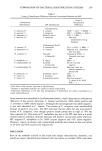
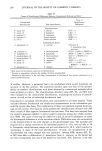
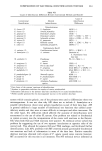
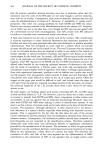
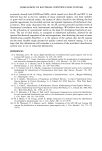
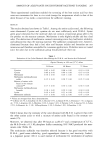
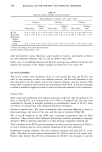
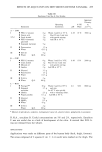
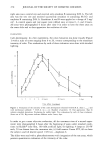
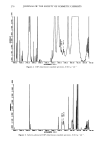
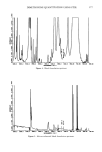
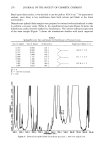
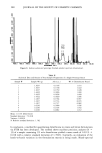
240 JOURNAL OF THE SOCIETY OF COSMETIC CHEMISTS (cm/hr) A = the diffusional area (cm2) and AC = the concentration differential across the membrane. This was taken to be equal to the donor phase concentration (cpm/ cm3). Since JT = VR ' (dC/dt), the permeability coefficient can be calculated from: p _ \ dt ,/ (Equation 2) A ß AC where V•t = the receiver half-cell volume (cm3), and (dC/dt) = the pseudo-steady state slope of the concentration versus time plot (cpm/cm3/hr). THICKNESS AND WEIGHT MEASUREMENTS Thickness of the skins was determined over the first year of mouse life. An excised dorsal or abdominal section several cm 2 in area was sandwiched between glass micro- scope slides. Using a micrometer, the thickness of the sandwich was measured with and without skin, the difference being the net thickness of the skin. The measurements were unaffected by varying pressure of the micrometer on the glass plates. Measurements were made in triplicate except at 108,328, and 342 days, where only two measurements were taken. No attempt was made to determine if soaking in the diffusion cells altered thickness. Since hydration effects on permeability are within the ultrathin stratum corneum for the most part, changes which might be noted would not have been relatable to permeability (to the stratum corneum). As a routine, mice were weighed before sacrifice. A number of weights were recorded at several ages and these exhibited little variability. For instance, six values were obtained at 25 days of age with an average weight of 14.2 gm and a standard deviation of 1.2 gm. RESULTS Several reports have appeared in the literature describing morphological changes that occur in the hairless mouse during the first weeks of life (16-20). The animals are born hairless but grow a coat of hair in the first few days after birth. This coat of hair appears normal up to the age of about 13 days, whereupon hair loss begins around the eyes and the nose, and then, in caudal progression, all hair is shed. At 21 days of age the body is virtually nude and covered with a thin, smooth, and pinkish skin. Around 35 days, a sparse second growth of hair often appears, which is lost between 45-60 days of age. The skin retains its "young appearance" for several months, but it gradually assumes a greyish cast and takes a grainy texture. Past 6 months of age the animals show obvious signs of aging. The skin develops wrinkles, in some cases forming deep folds, and its color darkens. The animals concomitantly become less active. Figure ! depicts mice weights as a function of age. A total of 224 weight measurements are summarized in this graph. Skin thicknesses of mice ranging in age from 2 days to 342 days are graphically presented in Figure 2. Average thicknesses have been plotted along with standard deviations at each measurement point. Permeability coefficients of water, methanol, ethanol, n-butanol, n-hexanol, and n- octanol determined on abdominal and dorsal skins of mice 4 days to 360 days of age

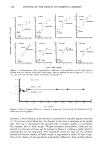
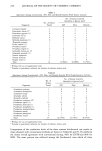
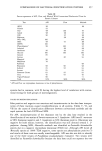
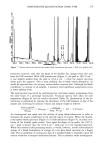
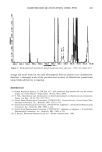
ALKANOL PERMEATION OF HAIRLESS MOUSE SKIN 241 60 4O 2O HAIRLESS MOUSE ß ß '•": - ' I I ! I ! I I 0 40 80 120 160 200 240 9.80 320 MOUSE AGE (DAYS) Figure 1. Plot of hairless mouse weight as a function of age. I I 400 600 MALE HAIRLESS MICE 500 400 % 3oo ,,._., • •ABDOMINAL SKIN • 200 • •oo I I I I o lOO 200 300 I 400 MOUSE A6E (DAYS) Figure 2. Plots of average thickness of hairless mouse skin as a function of mouse age. Data for both the abdominal and the dorsal skin sites are graphed. The data point at 328 days of 318 •m was left off the plot as it appeared non-representative of the overall trend. are reported in Tables I-VI. Some data were taken from other ongoing studies and in many of these the dorsal surface was subjected to chemical or physical trauma, which explains the absence of permeability coefficients for dorsal skins. The calculated standard deviations tend to be small, indicating a relatively high experimental precision. Ab- dominal and dorsal permeability coefficients of all permeants are plotted as a function of age in Figure 3. The figure contains six sub-plots, one for each of the permeants studied.
Purchased for the exclusive use of nofirst nolast (unknown)
From: SCC Media Library & Resource Center (library.scconline.org)