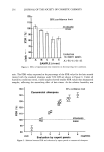
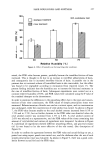
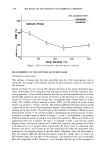
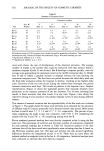
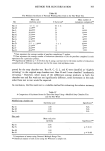
J. Soc. Cosmet. Chem., 40, 251-263 (September/October 1989) Estimation of shampoo and rinse effects on the resistance to flow over human hair and hair softness using a newly developed hydrodynamic technique YOSHIHIKO FUKUCHI, MASAHIRO OKOSHI, and ISAO MUROTANI, Shiseido Product Research Laboratories, 1050 Nippa-Cho, Kohoku-Ku, Yokohama-Shi, Kanagawa-Ken, Japan 223. Received November 29, 1988. Synopsis A new instrumental method that allows us to compare product effects on flow resistance and softness of human hair has been developed. A fluid (air or water) was passed through a circular tube filled with a bundle of hair. The resistance to flow provided by the hair was calculated from the pressure drop of the fluid. That is, the pressure drop decreases with decreasing flow resistance. The values of pressure drop measured in air and water probably reflect the frictional drag of the dry and wet hair, respectively. By this method we evaluated several groups of hair strands treated with different shampoos and rinses (conditioners). The result was in accord with expectation based on the formulas of samples and corresponded to the evaluation by expert panels. The pressure drop perpendicular to the hair strand, which was inserted into the T-tube, was also measured under constant humidity, and this pressure drop was found to reflect hair softness. It was shown that a component of the products, glycerin, makes hair softer. INTRODUCTION To evaluate the quality of hair cosmetics including shampoos and rinses (conditioners), the measurement of the frictional drag and softness of human hair is usually thought to be important. Since human hair is actually in the form of strands that interact with each other, it is very important to have a method capable of accurately evaluating the friction and softness of a hair strand. The results herein describe measurement of the resistance to flow of air or water over a strand of hair. We propose that this parameter relates to the frictional drag of human hair and that the data show a relationship between this parameter and the softness of human hair. MEASUREMENT OF THE RESISTANCE TO FLOW OVER HUMAN HAIR EXPERIMENTAL PROCEDURE The test section of a newly developed apparatus is illustrated in Figure 1. When a hair strand is firmly placed in the flow of water or air, the pressure of the fluid becomes higher at the upstream (point A) than at the downstream (point B) to produce a pressure 251

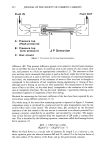
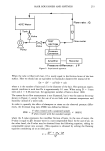
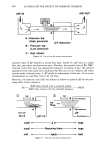
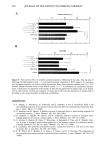
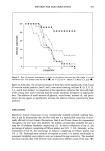
252 JOURNAL OF THE SOCIETY OF COSMETIC CHEMISTS Fluid IN A: Pressure tap (High pressure) B: Pressure tap (Low pressure) C: Hair strand Fluid OUT it A Detection Figure 1. Test section for frictional drag measurement. difference, Ap. This pressure difference appears to be related to the frictional resistance due to interfiber friction of hairs, if conditions such as the volume of a hair strand, flow rate, and pressure to a fluid are appropriately controlled (1,2). The resistance to flow over wet hair can be measured when water is used as the fluid, while that of dry hair can be measured when air is used as the fluid. As for the evaluation of commercial shampoos and rinses, the measurement of the resistance of water to flow over hair is thought to correspond to the evaluation of hair roughness during shampooing or rinsing of hair, although such a feeling on use has not been quantified. The measurement of the resis- tance of hair to air flow, on the other hand, corresponds to the evaluation of the sleek- ness of completely dried hair. We use the word "sleekness," specifically referring to the smoothness (opposite of roughness) of hair after drying. Methods for measuring the frictional coefficient of dry hair have been reported by sev- eral authors using different substrates (3-6). The whole setup of the water flow measuring system is depicted in Figure 2. Constant temperature water is circulated by a pump and sent by valve manipulation into the test section filled with a hair strand. The pressure drop, Ap, produced by the frictional resistance of the hair strand in the test section is converted to an electric potential by a pressure converter, amplified by an amplifier, and recorded by a recorder. The magni- tude of hair friction can be assessed from the magnitude of Ap under a constant flow rate. This is described by the following equation, sometimes called the Fanning friction factor equation (1): AP/L = Cf(pu2/2gc) (1/De) [Kgf/m 3] [-] [Kgf/m 2] Ira- When the fluid flows in a circular tube of diameter D, length L at a velocity u, the above equation gives the relation between Ap and Cf, where Cf is the friction factor of the tube surface, P the density of the fluid, and gc the gravitational constant.
Purchased for the exclusive use of nofirst nolast (unknown)
From: SCC Media Library & Resource Center (library.scconline.org)