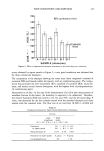
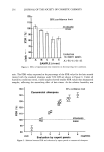
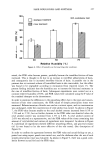
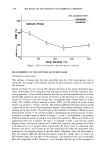
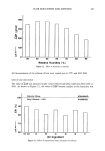
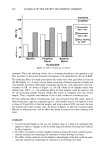
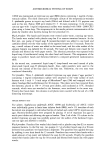
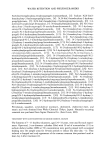
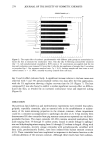
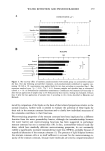
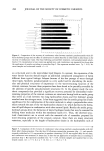
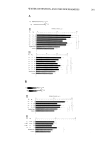
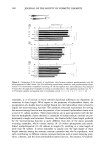
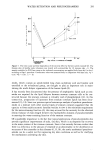
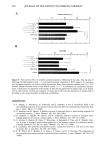
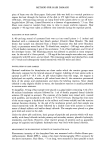
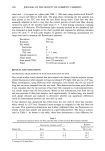
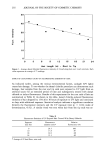
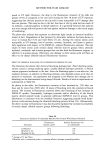
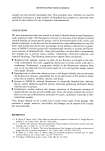
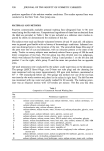
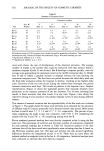
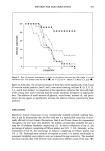
HAIR ROUGHNESS AND SOFTNESS 257 120' 110- 100- 90 80 70 60 shampoo treatment rinse treatment 95% confidence limit 50 Relative Humidity [%] Figure 6. Effect of humidity on frictional drag (dry condition). 70 raised, the FDR value became greater, probably because the interfiber friction of hairs increased. This is thought to be due to an increase in interfiber adhesiveness of hairs, and consequently due to increased interfiber friction of hairs. A possible rise in the pressure due to increased volume of humidified hairs is also conceivable, but this effect was found to be negligible according to estimation from reported values (7). The present finding indicates that the humidity acts to increase the frictional resistance in the case of interfiber friction of hairs. Subsequent experiments were carried out at a constant relative humidity of 50%, and FDR values were calculated using the F value of the standard shampoo as the denominator. In order to examine the differences in the smoothing effect due to the types and concen- trations of hair rinse constituents, the FDR values of simple prescription rinses were measured. Behentrimonium chloride was used as a cationic agent, and its concentration was unchanged, while the concentration of cetyl alcohol was varied. As shown in Figure 7, the FDR value became smaller as the cetyl alcohol content increased from O. 5 % to 1.5% and to 2.5%, but no further decrease in the FDR value was observed when the cetyl alcohol content was increased from 2.5% to 4.0%. Acetyl alcohol content of 2.0% was selected as a representative, and the FDR values of the rinses containing this amount of cetyl alcohol and various oil ingredients were measured. As shown in Figure 8, individual oil ingredients showed different smoothing effects, and glyceryl stearate (oil A) was found to be the most effective of the oils tested. (See description of Figure 8). In order to confirm the agreement between the FDR value and actual feeling on use, a paired test using expert panels was carried out, and the sleekness after the use of each simple prescription rinse was evaluated. As shown in Figure 9, there was a good corre- lation between actual feel and the FDR value.

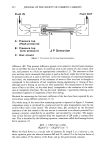
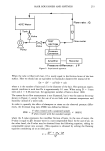
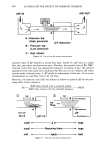
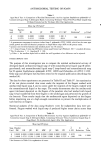
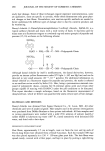
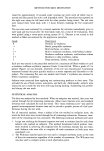
258 JOURNAL OF THE SOCIETY OF COSMETIC CHEMISTS 95% confidence limit STANDARD lOO SHAMPOO Cationic Rinse ''90 7O 0 1.0 2.0 3.0 Cetyl Alcohol [%] Figure 7. Effect of cetyl alcohol on frictional drag (dry condition). 410 MEASUREMENT OF THE SOFTNESS OF HUMAN HAIR EXPERIMENTAL PROCEDURE The softness of human hair has been described only by a few investigators, and in particular, the change of the softness induced by hair cosmetics could not be found in the literature. Figure 10 shows the test section (the softness detector) of our newly developed appa- ratus. Other parts of this apparatus were the same as those of the flow resistance mea- suring apparatus. A hair strand is inserted into the test section perpendicular to air flow and forcibly packed in the test section to be bent in the direction of air flow. A cross- section of air flow in the test section has a rectangular shape (4-ram high by 6-mm wide). The number of hairs inserted is about 1000, and the length of a part of hair which is in air flow is 15-mm-20-mm. The pressure difference between points A and B is detected by the top and bottom pressure sensors. This pressure difference reflects the softness of the hair strand. The principle of this method is as follows: When no air is flowing (flow rate Q = 0), the hair strand is compressing the interior wall by its force to restore a straight shape as shown in Figure 11, state 1, and therefore, the pressure difference between points A and B is zero under this condition. When an air flow at an appropriate flow rate is started, the state 1 is changed to state 2 and the hair strand begins to float, leaving the interior wall. Under this condition, the pressure of air flow is distributed so as to become lower toward point B. Thus, there is a balanced state between two forces: one to push up the hair strand and the other the downward force produced by the restoring power of the hair strand. Therefore, when the hair strand is soft, the pressure difference Ap between points A and B is small when it is hard, the Ap becomes large. On the basis of this principle, the softness of hair can be evaluated from the magnitude of Ap. However, it was thought that the use of the averaged or
Purchased for the exclusive use of nofirst nolast (unknown)
From: SCC Media Library & Resource Center (library.scconline.org)