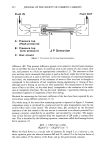
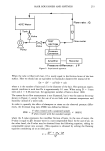
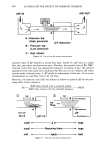
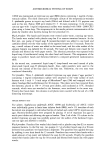
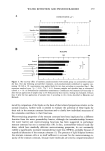
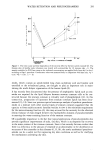
HAIR ROUGHNESS AND SOFTNESS 253 40øC Water Flow rate ß Q /•Valve \ '-- Va Ive•'"•• ECTIO, N• Pump , ' , I Pressure [ Converter [ ! I I A•,,,.,er t---• Recorder I Pressure difference ß • P Figure 2. Experimental apparatus. Flow meter When the tube is filled with hair, Cf is nearly equal to the friction factor of the hair surface. Here we should use an equivalent (or hydraulic) diameter De instead of D. De = (D 2 - nd2)/(D +nd) where n is the number of hairs and d is the diameter of the hair. The optimum experi- mental condition is such that De is approximately O. 1 mm. When using D = 5-mm tube and d = O.08-mm hair, the appropriate number of hairs is about 1800. The system for air flow measurement is not illustrated, but it was the same as the setup shown in Figure 2, except for the use of an air bath with constant temperature and humidity instead of a water tank. In order to quantify the effect of shampoos or rinses on the observed pressure differ- ences, the frictional drag ratio (FDR) was defined as follows: F when treated with a purposed sample FDR = X 1001%] F when treated with the standard sample where the F-value represents the interfiber friction of hairs. In the case of water, the F-value is equal to Ap, because water is a non-compressible fluid. In the case of air, on the other hand, the F-value may be obtained from the following equation, taking its compressible nature into account. (This equation is obtained by solving the Fanning equation considering air as an ideal gas.) AP 2 -3- 2p B ß Ap F= Q2

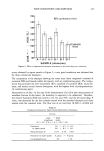
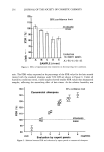
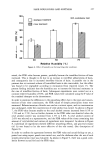
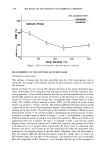
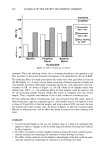
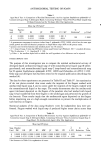
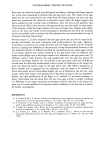
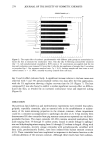
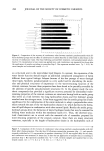
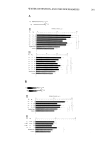
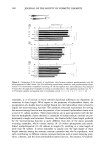
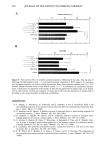
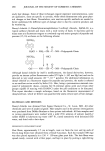
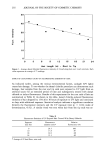
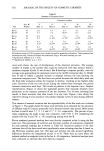
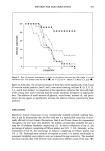
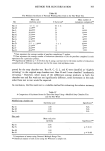
254 JOURNAL OF THE SOCIETY OF COSMETIC CHEMISTS where Q is a flow rate and PB is the absolute pressure at point B in Figure 1. For air or water flow, the smaller the FDR, the greater the reduction in hair friction. In other words, a sample with a smaller FDR value may be said to give greater smoothness to hair. The smoothing effect of hair cosmetics such as shampoos and rinses (conditioners) was quantified using this FDR value. RESULTS AND DISCUSSION Measurement in water flow. The experimental shampoos were prepared using those con- stituents shown in Table I. The concentrations of ordinary shampoo constituents, laureth sulfate and cocamide DEA, were unchanged. The concentration of polyquaternium-10, which is effective in reducing hair roughness on rinsing, was varied. Cocoamphoglyc- inate, which facilitates the adsorption of polyquaternium-10 to hair, was not pre- scribed for group A, but it was prescribed to be 2.4% for group B (6). Observed FDR values from the hair strands treated with individual shampoos are shown in Figure 3. They were measured using a tube diameter of 5 mm and a flow rate of 150-300 ml/min. Both in groups A and B, the FDR value became smaller as the concentration of polyquaternium-l0 was increased, i.e., the frictional drag was decreased. FDR values for group B were generally smaller than those for group A, indicating the effectiveness of cocoamphoglycinate. Thus, the effects of polyquaternium-10 and cocoamphoglyc- inate could be observed by this method. For the purpose of confirming the compatibility with a sensory evaluation, six shampoo samples from Table I were evaluated using expert panels. The method used was a half-head method with paired comparisons, and the roughness of hair during rinsing with warm water was evaluated. The results are summarized in Table II. The extent of roughness estimated by the use test was completely parallel to the values of observed FDR, demonstrating the appropriateness of the FDR values. Similar experiments were carried out for hair rinses (conditioners). The FDR values obtained for six types of simple conditioning rinses are shown in Figure 4. In compar- ison with the result for shampoos (Figure 3), the rinses showed considerably smaller FDR values. When the use test was also carried out as to the sleekness of rinse-treated hair during rinsing with warm water, the rank order of sleekness corresponded to the FDR values in a similar manner as in the use test of shampoos. Observed FDR values were compared with the extent of the smoothness of hair evalu- ated by the use test not only for simple prescription shampoos but also for commercial shampoo products. Eleven representative shampoos were selected from the products of our company, and the roughness on rinsing was scored in six grades by precise evalua- tion using expert panels. As indicated by the relation between FDR values and the Table I Formulas of Experimental Shampoos [Effective %] A-1 A-2 A-3 B-1 B-2 B-3 Polyquaternium- 10 0.2 Cocoamphoglycinate Laureth sulfate 13.8 Cocamide DEA 6.0 0.5 0.8 0.2 0.5 0.8 -- -- 2.4 2.4 2.4 13.8 13.8 11.4 11.4 11.4 6.0 6.0 6.0 6.0 6.0
Purchased for the exclusive use of nofirst nolast (unknown)
From: SCC Media Library & Resource Center (library.scconline.org)