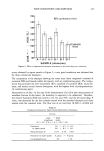
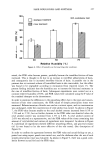
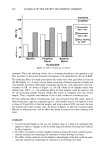
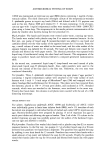
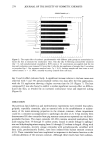
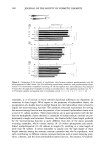
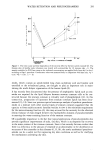
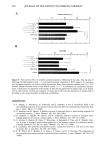
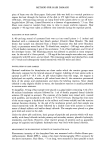
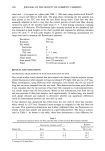
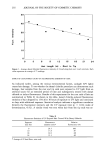
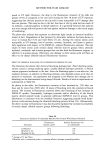
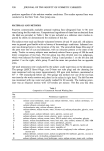
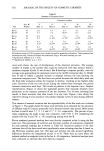
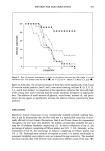
304 JOURNAL OF THE SOCIETY OF COSMETIC CHEMISTS 32•, JAN MAR APR JUN JUL AUG OCT NOV mONTHS Figure 3. Seasonal comparisons of mean total irritation scores during various months are shown for bar A (solid) and bar B (crosshatch). believe the test method reduces the influences of stratum corneum hydration and turn- over due to the sponge application procedure and therefore makes the test less weather- dependent. We have found that the flex wash is capable of significantly discriminating between milder cleansing systems than is typically achievable with a chamber test. This result is illustrated in Table IV, which compares the relative differences observed for the flex wash and a modified soap chamber test (6) for three soap bars. Using the flex wash one observes statistically significant differences that are not seen using a modified soap chamber test. Furthermore, the modified soap chamber test is reported to be as sensitive as the test previously designed by Frosch and Kligman (7). Current trends to develop milder active systems for personal cleansing and the ability to more easily discriminate between these formulations is an important aspect of any clin- ical testing regime. We find that the flex wash is capable of discriminating smaller differences in irritation potential, while good correlation to the soap chamber test can be found when the differences in irritation potential for two products are large (e.g., soap versus syndet bars). As an example, in these studies we chose bar A as a reference standard since Frosch and Kligman demonstrated that this product was the mildest of 18 bars tested in the soap chamber test (2). Utilizing the flex wash, bar A was also found to be superior in mild- ness to the eleven bars tested, which in overall terms correlates well with results re-

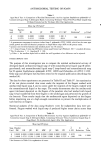
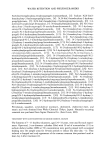
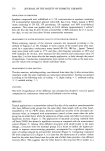
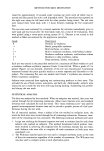
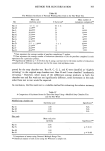
METHOD FOR SKIN IRRITATION 305 Table III The Mildness Attributes of Personal Washing Bars Used in the Flex Wash Test Mean total Mean number of Bar erythema score % Survivors* evaluations completed** BarA 5.7 -+ 1.2 93 -+ 6 19 Bar H 11.0'** 83 18 Bar L 18.4'** 31 14'** Bar C 20.4*** 26 14'** Bar K 25.4*** 15 7*** Bar E 24.4*** 12 12'** Bar G 27.8*** 12 8*** Bar J 26.1'** 7 9*** Bar B 27.7 + 2.0*** 5 -+ 3 10'** Bar I 27.6*** 0 9*** Bar F 28.6*** 0 8*** Bar D 29.4*** 0 7*** * Data represents the average number of panelists completing 15 washes. ** Data represents the average number of evaluations (maximum of 20) the panelists completed in each experiment for a particular product. *** Significantly different (p 0.05) from bar A using a survival test for the mean number of evaluations completed and a Wilcoxon matched pair test for the mean total erythema scores. ported for the soap chamber test. Bars B, C, G, J, and K were classified as "slightly irritating" in the original soap chamber test. Bars H and I were classified "moderately irritating." However, while many of the differences among products in both the chamber test and flex wash are not significantly different, some movement in the rank order from test to test would be expected. In conclusion, the flex wash test is a reliable method for evaluating the relative irritancy Table IV A Comparison of Erythema Scores for Three Bar Soaps Using a Modified Soap Chamber Test and the Flex Wash Modified soap chamber test Erythema score Significance* Bar G 1.09 N.S. Bar M 1.09 N.S. Bar N 0.94 N.S. Flex wash Mean end point erythema Significance** Bar G Bar N Bar M Bar N 5.83 2.2O p • 0.01 1.69 1.18 p • 0.08 * Comparisons of means using Duncan's Multiple Range Test. ** Statistical analysis of rank scores using the Wilcoxon 2 sample test.
Purchased for the exclusive use of nofirst nolast (unknown)
From: SCC Media Library & Resource Center (library.scconline.org)