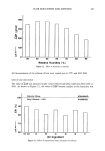
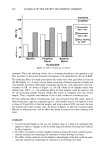
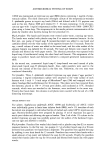
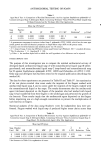
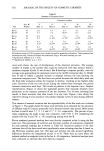
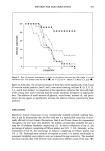
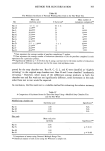
268 JOURNAL OF THE SOCIETY OF COSMETIC CHEMISTS The second experiment was identical to the first except that (1) commercial liquid soap C (soap-based) was used instead of pilot plant-made liquid soap B (detergent-based) and (2) commercial soap bar D was also tested. Panelists who were assigned soap bar D followed the same washing procedure except that they picked up the soap bar and wetted it under warm running tap water before rubbing the soap over their hands for the 15-second application step. Test procedure. Immediately after washing and drying his/her hands, each panelist gently but firmly pressed the four fingers (thumb not used) of one hand to the surface of an S. epidermidis-containing plate for 30 seconds and the four fingers of the other hand to an E. coil-containing plate for 30 seconds. The assignment of the plates to panelists' hands, as well as the assignment of soaps to the panelists, was determined by a computer-gen- erated randomization table. After the last panelist touched his/her plate, all the plates were incubated at 35øC for 24 hours. The plates were then examined for clear areas underneath the panelists' finger imprints. Three trained judges independently rated the clarity using the following scale: Overgrowth (no clearing) = 0 Turbid area (slight clearing) = 1 Clear area with growth = 2 Clear area with rough edge = 3 Clear area with smooth edge = 4 The judges were not informed of the identity of the test soap used by individual pan- elists until after the evaluation. RESULTS AGAR PATCH TEST The purpose of this investigation was to determine if the antibacterial activity of a detergent-based liquid soap could be tested by the agar patch test method. Previously, the method has been validated only with soap bars containing different concentrations of triclocarban (1,2). In these studies, liquid soap A (detergent-based) containing triclosan was compared with two nongermicide liquid soaps against a streptomycin-resistant derivitive of Staph- ylococcus epidermidis ATCC 14990. The data for these tests are presented in Table I and Table II. Analyses of the data in both tables showed that complete inhibition (100% reduction compared to either nonantibacterial liquid soap) was obtained with liquid soap A against S. epidermidis. The results in Table I and in Table II were both significant at a p-value of less than 0.0001. These results showed that the residual antibacterial activity of a triclosan-containing liquid soap can be successfully demonstrated by the agar patch test. Moreover, the results demonstrate that the residual antibacterial ac- tivity of liquid soap A is due to the triclosan, since liquid soap B shows no residual antibacterial activity and is identical to liquid soap A except that liquid soap B contains no triclosan. The results also show that both detergent-based and soap-based liquid soaps can be tested using the agar patch method. Based on these and previously pub- lished results (1,2), direct comparisons between the residual antibacterial effectiveness of bar and liquid soaps could readily be made using the agar patch test.

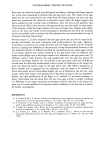
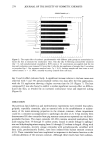
ANTIMICROBIAL TESTING OF SOAPS 269 Table I Agar Patch Test: A Comparison of Residual Bacteriostatic Activity Against Staphylococcus epidermidis a of Commercial Liquid Soap A (Detergent-Based, Containing Triclosan) Versus Pilot Plant-Made Liquid Soap B (Same Formula but No Triclosan) After One Application Mean log CFU/plate b Soap Panelist: % used SC EL JF PW • + SD c Reduction d p-Value e A 0.0000 0.0000 0.0000 0.0000 1.981 + 100 .0001 B 2. 1270 2.0132 2.0190 1.7652 .0914 a A spontaneous streptomycin-resistant isolate from S. epidermidis ATCC 14990, which has the same agar media growth rate and biochemical properties on Staph-Ident strips (API) as the parent strain. b Contact time between forearms and streaked plates was 30 minutes. • • = mean of (soap A mean log CFU_/plate minus soap B mean log CFU/plate). SD = standard deviation. d The % reduction = (1- 1/antilog d) x 100. e p-Value = the smallest alpha level at which the null hypothesis of no difference can be rejected. FINGER IMPRINT TEST The purpose of this investigation was to compare the residual antibacterial activity of detergent-based antibacterial liquid soap A with nonantibacterial liquid soap B (deter- gent-based), and nonantibacterial liquid soap C (soap-based) and nonantibacterial soap bar D against Staphylococcus epidermidis ATCC 14990 and Escherichia coli ATCC 11229. Only soap and detergent bars had been tested in the original publication describing this method (4). The data for these experiments are presented in Table III and Table IV. An examination of the test plates revealed clear zones under the imprints of the fingers washed with antibacterial liquid soap A and no zones under the imprints of the fingers washed with the nonantibacterial liquid or bar soaps. The results demonstrate that the antibacterial agent (triclosan) deposited on the fingers of the panelists who had washed with liquid soap A had transferred from their fingers to the seeded agar and prevented the growth of the bacteria. These results imply that the antibacterial agent deposited on the fingers before imprinting was at a high enough concentration to prevent the multiplication of such bacteria on fingers. Statistical analyses of the data using Student's t-test for independent data were per- formed. Fingers washed with liquid soap A produced higher mean clarity scores than Table II Agar Patch Test: A Comparison of Residual Bacteriostatic Activity Against Staphylococcus epidermidis • of Commercial Liquid Soap A (Detergent-Based, Containing Triclosan) Versus Commercial Liquid Soap C (Soap-Based, No Antibacterial Agent) After One Application Mean log CFU/plate Soap Panelist: • % p- Used DK RK JW BC MW JF MB PD + SD Reduction Value A 0.0000 0.0000 0.0000 0.0000 0.0000 0.0000 0.0000 0.0000 2.3019 C 2.4048 2.4752 2.5303 2.3100 2.2596 2.5661 1.5894 2.2797 -+ .3100 100 .0001 See footnotes in Table I for explanation of terms.
Purchased for the exclusive use of nofirst nolast (unknown)
From: SCC Media Library & Resource Center (library.scconline.org)