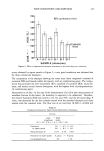
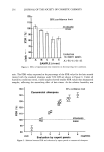
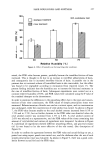
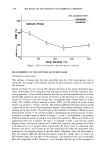
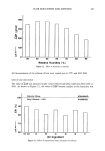
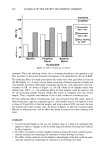
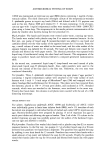
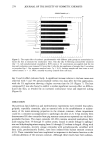
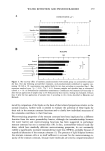
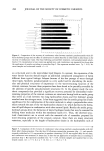
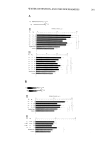
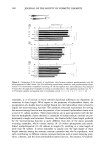
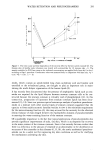
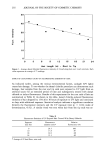
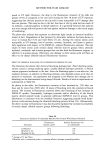
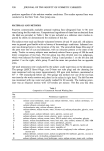
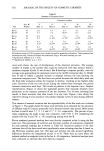
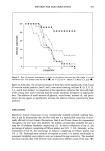
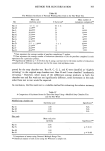
292 JOURNAL OF THE SOCIETY OF COSMETIC CHEMISTS 5O 4O 3O 2O 10 0 3 6 9 12 15 18 21 24 Hair Length (in) - Root to Tip Figure I. Average dansyl chloride fluorescence intensity of 24-inch-long hair over 3-inch intervals. Each value represents an average of 75 readings. EFFECT OF ULTRAVIOLET LIGHT ON FLUORESCENCE EMISSION OF HAIR As indicated earlier, among the various environmental factors, sunlight (UV light) causes hair damage. To see whether the dansyl chloride procedure can demonstrate such damage, hair samples from the root and tip ends were exposed to UV light from an artificial source for an extended period of time and subsequently treated with dansyl chloride to induce fluorescence. Results of this experiment for the root ends of hair are summarized in Table II. As shown in the table, dansyl chloride-induced fluorescence emission of hair dropped by 13% after 10 hours of exposure to UV light and continued to drop with additional exposure. Statistical analysis indicates a significant correlation between the fluorescence intensity and the UV exposure time (p = 0.04 index of determination, 0.92). A similar trend was seen when hair from the tip ends was ex- Table II Fluorescence Emission of UV-Exposed Hair Treated With Dansyl Chloride Exposure Fluorescence Relative time (hr) emission units* fluorescence (%) 0 2O.5 100 10 17.8 87 18 14.0 68 34 12.3 60 * Average of 22 hair fibers, root ends.

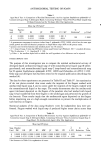
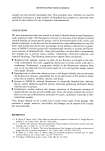
METHOD FOR HAIR DAMAGE 293 posed to UV light. However, the drop in the fluorescence intensity of tip ends was greater (27%) as compared to the root ends during the first 10 hours of UV exposure, suggesting that the hair portion at the tip ends is more susceptible to UV damage than the root portion. This may be due to the fact that hair at the tip ends has lost much of its melanin, a natural pigment to absorb radiation. It is generally believed that melanin acts as an energy sink and protects the hair against radiation damage in the initial stages of weathering. The above data indicate that exposure to ultraviolet light results in chemical modifica- tion(s) of hair. Degradation of hair proteins by ultraviolet radiation has been shown to occur in human hair (5,6) and wool fibers (21,22). Among the various amino acids susceptible to UV damage, loss of cysteine, tyrosine, histidine, and lysine is particu- larly significant with respect to the DANS-Cl-induced fluorescence emission. The side chains of these amino acids contain dansyl chloride reactive groups (thiol, phenolic hydroxyl, imidazole, and e-amino groups) that can also bind the fluorescent reagent, in addition to ce-amino groups. Obviously, any damage to these amino acids will have an effect on the dansyl chloride-induced fluorescence emission. EFFECT OF CHEMICAL BLEACHING ON FLUORESCENCE EMISSION OF HAIR The literature documents that chemical bleaching damages hair. Hair bleaching prepa- rations contain a strong oxidizing agent, usually alkaline hydrogen peroxide, to bleach various pigments (melanins) in the hair. Since the bleaching agent is non-selective, the oxidation process, in addition to bleaching melanin, also degrades amino acids that are sensitive to oxidation. An experiment was designed to see whether hair damage due to bleaching can be demonstrated using dansyl chloride. Results of such an experiment are summarized in Table III. As shown in the table, the fluorescence intensity of hair increased by 15% after one hour and by more than 250% after 16 hours of bleaching with the commercial bleach system. The increase in fluorescence emission shows that bleaching of hair increases its DANS-CI uptake. Presumably, hydrogen peroxide and/or alkalinity of the bleach system cleaved peptide bonds to generate additional DANS-C1 reactive groups. This observation is consistent with the available literature suggesting peptide bond hydro- lysis as a side reaction during the chemical bleaching process of hair (23). Alternatively, the above increase in fluorescence may also be partly explained by increased accessibility of certain dansyl chloride reactive groups following bleaching. Table III Fluorescence Emission of Chemically Bleached Hair Treated With Dansyl Chloride•c Fluorescence Relative fluorescence (%) Treatment emission units* (vs unbleached) Unbleached 18.2 100 Bleached (1 hr) 21.0 115 Bleached (16 hr) 66.0 363 * Average of 25 hair fibers. •c Bleached with a commercial product containing alkaline hydrogen peroxide/persulfate.
Purchased for the exclusive use of nofirst nolast (unknown)
From: SCC Media Library & Resource Center (library.scconline.org)