TWO TESTS OF DETERGENT IRRITANCY 149 (2) (3) (4) (5) (6) (7) (8) (9) (10) (11) (12) (13) (14) (15) (16) (17) (18) Vivo," in Percutaneous Absorption. Mechanisms-Methodology-Drug Delivery, 2nd ed., R. L. Bronaugh and H. I. Maibach, Eds. (Marcel Dekker, Inc., New York and Basel, 1989), pp. 77-94. M. Paye, B. M. Morrison, and K. P. Wilhelm, Skin irritancy classification of body cleansing products. Comparison of two test methodologies, Skin Res. Technol. 1, 30-35 (1995). T. Agner and J. Serup, Sodium lauryl sulphate for irritant patch testing--A dose-response study using bioengineering methods for determination of skin irritation, J. Invest. Dermatol., 95,543-547 (1990). S. Freemann and H. I. Maibach, Study of irritant contact dermatitis produced by repeat patch test with sodium lauryl sulfate and assessed by visual methods, transepidermal water loss, and laser Doppler velocimetry,J. Am. Acad• Dermatol., 19, 496-502 (1988). C. F. Allenby, D. A. Basketter, A. Dickens, E. G. Barnes, and H. C. Brough, An arm immersion model of compromised skin. I. Influence of irritation reactions, Contact Dermatitis, 28, 84-88 (1993). P. Clarys, I. Manou, and A. O. Barel, Influence of the solution temperature on the irritation in the hand/forearm immersion test, Contact Dermatitis (accepted for publication). A. Hannuksela and M. Hannuksela, Irritant effects of a detergent in wash and chamber tests, Contact Dermatitis, 32, 163-166 (1995). F. Goffin, M. Paye, and G. E. Pi•rard, Comparison of in vitro predictive tests for irritation induced by anionic surfactants, Contact Dermatitis, 33, 38-41 (1995). F. A. Simion, L. D. Rhein, G. L. Grove, J. M. Wojtkowski, R. H. Cagan, and D. D. Scala, Sequential order of skin responses to surfactants during a soap chamber test, Contact Dermatitis, 25, 242-249 (1995). F. Panisset, P. Treffel, B. Faivre, P. B. Lecomte, and P. Agache, Transepidermal water loss related to volar forearm sites in humans, Acta Derm. Venereol. (Stockh.), 72, 4-5 (1992). J. Pinnagoda, R. A. Tupker, T. Agner, and J. Serup, Guidelines for transepidermal water loss (TEWL) measurement, Contact Dermatitis, 22, 164-178 (1990). A. O. Barel and P. Clarys, "Measurement of Epidermal Capacitance," in In Vivo Examination of the Skin: A Handbook of Non-Invasive Methods, J. Serup and G. Jemec, Eds. (CRC Press, Boca Raton, FL, 1995), pp. 165-170. S. W. Babulak, L. D. Rhein, D. D. Scala, F. A. Simion, and G. L. Grove, Quantification of erythema in a soap chamber test using the Minolta Chroma (Reflectance) Meter: Comparison of instrumental results with visual assessments, J. Soc. Cosmet. Chem., 37, 475-479 (1986). A. Emilson, M. Lindberg, and B. Forslind, The temperature effect on in vitro penetration of sodium lauryl sulfate and nickel chloride through human skin, Acta Derm. Venereol. (Stockh.), 73, 203-207 (1993). C.L. Froebe, F.A. Simion, L.D. Rhein, R. H. Cagan, and A. Kligman, Stratum corneum lipid removal by surfactants: Relation to in vivo irritation. Dermatologica, 181, 277-283 (1990). M. Rieger, Surfactant interactions with skin. Cosmet. Toiletr., 110, 31-50 (1995). I. Effendy and H. I. Maibach, Surfactants and experimental irritant contact dermatitis, Contact Der- matitis, 33, 217-225 (1995). E. Berardesca and H. I. Maibach, Bioengineering and the patch test, Contact Dermatitis, 18, 3-9 (1988).

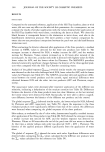
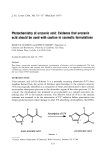
J. Soc. Cosmet. Chem., 48, 151-157 (May/June 1997) Photochemistry of urocanic acid: Evidence that urocanic acid should be used with caution in cosmetic formulations KERRY M. HANSON and JOHN D. SIMON*, Department of Chemistry and Biochemistry, University of California, San Diego, 9500 Gilman Drive, LaJolla, CA 92093-0341. Accepted for publication July 26, 1997. Synopsis Data from a previously reported spectroscopic investigation of urocanic acid are summarized. The data support the conclusion that urocanic acid should be used with caution as an ingredient in sunscreen and conditioning cosmetic formulations because reactive intermediates can be produced following absorption of the sun's lower UV-B wavelengths. INTRODUCTION Trans-urocanic acid (t-UA) (Scheme 1) is a naturally occurring ultraviolet (UV) chro- mophore formed from the action of histidase upon histidine in the stratum corneum. t-UA was originally identified as a component of sweat, and determined to have a broad, structureless absorption spectrum in the ultraviolet region of the solar spectrum (1). As a result, the chromophore was proposed to act potentially as a natural sunscreen, ab- sorbing solar UV in the stratum corneum. The effective result of t-UA in the stratum comeurn was assumed to be the attenuation of UV radiation before penetration into deeper epidermal layers where damage to other UV-absorbing chromophores, like DNA, H 0 H \ •• AbsorptioUVof H trans-urocanic acid cis-urocanic acid Scheme 1. * Current address: Department of Chemistry, Duke University, Durham, NC 27708 151
Purchased for the exclusive use of nofirst nolast (unknown)
From: SCC Media Library & Resource Center (library.scconline.org)