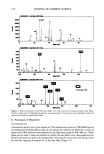
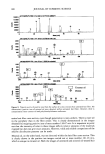
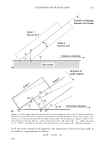
188 JOURNAL OF COSMETIC SCIENCE no scale lifting was observed, they still claim that failure in the intercellular cement between cuticle cells occurs, with the relative sliding of the scales, in response to the extension of the fibers. THE CUTICLE CELL The cuticle cell surface (4,6), as indicated in the sectional diagram (Figure 2), consists of a thin hydrophobic layer (upper-[B-layer) beneath which are the two layers "A" and exocuticle. Both these latter layers contain a high degree of disulfide bonding, resulting in mechanically inextensible structures low in swelling when placed in a wet environ- ment. The endocuticle layer beneath these rigid structures is low in disulfide cross- linking, resulting in a mechanically more extensible structure capable of a high degree of water uptake. This great difference in water uptake by the "A" and the exocuticle layers as against the endocuticle has been shown by Robinson (7) to produce the pronounced projection of scales in unextended wet wool fibers. This scale projection in the wet wool fibers is the prime cause of "felting" entanglement in wool fiber masses during washing in water. For extension of hair fibers under ambient conditions to 30-35% strain, Ruetsch and Weigmann (5) observed from autofluorescence and scanning electron microscopic stud- ies the cuticular damage and failure at the scale edges, which result in scale lifting. The difference in the stiffness of the "A" and exocuticle layers as against the considerably less stiff endocuticle layer results, during the longitudinal extension of a hair fiber, in a major component of the distortion occurring in the endocuticle (see Figure 2b). On the basis of this result and the observation by Swift (8) that material observed with scale lifting is associated with endocuticular debris, Ruetsch and Weigmann (5) concluded that endocuticular failure precedes scale edge lifting. This conclusion from later observation by Swift (4) and others (3) must be re-examined. Swift (4) noted the failure mechanically of the cell membrane complex (CMC) along the upper-[B-layer. As mentioned earlier, Gamez-Garcia (3) observed no endocuticular debris at internal surfaces of detached scale structure. The possible involvement of the hydrophobic upper- [B-layer, together with its surface of 18-methyleicosanoic acid (18-MEA) in the failure of the cementing of overlapping scale structures and its involvement in standard permanent setting procedures of human hair in salons, is next discussed. THE UPPER-[•-LAYER OF THE CUTICULAR CMC Jones and Rivett (6) have proposed a model for the upper-[B-layer of cuticular CMC consisting of a fatty acid monolayer, approximately 3-nm thick, attached by thio-ester linkages to a proteolipid membrane of approximately the same thickness (Figure 2a). The proteolipid layer in turn is attached to the "A" layer of the exocuticle of the cuticle cell. The fatty acid is the 18-MEA, with the straight chains forming a parallel array of ordered structures terminating in a short branched chain. This parallel chain array is at right angles to the proteolipid membrane, with the branched terminating chain on the surface providing mobility to the fatty acid monolayer. The evidence (9) provided for this increased mobility is the demonstrated lowering of the melting point from 77øC for eicosanoic acid to 56øC for 18-MEA by the introduction of the methyl group. The

EXTENSION OF HUMAN HAIR 189 presence of the methyl group in 18-MEA is likely to lead not only to a greater mobility of the fatty acid monolayer but also to a possible reduction of the adhesion between cells. The reduced amount of cystine crosslinks in the endocuticle certainly would result in a higher degree of swelling in water. Furthermore, the mechanical opposition to distortion would be reduced. However, the fact that the endocuticle distorts considerably more than the exocuticle when stressed does not of itself mean that the endocuticle will fracture under a lower stress than the remainder of the cuticle. The endocuticle is more extensible, as a lightly cross-linked elastomeric structure within which the molecular chains are able to flow past each other with greater ease because of the lower presence of cross-links. The 18-MEA surface in contact with the underside of a cuticle above it (see Figure 2a) can, because of its surface mobility, slide past the upper cuticle. From the above, the proposal that the surface of the upper-[•-layer is the region of weakness allowing flow of cuticle past cuticle (see Figure 2a) during fiber extension must be considered as an important alternative mechanism to the breakup of the endocuticle under stress that might result in the "decementation" between cells. Near the edge of the upper endocuticle and the upper-[•-layer of the lower cuticle (see "X" in Figure 2b), the distorted endocuticle will not only tend to relieve the distortion stress by allowing the lower cuticle to slide, exposing more upper-[3-1ayer, but would also tend to lift. The lifting action would progress along the junction with the upper-[•-layer, allowing a film of air to penetrate along the junction. The results of Guiolet eta/. (2) suggest, from Figure 1 and their own data on loss of transparency, that at around 8% strain on the hair fibers under the experimental conditions of relative humidity and rate of straining, failure at the surface of fracture of the upper-[•-layer commences. This failure is pro- gressive up to the maximum extension applied. DISCUSSION WITH REFERENCE TO PERMING AND CONDITIONING The failure of the adhesion of cuticle cells to the hair cortex has been observed to lead to the complete breakdown of the hair at the fiber ends. This observation was obtained in experimental comparison of the action of combing of hair with and without condi- tioner (10). The use of hair conditioner resulted in the cuticle being present on much longer lengths of hair prior to exposure of the cortex and breakdown of the hair structure. The progressive loss of cuticle can be clearly seen in SEM pictures. Once the cortical structure is exposed, the main hair shaft fibrillates into split ends and begins to break up. As mentioned earlier in this paper, 18-MEA in the upper-[•-layer not only allows for sliding of the lower cuticle relative to the upper cuticle, but plays an important role in the adhesion between cuticle cells. Failure of this adhesion would be expected to make the cuticle fragments much easier to remove, leading to exposure of the cortex. In experimental perming procedures at elevated temperatures, as described elsewhere (11), no neutralizer was used. The resultant permed hair felt smooth and was not left harsh, as is the case in the normal perming procedure. The permed hair required a minimum of conditioning, and on successive brushing and combing there was little evidence of broken pieces of hair ends, as can occur after a normal perming procedure. It appears that this perming process preserves the lubrication and adhesion of the cuticle cells better than the conventional perming process. It should be noted that hair fibers when they first protrude from the follicles have up to ten overlapping cuticle cells. The result is that in the life of a hair fiber the action of
Purchased for the exclusive use of nofirst nolast (unknown)
From: SCC Media Library & Resource Center (library.scconline.org)