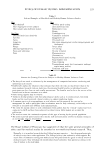
224 JOURNAL OF COSMETIC SCIENCE able, e.g., children and those with severe mental or behavioral disorders and persons unfamiliar with medical concepts and technology. There should be no coercion, undue influence, or intimidation to take part. This point is particularly relevant when volunteers include co-workers, students, prisoners, or members of the military. Simi larly, there should be no excessive inducement to take part: the level of remuneration (if any) should reflect the inconvenience to the volunteer during the trial and reim burse any out-of-pocket expenses. Payments should not be used to engage volunteers in studies that they would not normally take part in simply to benefit from a substantial monetary reward. Once accepted onto a study, subjects should also be given the right to withdraw at any time from the study if they so wish. ( b) Beneficence and non-maleficence. These essentially provide for the experimenter to seek only to do good and to explicitly do no harm. Within the field of medical research, arguments for these principles can be made for much of the work carried out. However, they can be difficult if the research participant does not benefit directly, e.g., • in safety studies on medicines using healthy volunteers, or • because of the long delay between obtaining results from basic clinical research and commercial exploitation, or • if the study did not provide a positive result, or • if the trial was conducted purely as an educational program for practitioners. The arguments are even more difficult to substantiate in the cosmetics arena, where the benefits to the individual and society as a whole are less easy to justify. It is therefore incumbent upon experimenters to carry out a risk-benefit analysis to justify to them selves and to an ethics committee that the proposed study's benefits outweigh the potential risks to the participants. This should include a review of the scientific validity of the study, since research that is flawed will present no benefit to either the subject or society and cannot be ethically valid. Furthermore, poorly designed studies could affect the risk-benefit analysis and may even prove to be positively harmful to volunteer participants. ( c) Justice. The principle of justice requires the burden of research to be distributed fairly, i.e., the group that will benefit from the research should be the group on which the research is carried out. This prevents the abuse of disenfranchised bodies of society, e.g., the export of research to developing nations. Obviously, there is a scientific drive to ensure the test population closely reflects the target population. Also, a researcher who has clinical or teaching responsibilities might be accused of neglecting these daily duties in the event of conducting excessive research. While these ethical principles are not exhaustive, and their relative weight may vary between societies, they provide a set of core values against which the researcher and the ethics committee (as guardian of these principles) should measure their work. But what of the relevance to the cosmetic scientist? The chemical, cosmetic, toiletry, detergent, household cleaning, and food sectors con duct extensive human testing on healthy volunteers to evaluate the quantitative and qualitative effects of chemical, physical, biological, and radiological agents. Work is conducted in academia, in industry, and by independent commercial contract clinical research organizations. A selection of common routine, non-medical, healthy human volunteer tests is presented in Table I. These human studies must be conducted safely and ethically to protect the health and well-being of the volunteers. Drivers are illus trated by Table II.

ETHICS OF HUMAN TESTING: IMPLEMENTATION Table I Selected Examples of Non-Medicinal Healthy Human Volunteer Studies Hair Anti-dandruff Hair clipping for in vitro analysis Hair volume salon half-head studies Oral Care Dentinal hard-tissue abrasivicy Calculus Caries Skin 48/96-hr patch testing Arm immersion tests Ballistomecer tests Biopsy Comedogenici ty Cumulative irritation Exaggerated use Flex-wash tests 225 Gingivitis Hoc-room antiperspirant studies (antiperspirants and Malodor Plaque Dentinal hypersensitivity Stains and whitening Taste deodorants) In-use safety Itch testing Occular irritation Photosensitivity Phototoxicicy Repeated-insult patch testing Soap-chamber tests Tape-stripping Transepidermal water loss (corneometer readings evaporimeter studies) Underarm sniff tests Table II Reasons for Growing Concern for Subjects in Healthy Human Volunteer Trials • The duty of care owed to volunteers by the management of companies/institutions conducting and sponsoring such research. • Risk/benefit analysis for volunteers that indicates chat while the risks are much lower than in the more-regulated research trials on medicines, the potential health benefits to individual research participants are less clear-cut, and usually non-existent. The benefits tend to be to the success of the business and to future consumers as a whole. • Some testing regimes may be invasive. • Trends to develop products with more physiological claims such as in cosmeceuticals, functional foods, and the need to provide clinical evidence to support marketing claims. • A common practice of using employees as trial subjects and the potential for coercion by management for staff to participate (their involvement must be truly voluntary), or for subjects to be overused or recruited onto different trials simultaneously. • The trend for journal editors to seek confirmation from authors chat the "clinical" studies have been conducted to GCP and have been subjected to ethical review before papers are accepted for publication. • The need to ensure the continued acceptance of this type of testing by the general population. • The need to provide protection for the scientific staff and institutions involved in human testing in an increasingly litigious environment. The Royal College of Physicians has suggested (2) that the same general principles of ethics used for medical studies be extended to non-medicinal human research. Thus, Naturally, it is in medical research chat this College has most expertise ... but the general principles of ethical review have wider application. The College believes that authorities which appoint Re search Ethics Committees serving non-medical areas will profit from this guide to ethical review of medical research. They will adapt the membership of any Committee they appoint according to the class of studies to be undertaken.
Purchased for the exclusive use of nofirst nolast (unknown)
From: SCC Media Library & Resource Center (library.scconline.org)