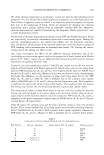
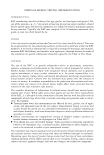
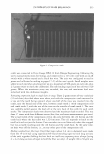
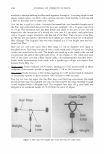
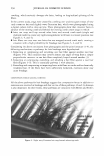
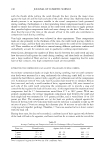
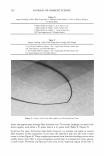
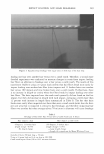
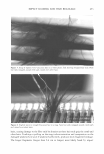
PATHWAYS OF HAIR BREAKAGE 235 Figure 1. Compression comb. comb was connected to Force Gauge DPiS 32 from Omega Engineering, following the user's manual instructions for wiring, and connected to a 115-volt cord with an on-off switch with a white neutral and a black hot wire. The unit was configured to read in grams and calibrated according to pages 17-23 of the user's guide. Small weights were added to each end of an attaching wire up to a maximum of 500 grams on each side, plus 2.5 grams (wire) to check the calibration. The safe-loading capacity of the cell was 1520 grams. When the maximum stress was exceeded, the zero and maximum load were rechecked with the calibration weights. Estimating compression loads on single hairs in snags. Three 2-gram tresses of very curly hair (12-inch hair) described above were taken, and with the compression comb mounted in a vise and the teeth facing upward, about one-half of the tress was inserted into the comb, near the bound end of the tress, between comb tooth 1 (with compression cell) and comb tooth 2, with the rest of the tress on the outside of comb tooth 1. The tress was carefully pulled against the load cell at the very back of the comb for each comb stroke. The compression loads were observed and the maximum load recorded. This was done 17 times with three different tresses (five, five, and seven measurements per tress). The actual width of the compression cell in this area (between the cell button and the comb back where the hair rubs) was 1,524 microns. The cell responds to loads on the total back and not just the button. Care was taken to record data only when the snagged hair was actually touching only the cell button and the comb back. At the same time, no hairs were off the button, i.e., on any other part of the compression cell. Making weighted hair fiber loops. Hair fiber loops (about 6.4 cm in diameter) were made from the 14-inch hair using tape (Scotch® brand mending tape) to bind long sections of the ends together (folding the hair back on itself over separate pieces of tape [using 4 x 4-cm-long sections of tape] to hold the fiber securely). A weight (10 to 50 gm) was

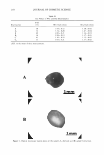
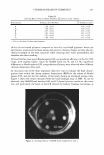
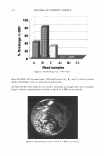
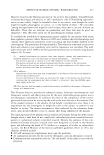
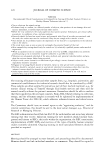
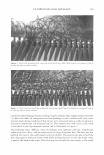
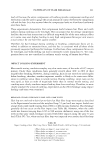
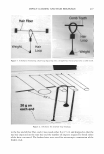
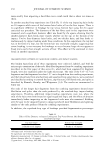
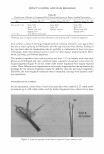
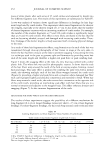
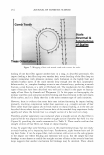
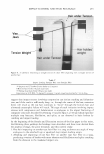
23 JOUR1 1 r\L OF CO MET.IC SClfaTCE attached to the tape holding the fiber ends together, through a 15-cm-long single-strand plastic-coated copper wire (#16) with a circle at one end to ind the fiber to the tape and a hook at the other encl to attach the weight. l-foir loojJ over str,,ight hair i,n t'ICI. A strai �hr horizontal hair was threaded through one of the fiber loops (descri eel above) and the loo was weighted with a 20-gram loa (total wt 21 g). The horizontal hair was held firmly and taped to the jaws of one vise and draped over the bottom jaw of a second vise (vise jaws 4. 5 cm apart), and pulled taut with a 10-gram weight attached to the free end of the fiber. Then the part of the fiber on the vise jaw was taped to the bottom hard-rub er jaw of the second vise to minimize fiber slippage. The weighted loop was then dropped at a 15-cm height onto the hori zontal hair fiber. Hair loop over comb tooth impact. Hair fiber loops 6.4 cm in diameter were made as described above. Each loop was placed over a comb tooth, and a 50 gram or a 30 gram weight was connected to the wire. �rl1e weight was raised up to the comb in the vise and droppe near the ack of the comb tooth (drop ] 5 cm) (:Figure 2). The comb teeth used were of two types cut from a Blue Goody comb, with measurements described below. Comb tooth measurements 'ere made with a spindle-type caliper micrometer from General Tools Mfg. Inc.: Thick tooth: Tooth thickness 0. 70 inches, tapering to 0.056 inches (tooth to about midpoint of micrometer spindle or approximately 1 778 to 1422 microns) . .Fine tooth: Tooth thickness 0.049 inches, tapering to 0.037 inches (tooth to midpoint of micrometer spindle or approximately 1245 microns to 940 microns). Hair loop over hair loop impact. For this fiber loop over fiber loop experiment, the taped end of one hair loop was clamped into one vise with another hair loop threaded through it and weighted wit a 30-gram load. The weighted hair loop (31 g total load) was dropped at an estimated height of 15 cm from the point of impact. Hair Fiber Weight ... ····•.,. ··•. Hair Loop GombT�th Hair Loop ··········Weight Figure 2. Hair loop over straight hair versus hair loop over comb tooth.
Purchased for the exclusive use of nofirst nolast (unknown)
From: SCC Media Library & Resource Center (library.scconline.org)