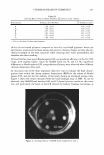
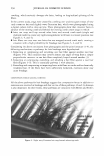
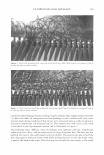
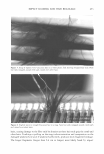
]. Cosmet. Sci., 57, 233-243 (May/June 2006) Hair breakage during combing. I. Pathways of breakage CLARENCE ROBBINS, 12425 Lake Ridge Circle, Clermont, FL 34711. Accepted for publication January 4, 2006. Synopsis Hair breakage during combing was evaluated by combing tresses and examining photographs of snags of hair fibers in combs. The resultant hair fiber arrangements suggest that breakage likely involves hair-on-hair interactions, and broken fragment size suggests that breakage occurs primarily at or near the hair-comb interface. Compression forces during combing were also measured, and impact loading of a hair fiber over another hair versus a hair fiber over a comb tooth shows that compression and abrasion are important to breakage during combing and that impact loading of one hair fiber over another during snagging is a probable and important pathway for hair breakage. INTRODUCTION There are several important papers in the scientific literature on the fracturing and breakage of human hair fibers (1-5). However, there is also literature that raises ques tions as to how relevant tensile test conditions are for simulating or even for predicting hair breakage on live heads (3-6) or from combing tresses in the laboratory. About 50 years ago, Hamburger et al. ( 6) conducted an interesting experiment in which they determined the load required to pull hair fibers out of the scalp. They found that this load at 65% RH is approximately equal to the Hookean limit and considerably lower than the breaking load for human hair fibers. Therefore, one of their conclusions was that hair fibers will not break on the scalp due to tensile forces alone, but will pull out of the scalp before breaking. However, we know from studies that examined the ends of hairs removed by combing on live heads (7 ,8) that hair fibers do actually break on live heads during combing. Unbroken hairs that are simply pulled out of the scalp contain a bulb on the other hand, those that are broken off do not contain a bulb, but a fractured end. In this type of study, even on chemically untreated hair, some of the hairs examined are found to be broken (7 ,8), more so for African hair (7) (average of 66% of total hairs from two persons) than from Caucasian or Asian hair (7) (from 3% to 24% among four panelists). Therefore, we are left with the conclusion that all of the hair fibers that break during combing on live heads are either damaged until their breaking force is below that of the Hookean limit of undamaged hair, or a more likely scenario, breakage of hair fibers during combing 233

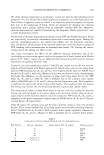
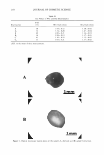
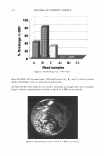
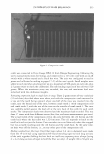
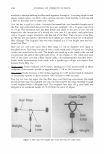
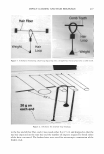
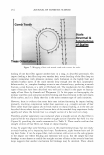
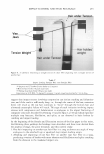
234 JOURNAL OF COSMETIC SCIENCE "hair on the head is more complex than simple tensile fracture of single hairs," a reasonable conclusion offered by Brown and Swift (3) about 30 years ago. In this current work, hair snags were studied to determine the important hair-on-hair versus hair-on-comb arrangements and interactions during combing. Compression forces were also measured by combing tresses with a comb containing a compression cell, and impact loading was explored to try to determine hair breakage under conditions that more closely simulate actual breakage during combing hair on live heads. EXPERIMENTAL The hair used in these experiments was purchased as 12-inch dark-brown virgin hair from Caucasians and reported to be undamaged. It was purchased from DeMeo Brothers of New York City. This hair actually measured 14 inches. In some of the snagging experiments, small tresses of highly coiled steam-set 12-inch hair, purchased from DeMeo Brothers, was also used. All experiments were conducted at 41 ± 2% RH and room temperature. TRESS COMBING AND COLLECTING BROKEN FRAGMENTS Eight-gram hair tresses from the above-mentioned 14-inch European hair were made: three were cross-cut two inches from the bottom, and three were angle-cut, two inches from the bottom to the tip, providing a tapered cut. All tresses were washed with a cleaning shampoo, gently detangled and combed out, and allowed to air dry overnight. Each tress was then gently combed about ten strokes to detangle the hair prior to testing. Each tress was clamped at the top into a fixed position and then combed 100 strokes. Each comb stroke started at a line behind the tress at 1 7 .8 cm from the bottom of the tress so that each comb stroke was 1 7 .8 cm. The broken-off hair fragments were collected on a large piece of white plastic, 7 6 x 84 cm, and separated by size into five different groups of 17.8 plus cm, 12.7 to 17.8 cm, 6.4 to 12.7 cm, 1.27 to 6.4 cm, and smaller than 1.27 cm. The fragments in each group were counted. This experiment was con ducted at 41 % RH and 70 ° F. COMPRESSION COMB AND MEASUREMENTS Making a compression comb. At the large-tooth end of an ACE hard-rubber comb (62746 part#), the second tooth from the end was cut off at the back and a small slot was made in the side of the comb back (about 0.05 to 0.1 inches). The cut areas were made smooth using a miniature file. The compression cell (sub-miniature compression load cell LCMKD-1 ON from Omega Engineering, a 10 Newton or 1 Kg cell) was glued in place at the base of the comb, adjacent to the large end tooth of the comb, with the sensor of the cell pointing inward toward the next tooth, leaving a distance of 0.062 inches or 0.15 7 cm between the sensor of the cell and the adjacent comb tooth (Figure 1). The removed tooth was cut (to shorten it) and glued on the inside of the large end tooth and on top of the edge of the compression cell (Figure 1). The compression cell on the
Purchased for the exclusive use of nofirst nolast (unknown)
From: SCC Media Library & Resource Center (library.scconline.org)